Alterations Complete Walkthrough: Twelve Orders, Their Requirements, and the Three Things She Never Said
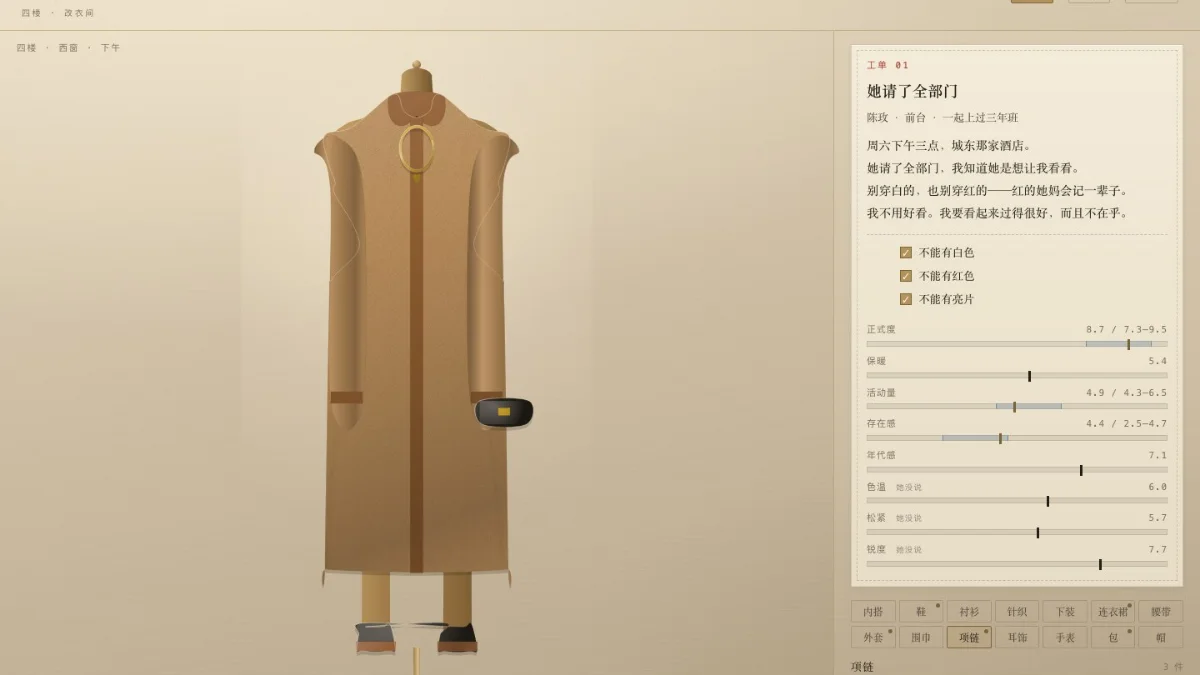
What this covers: the three hard requirements and the five measurement ranges on every order, what actually drives the three preferences the game never shows you, the six rules you will trip, and one S-grade outfit per order. There is no story to spoil here, only arithmetic.
The game runs at https://he-shen.gamestrategists.com/ and the hub page is at https://gamestrategists.com/games/he-shen/. Every figure below can be read off the screen: the top bar says which order out of twelve you are on, the ruler-like bars beside the order are the ranges she gave you, and the verdict screen prints what you scored and how far off you were, axis by axis.
One: three things to hold on to
- Hard requirements are a threshold, not a score. Pass all three and you get a grade; miss one and the order comes back with no penalty, as often as you like. So on a first pass, clear the threshold before you chase anything pretty.
- Measurement axes are ranges, not "higher is better". Formality is not a ladder — order 8 wants 2 to 4.8, and dressing it to 8 is wrong in the wrong direction. The blue band on the bar is the target.
- Preference axes show a reading, never a target. Colour temperature, ease and sharpness display where you are and never where she wants you. Those three have to be read out of her tone.
Two: the verdict is arithmetic
Every garment carries six numbers: formality, warmth, mobility, presence, sharpness, ease. An outfit reads by weighted mean over the places it fills — a coat counts three parts, an earring counts zero point two. So if you want to move an axis, move the coat, the dress, the bottom, the shirt or the knit. Jewellery will not get you there.
Two things are not on any single garment:
- Layers add warmth. Two or more thick layers (a coat, a knit, a scarf, a warm base layer) add up to another one point six on top of the average.
- Colour has a volume. The saturation across the whole outfit is averaged, and a bright outfit gains a point of presence while an all-grey one loses a point.
The second one matters: dyeing changes the verdict. The same coat dyed charcoal and dyed true red sit two points apart on presence. When an axis will not land, dye something before you swap garments.
Three: the three axes she never states
Colour temperature is computed from what you dyed, not from the cut. Hue sets direction, saturation sets strength, and near-black or near-white pull back toward neutral. To bring it down, reach for navy, charcoal, forest green — deep and cool. To bring it up, camel, caramel, apricot, mustard.
Ease comes from the cut and cannot be dialled. Loose means wide-leg trousers, long skirts, mohair, coats. Close means a shift dress, a satin skirt, a stiletto.
Sharpness is the one people trip on. It is the average across pieces, then plus or minus from the rules. To soften: knits, round toes, canvas, slouchy cuts, two large prints. To sharpen: tailored trousers, a pointed toe, leather, an open coat showing its layers, an inner cuff running past the coat sleeve, a wide leg landing on a point.
Four: the twelve orders
Each entry gives the three hard requirements, the five ranges she gave you, and one outfit that grades S. The ranges are the blue bands on the bars at the right of the screen; the readings are the first column of the verdict.
01 She invited the whole floor
- Hard requirements: no white (main colour), no red or pink, nothing sequinned.
- Ranges: formality 7.3–9.5, mobility 4.3–6.5, presence 2.5–4.7.
- One S-grade outfit: black shift dress + black patent clutch + black flats + fine gold chain + long drop earrings.
The point is quiet and formal. The black shift dress carries it: formality eight, presence only three. Do not add the camel coat — it pushes presence past five and straight out of the range. And skip the pearl studs; their main colour is white, which trips the first requirement.
02 The registrar's office, ten o'clock
- Hard requirements: nothing sequinned or metal, mobility at least 5, heel no higher than 1.
- Ranges: formality 6.7–8.3, mobility 5.2–6.8, presence 3.9–5.5.
- One S-grade outfit: khaki trench + ivory linen shirt + black tapered trousers + brown loafers + caramel shoulder bag.
The trench is the key: formality seven with mobility five, which delivers "presentable" and "not trying" at once. Tapered trousers rather than tailored ones — tailored takes formality to eight and a half.
03 Eight kilometres each way
- Hard requirements: no skirt, a tote or a backpack, mobility at least 7.
- Ranges: formality 2.2–3.4, warmth 3.2–4.4, mobility 7.1–8.3.
- One S-grade outfit: washed denim jacket + white ribbed tank + straight jeans + bone canvas sneakers + bone canvas tote.
Formality has to sit under 3.4, which rules out the trench and leaves the denim jacket. Swap the sneakers for ankle boots and mobility drops below six, failing the hard requirement outright.
04 Ten years, the class rep booked it
- Hard requirements: nothing sequinned, no true red, something old on you (the brass brooch or the brass watch).
- Ranges: formality 7.1–9.9, presence 3.9–6.7, era 5.9–8.7.
- One S-grade outfit: champagne silk shirt + navy tailored trousers + camel long coat + caramel ankle boots + brass square watch.
Sharpness here is 7.8 to 10, which is high — it needs the hard combination of tailored trousers, silk and a coat. No knits anywhere. Era has to land between six and eight, and the 1985 watch does the pulling.
05 The courtyard, midday
- Hard requirements: the brass brooch visible on the outside, no black (main colour), warmth at least 5.
- Ranges: formality 5.8–7, warmth 7.2–8.4, presence 4–5.2.
- One S-grade outfit: oat crewneck knit + charcoal wool skirt + camel long coat + caramel ankle boots + grandmother's brass brooch.
Warmth has to reach 7.2, and only the camel coat over a knit gets there. Pin the brooch on an open coat — button it shut and the brooch counts as covered, failing the requirement.
06 The tea house, noon, and his mother
- Hard requirements: no leather outerwear, nothing sequinned, heel no higher than 1.
- Ranges: formality 5.8–7.3, presence 3.1–4.5.
- One S-grade outfit: ivory linen shirt + ivory long skirt + black flats + caramel shoulder bag + pearl studs.
All three preferences are narrow: colour temperature 5.2–6.6 (neutral to warm), ease 5.4–6.8 (fitted, not slouchy), sharpness 3.9–5.3 (soft, not severe). So no leather, no pointed toe, no tailored trousers; a long skirt and a linen shirt sit right in the middle of all three.
07 A whole day, the park
- Hard requirements: mobility at least 8, no skirt or dress, no heels.
- Ranges: formality 0.2–2, warmth 3.9–5.7, mobility 7.6–9.4.
- One S-grade outfit: caramel cardigan + straight jeans + bone canvas sneakers + navy backpack.
The backpack has a hidden benefit: besides dragging formality down two points it adds one to mobility, which is the step most people miss here. Without it mobility often sticks just under eight.
08 Over at eleven, all night
- Hard requirements: warmth at least 7, presence no higher than 5, nothing sequinned.
- Ranges: warmth 7.9–8.7, presence 3.4–4.2.
- One S-grade outfit: black turtleneck base + black tapered trousers + camel long coat + rose wool scarf + caramel ankle boots + charcoal beanie.
Warmth has to reach eight, and only the three-layer route of coat, scarf and turtleneck gets there. Presence has to come down under 4.2 at the same time — camel is already a presence-heavy colour, so add no earrings and no bag.
09 Three minutes on stage
- Hard requirements: presence at least 6.5, formality at least 7, no hat.
- Ranges: formality 7.7–10, mobility 1.6–4, presence 8.1–10.
- One S-grade outfit: champagne sequin dress + red stiletto + black patent clutch + long drop earrings.
This is the one order in the game that rewards going too far. The sequin dress alone takes presence to ten, and with the red heels formality clears too. Do not add a coat — it drags presence back down. The heel caps mobility at three, which lands right inside 1.6 to 4.
10 Sixth floor, no lift
- Hard requirements: mobility at least 7.5, no skirt or dress, no leather outerwear.
- Ranges: formality 0–1.4, warmth 2.7–4.5, mobility 8.4–10.
- One S-grade outfit: white ribbed tank + straight jeans + bone canvas sneakers + navy backpack.
Formality has to be under 1.4, so the whole outfit is basically tank, denim and canvas. Add a cardigan and it fails — formality jumps to 3.1.
11 Tomorrow, three in the afternoon
- Hard requirements: no red or pink, nothing sequinned, wear a coat.
- Ranges: formality 6–8.2, warmth 6.3–8.5, presence 3.7–5.9.
- One S-grade outfit: black turtleneck base + black tapered trousers + camel long coat + brown loafers.
This order is two lines long: tomorrow at three, Hall Two; no red, she would be unhappy. Not one word about death. The "no red or pink" requirement is the heaviest thing here — wine, brick and dusty rose all count as red, so do not treat them as neutrals. Sharpness has to reach 7.8, which the tapered trousers and the coat supply.
12 The last order
- Hard requirements: none. Ranges: none.
- Whatever you build gets read back to you. The verdict is not a score; it is the outfit spoken aloud.
Five: the six rules you will trip
The rules never block you, but they add and subtract, and all of them are listed on the verdict screen under what the mirror said.
- A coat buttoned shut wastes everything underneath. Open adds a point of sharpness, closed costs one.
- A belt over a thick knit. Knit ease at seven or above costs a point; over a thin knit it earns one.
- A scarf and a necklace at once. They fight for the same place and cost a point. Pick one.
- Two things talking loudly. Two large prints cost two sharpness; so do two shiny pieces.
- More than three main colours. Costs a point of sharpness. Only main colours count — not collars, hardware or soles.
- More than nine pieces. Adds presence and costs two sharpness. Filling all fourteen places is not automatically better.
Six: three misconceptions
"Higher formality is safer." It is not. Orders 8 and 10 both want low formality, and maxing it walks you out of the range. Read the bar first.
"The expensive one must be better." There are no prices, only numbers. The canvas tote in order 3 beats the clutch by a mile because its formality is three and the clutch is eight.
"Dyeing is only cosmetic." Colour temperature is computed from what you dyed, and colour volume moves presence. In order 1, a black shift dress with the camel coat reaches presence 5.3; dye the coat charcoal and it drops under 4.5. Same outfit, different colour.
Seven: checking the numbers
| Claim | Number | Where to read it on screen |
|---|---|---|
| Orders | 12 | the top bar, "order n / 12" |
| Places | 14 | count the small tiles on the right |
| Garments | 48 | open each place and add up the "pieces" count on the rail |
| Dressing rules | 24 | the verdict, under what the mirror said |
| Materials | 6 | the bottom-right corner of each hanger card |
| Prints | 12 in 3 scales | select a garment and open the print drawer |
| Turntable | -18° to +18° | the readout under the form |
| Zoom | 1.00 / 1.25 / 1.50 | the multiplier under the form |
| Layering warmth cap | +1.6 | wear three thick layers and compare the warmth reading |
| S-grade outfits per order | 84 to 1,351 | build something different and get an S again |
The last row has no shortcut, but it is the thing this game most wants you to know: what is judged is a range, not one intended outfit. The one you built being different from the one in her head can still be right.