Alterations
A dress-up game set in a 1998 alteration room: twelve orders, forty-eight garments, fourteen places, and a verdict that is arithmetic.
A dress-up game set in a 1998 alteration room: twelve orders, forty-eight garments, fourteen places, and a verdict that is arithmetic.
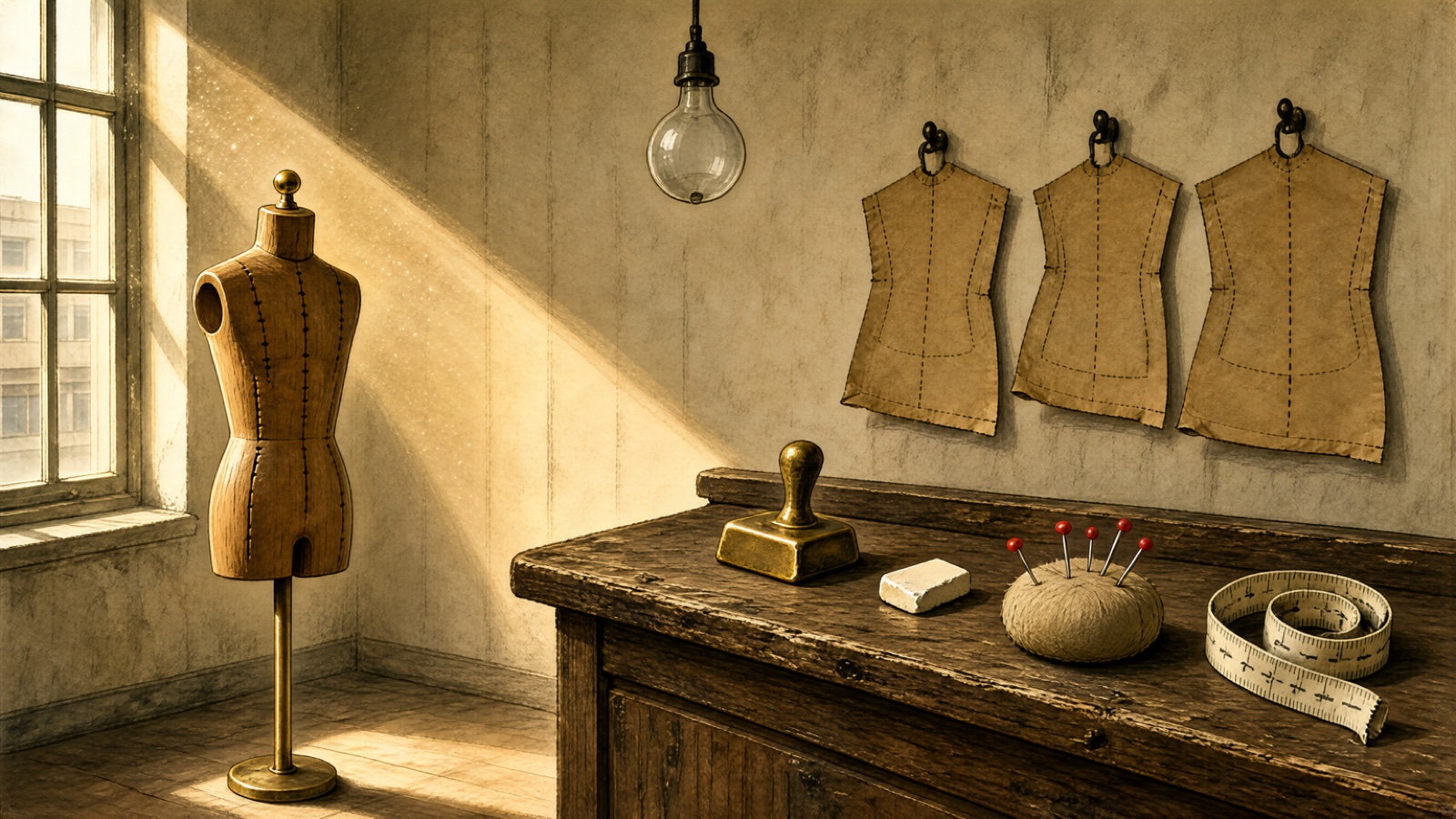
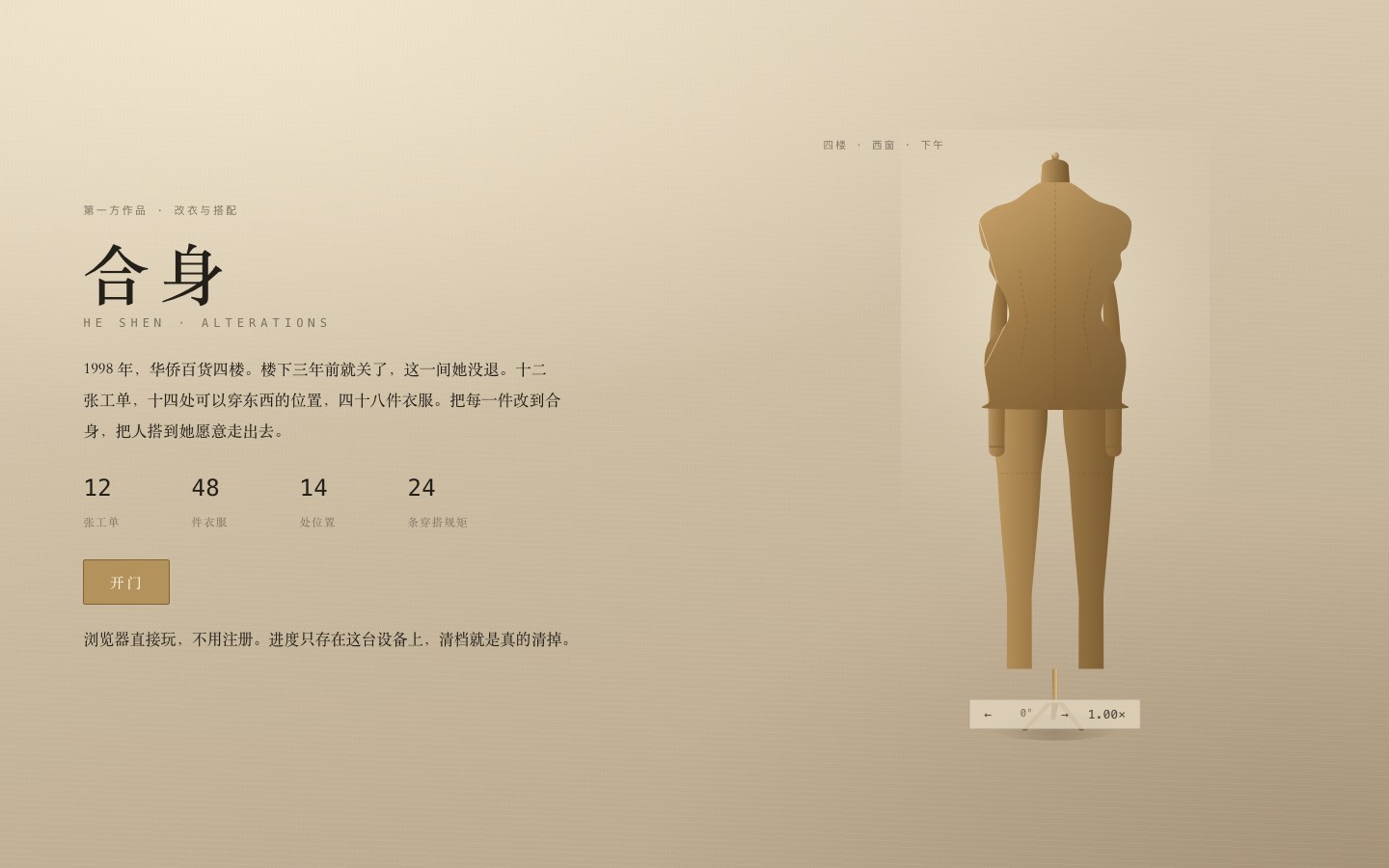
1998, fourth floor of the Overseas Emporium. The store closed three years ago; she kept this room. Twelve orders, fourteen places to put something, forty-eight garments. Take each piece in until it fits, and dress her until she is willing to walk out.
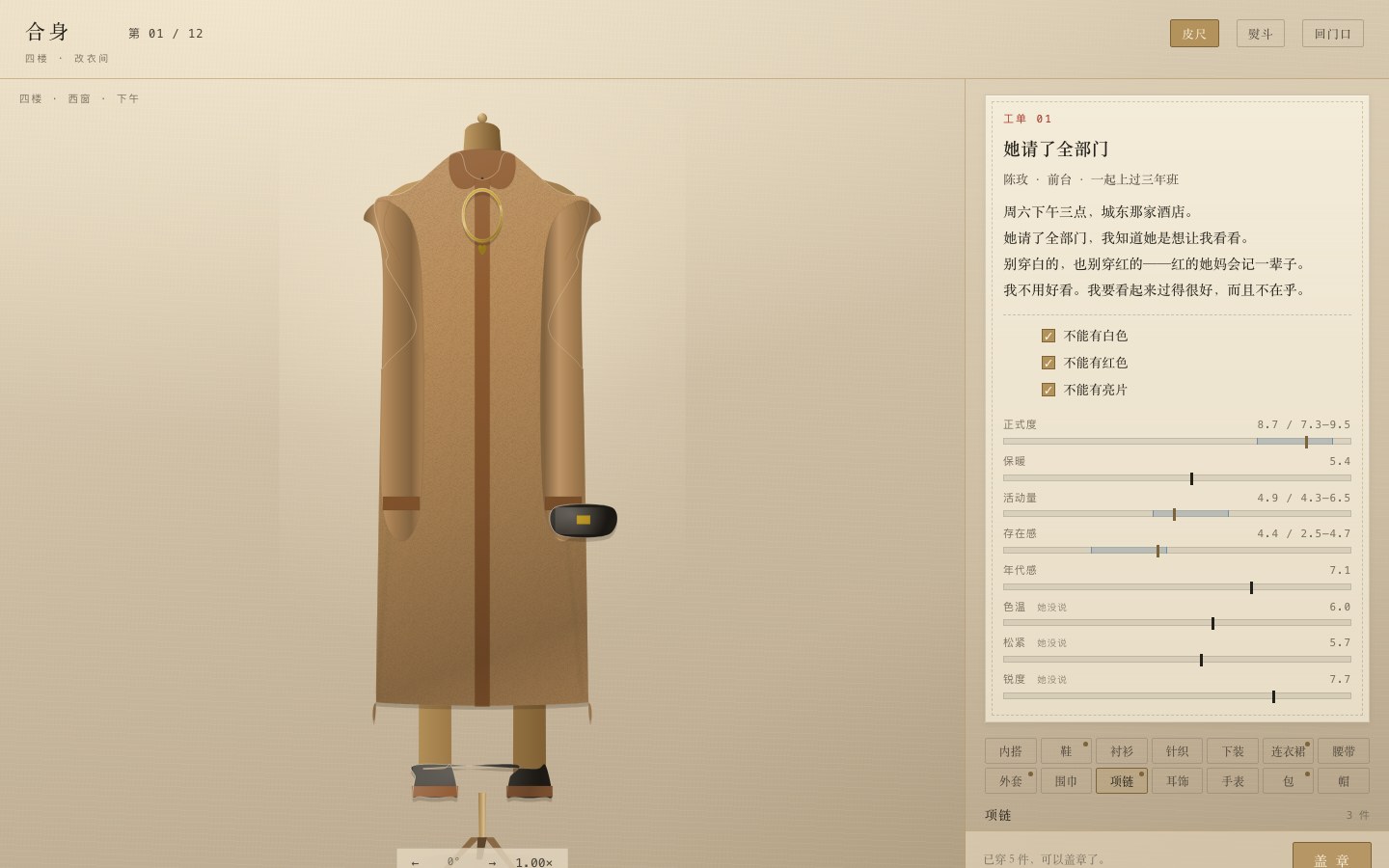
Dress-up games usually hand you a person, a pile of clothes and a score, and never say where the score came from. This one reverses the order: the person speaks first, then the numbers do.
An alteration room is the right shell for it. It is not a shop; it is the place where someone takes a garment off and you make it wearable again — one layer more than "wardrobe". The clothes are old, the person is specific, and whether it fits is measured, not felt. 1998 because the ready-to-wear of that year still had a waist, and because the department stores downstairs were closing one by one around then; the fourth floor kept its room.
The form is wood and has no face. That is deliberate: give it a face and the player starts judging the face instead of the clothes. The clothes are the subject.
Every garment carries six numbers — formality, warmth, mobility, presence, sharpness, ease, each 0 to 10 — plus a year (which feeds the era axis) and a material. An outfit reads by weighted mean over the places it fills: a coat carries a weight of 3.0, an earring 0.2, so the coat decides more of the outfit's character.
Colour temperature is not in that table. It is computed from whatever the player dyes: hue sets direction, saturation sets strength, and extreme lightness pulls back toward neutral. Dye a coat from camel to charcoal and the temperature drops; dye it true red and presence gains a point from the loudness of the colour. That is why dyeing is not only cosmetic — it genuinely moves the verdict.
The rules explain why something does not work. All twenty-four are plus or minus, and not one of them blocks you: a belt over a thick knit costs a point of sharpness, a scarf and a necklace at once cost a point, a below-knee coat over a short skirt costs a point, two large prints cost two, more than three main colours costs one, more than nine pieces adds presence and costs two sharpness. Two more are computed: layering thick pieces adds warmth, and the saturation-and-lightness loudness of the whole outfit pushes presence up or down.
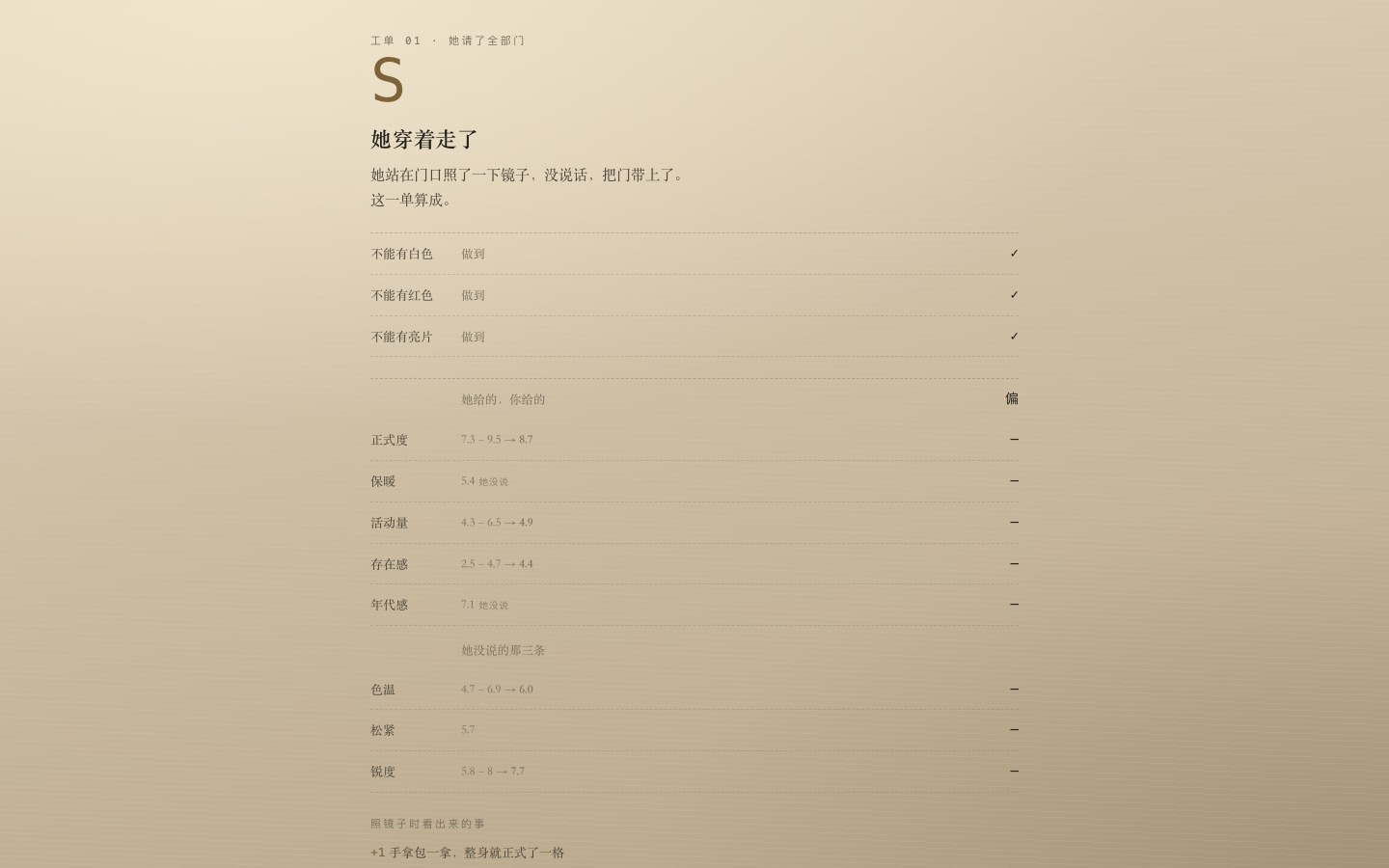
Each order gives a range on five measurement axes, not a point. Land inside all of them and it is an S; drift out and it is an A or a B. More than one outfit can earn that S — during development, 24,000 random samples were run per order, and each one had between 84 and 1,351 distinct compliant outfits that graded S.
Three more axes exist only in the client's tone of voice: colour temperature, ease, sharpness. The interface shows your current reading but never her range — you can see where you are, not where she wants you. Those three are revealed after the stamp. Fail to read her and you have to make it up elsewhere.
The verdict never names an intended outfit. It only lays out the account: her range, your score, how far off, and which pieces pushed it there. That is the line between freedom and unfairness — a player has to be able to work out why they lost.
There is not one bitmap in the forty-eight. The form, the patterns, the folds, the prints and the stitching are all Canvas paths, so they stay sharp at 1.5x zoom — something a raster paper doll cannot do.
Every garment is drawn seven times: contact shadow, base gradient, folds, print, material sheen, rim light, stitching. The light comes from the window at upper left and all six materials share it, so the difference between a cotton shirt and a silk one lives entirely in the terminator and the shape of the highlight, exactly as it does in life. Cotton is matte with a very fine grain; wool has a fuzzy edge and visible heathering; silk carries an anisotropic highlight along the weave that travels with the folds; leather has a broad highlight, fine pebbling and a hard rim at every turn; sequins are discrete glints; metal gets its own high-contrast edging.
The turntable runs from eighteen degrees left to eighteen right in seven steps, each layer shifting sideways by its depth while the light follows. Stitching only appears above 1.25x zoom — you have to lean in.
The first order is a former colleague's wedding: no white, and no red, because her mother would remember red for the rest of her life. The fifth is a grandmother's eightieth: warm, no black, and the brass brooch pinned where it can be seen. The seventh is a whole day with a four-year-old, which means squatting down and standing back up. The tenth is moving house, sixth floor, no lift, twenty trips.
The eleventh order says two lines: tomorrow at three, Hall Two; no red, she would be unhappy. Not one word about death. The twelfth is her own, with no hard requirements and no ranges — the shop closes next month, and she measures herself.
The ending branches three ways on how many S grades the first eleven orders earned, and none of them preaches. Finishing unlocks free dressing: any client, the whole wardrobe, stamp whenever you like.
Is there a right answer?
No. What is judged is a range on each axis. Random sampling during development found between 84 and 1,351 distinct S-grade outfits per order.
Can the hard requirements corner me?
Three per order, all checkable at a glance: no white, wear a coat, mobility at least 7. Miss one and the order comes back with no penalty, as often as you like. The twelfth has none.
Why does some dyeing never work?
Colour temperature is computed from what you dyed, and presence is pulled by the loudness of the colour. A highly saturated red will stand out in any low-formality setting, and charcoal drops you into a different range. The verdict tells you which axis went wrong.
Does it work on a phone?
Yes. On narrow screens the form sits on top and the order and rails below; the turntable, dye controls and stamp are all finger-sized.
Where are records kept?
Only in this browser, under the gs:he-shen: namespace. No accounts, no server, no cross-device sync; "clear and start over" on the title screen really deletes it.
Are there ads?
The page loads Google AdSense, as every game site here does, to cover domain and hosting. There are no ad slots inside the game: no popups, nothing over the controls.
Start with the first order — Runs on its own subdomain · 12 orders, 48 garments, 14 places · records stay on this device