Room 404
Room 404 is our first-party horror-mystery ARG: search ten simulated websites to trace twenty years of disappearances in one apartment building. 8 acts, 10 puzzles, 4 endings, about 3–4 hours in the browser, with a full walkthrough.
Room 404 is our first-party horror-mystery ARG: search ten simulated websites to trace twenty years of disappearances in one apartment building. 8 acts, 10 puzzles, 4 endings, about 3–4 hours in the browser, with a full walkthrough.
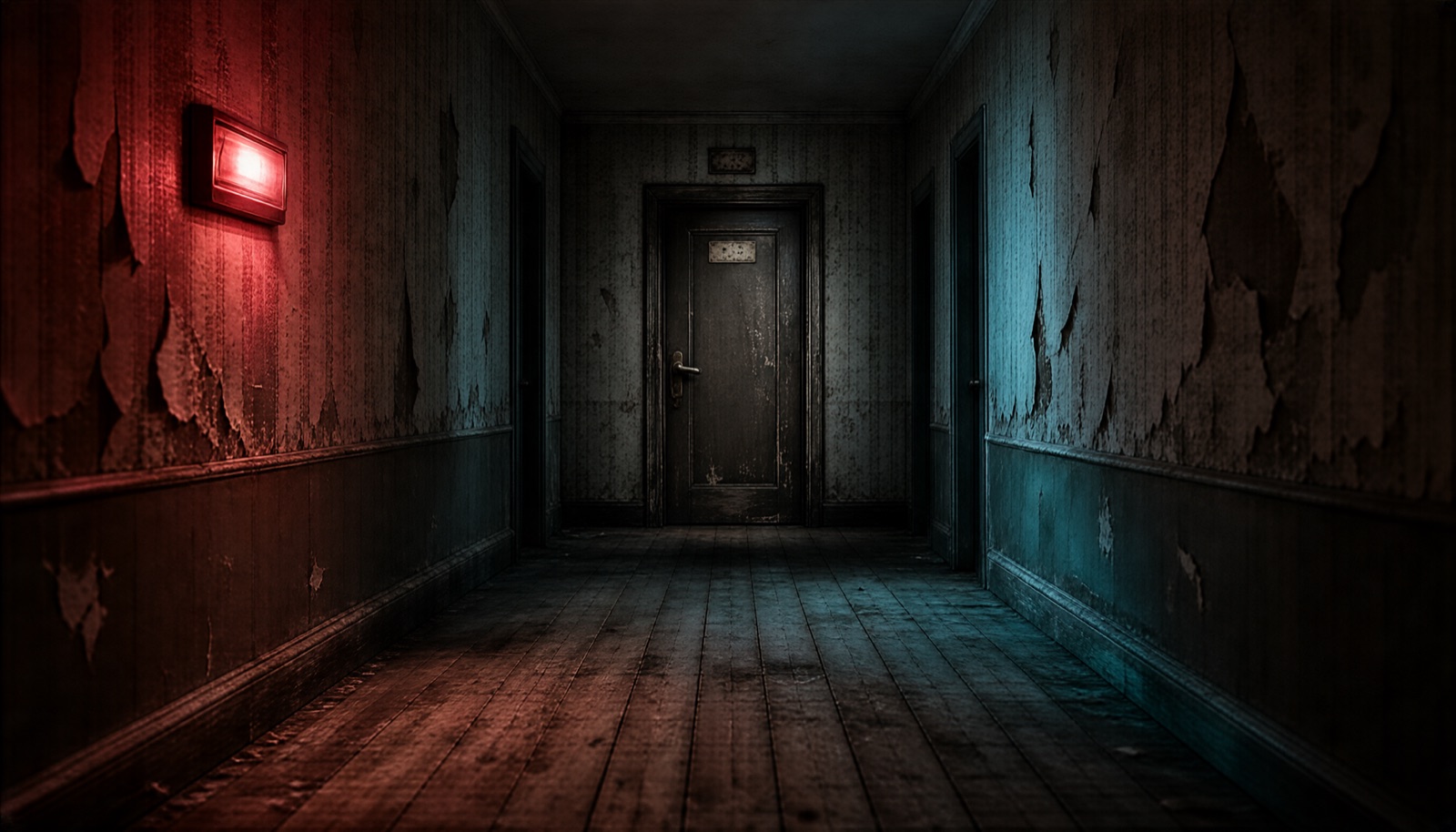
A horror-mystery ARG that starts with a cheap rental: you search ten simulated websites, cross-check clues and piece together twenty years of missing tenants. 8 acts, 10 puzzles, 4 endings, a 12-page tenant register, about 3–4 hours, runs in the browser, progress saved locally.
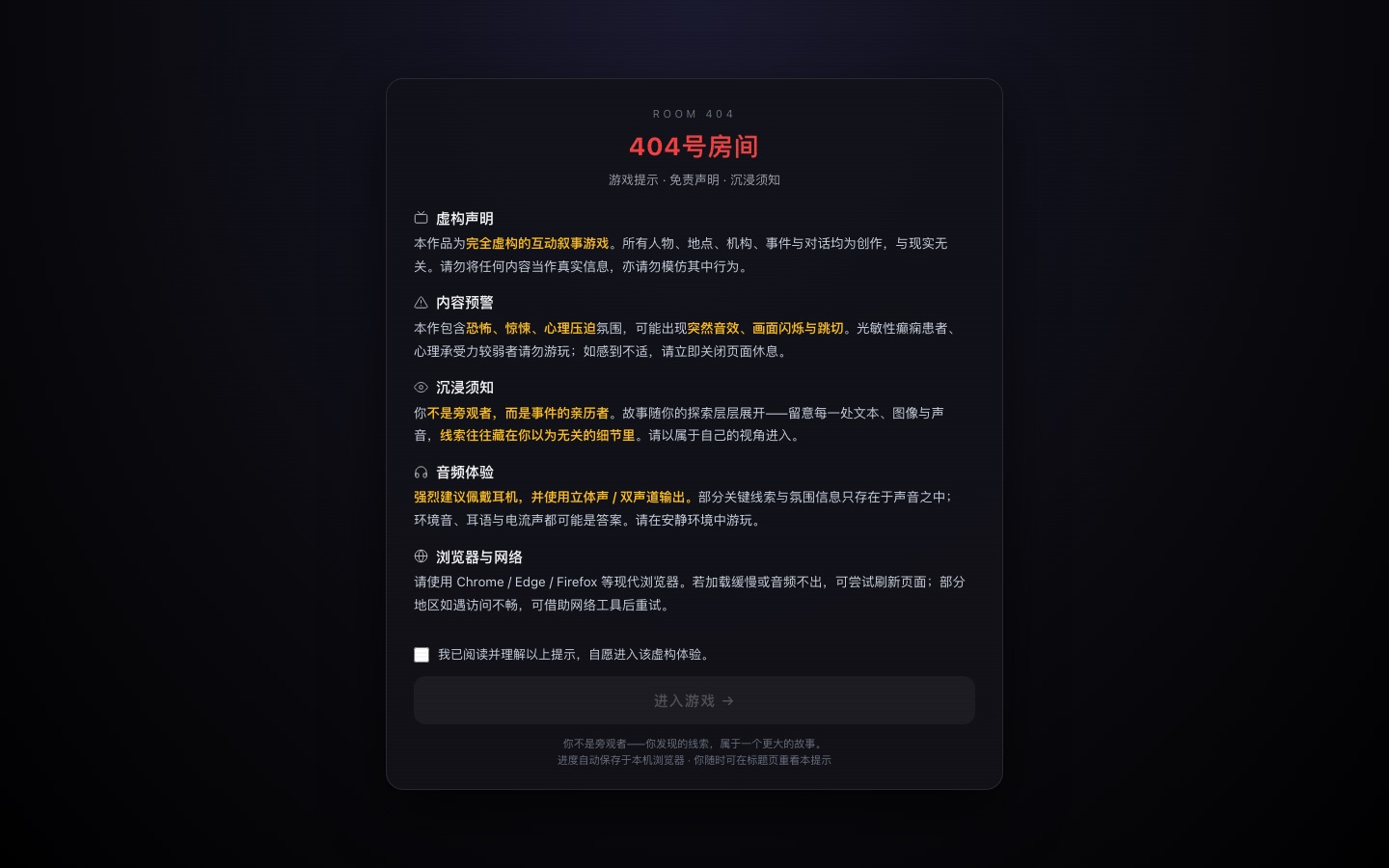
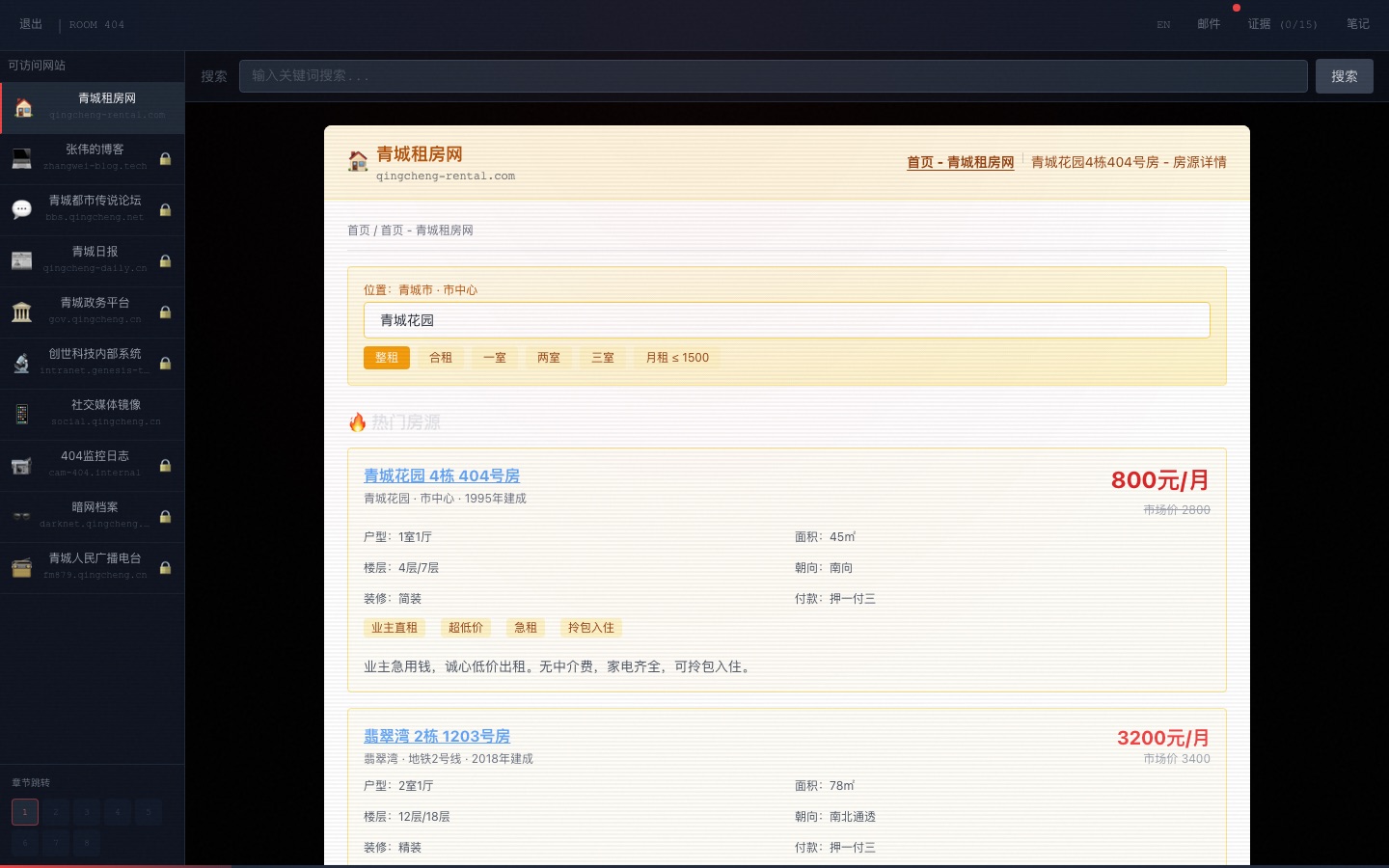
June 2026. Lin Xia rents Room 404 in Qingcheng Garden for a suspiciously low price. On her first night she finds three wrong things: the Wi-Fi is called ZhangWei_404, there is a torn USB drive in the desk, and one patch of wall has been painted over again and again.
It is not a coincidence. She has been watching this room on a missing-persons forum for three months — three years ago her brother Lin Yuan's last location ping vanished near this building. Over the next days she picks up the previous tenant's digital footprints one page at a time: a lease, a blog, an anonymous forum post, a newspaper, a government file, and finally a company intranet.
It plays like a set of simulated websites. No map, no combat, no timers — only ten sites you can open and search. What you type into a search box lands in mail, evidence and notes panels; the game never highlights the sentence that matters.
That is also what separates it from a typical browser puzzle: the answer is not hidden in an animation. It is hidden in whether this page agrees with that one — a twenty-year-old missing notice in a newspaper and a resignation email in a company intranet can turn out to describe the same person twice.
The game runs on its own subdomain and saves progress there; it does not sync across devices, and clearing browser data means starting over.
Acts 7 and 8 are post-main-story chapters that connect to other games in the same universe; the main line still reaches a complete ending.
Every answer can be traced to something inside the game — which is why our walkthrough can be checked line by line.
This page names the endings and their direction only — no triggers, no key answers. The walkthrough has the full solutions.
With all twelve register pages collected, every ending gains a final register page. It changes no branch; it is the shared coda.
The in-game missing-persons archive publishes only seven records; the dark-web experiment table has twelve numbers, several blacked out. The register restores those numbers into twelve people: Zhao Mingyuan, Qian Lihua, Liu Jianguo, Zheng Wenjing, Zhou Hui, Luo Jianping, Sun Xiaoling, Chen Xiaodong, Wu Xue, Fang Li, Zhang Wei and He Jing.
The register unseals by act, two pages at a time. Each page carries the number, extraction date, age, job, one object left in 404, and the last thing the person said before extraction — not a date of death, just an unfinished ordinary sentence.
The entrance sits at the top of the evidence panel: “Tenant register n/12.” Unsealed records survive “Start over,” and an older save is backfilled to its current act when the game opens. All twelve are guaranteed before the final chapter.
With the full set, every ending gains a page headed “Tenant register · twelve people”: the twelve names read in move-in order, with one line still blank at the end. It rewrites no ending; it is their shared coda.
The twelve object photographs are AI-generated illustrations used to fill in the objects, not screenshots of the game.
Act, puzzle, ending, clue and email counts come from the game's own data files, not from a marketing sheet. Both screenshots were taken from the running game on 2026-10-18 — they are captures, not composites.
The twelve register records, their dates, objects and last lines come from tenants.js; the build gate checks two records per act, all twelve images, and has negative controls (a duplicate number or a missing image turns it red).
If a number here disagrees with what you see in the game, the game is right and this page is stale; tell us in the changelog and we will fix it.
For players who enjoy reading documents, lining up timelines and finding the answer in an unremarkable sentence. Sessions run 40–60 minutes, so it plays well across several evenings.
Not for players looking for fast action, or for anyone who does not want horror: there are sudden sounds and screen flicker. Not recommended for players with photosensitive epilepsy or low tolerance for psychological pressure.
Do I need an account or payment?
No. It runs in the browser, free, with no sign-up.
Where is progress saved?
In the browser's localStorage on the game's subdomain; it does not follow you across devices.
How scary is it?
Horror atmosphere with sudden sounds and screen flicker. A full warning is shown before entry, and you can choose not to enter.
Does it work on a phone?
Yes, portrait is supported; the research-style play is more comfortable on a desktop.
How long is it?
About 3–4 hours for the main line; seeing all four endings takes longer.
Will this page spoil it?
It covers premise, structure and ending names only — no key answers. Use the walkthrough for solutions.
Can I miss the tenant register?
No. It unseals two records per act and is complete before the final chapter; unsealed records follow your save and survive “Start over.” The full set adds one register page after every ending.
What if the game will not open?
Try a current Chrome, Edge or Firefox first. If it still fails, email contact@gamestrategists.com with your device and browser version.
Start investigating — Runs on its own subdomain · progress saved locally · contains horror and screen flicker