Eye of the Abyss is our first-party psychological-horror ARG: psychologist Lin Mo takes a distress letter from a patient watched by another version of himself. 9 acts, 15 puzzles, 24 simulated websites (120 pages), 42 clues, 4 endings, 10–15 hours. Contains psychological horror and sudden audio.
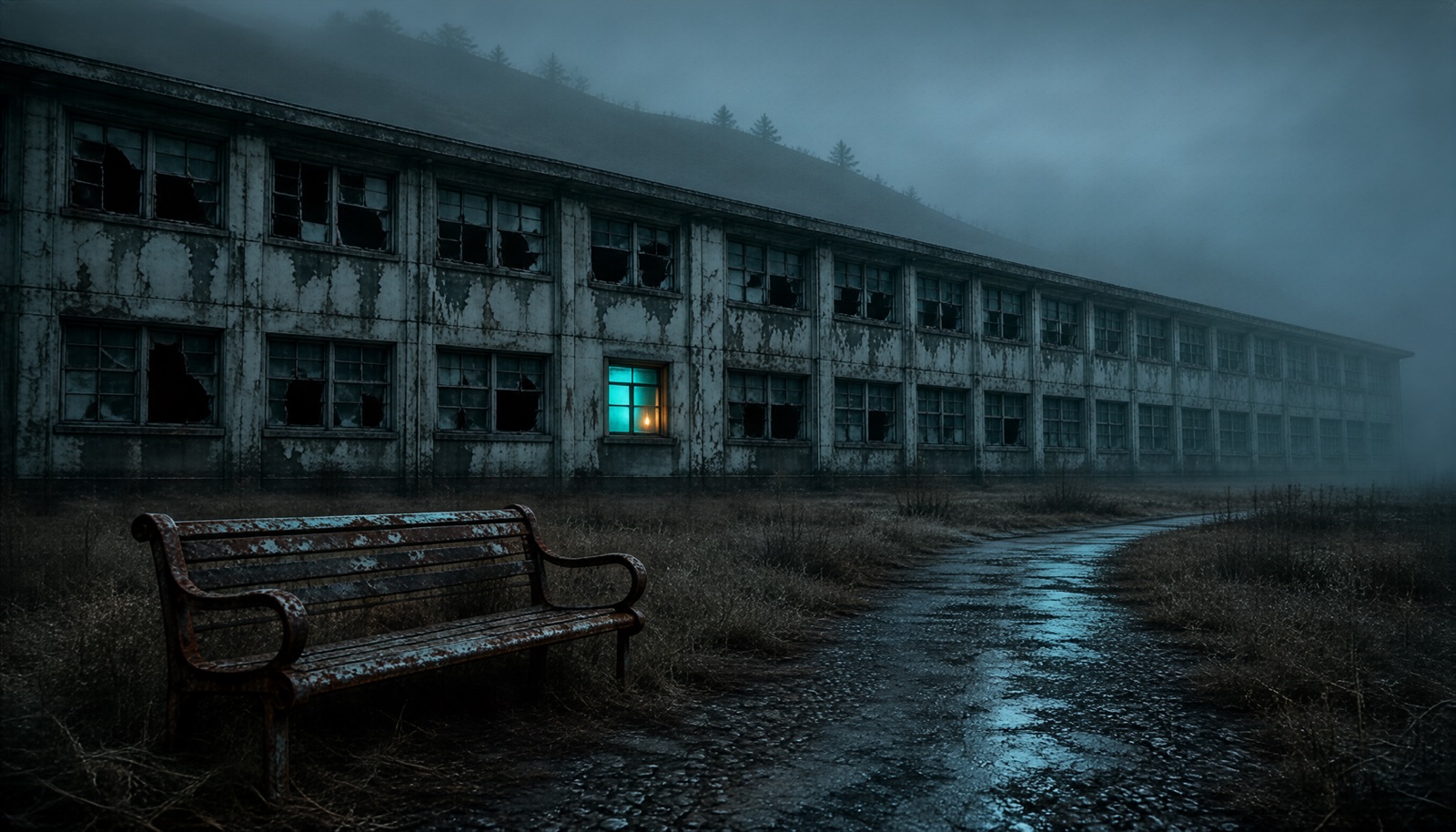
Illustration (AI-generated), not a game screenshot
You are a psychologist named Lin Mo. A mysterious patient, Shen Yuan, writes that he is being watched by “another version of himself” — and that this other self is replacing him. You go to the abandoned sanatorium. The letter itself was the trap. 9 acts, 15 puzzles, 24 simulated websites (120 pages), 42 clues, 17 emails, 4 endings, 8 unfiled session recordings, 10–15 hours.
Acts:9
Puzzles:15
Simulated sites:24 / 120 pages
Session tapes:8, one per act
Clues:42
Emails:17
Endings:4
Length:10–15 hours
Platform:Browser, nothing to install
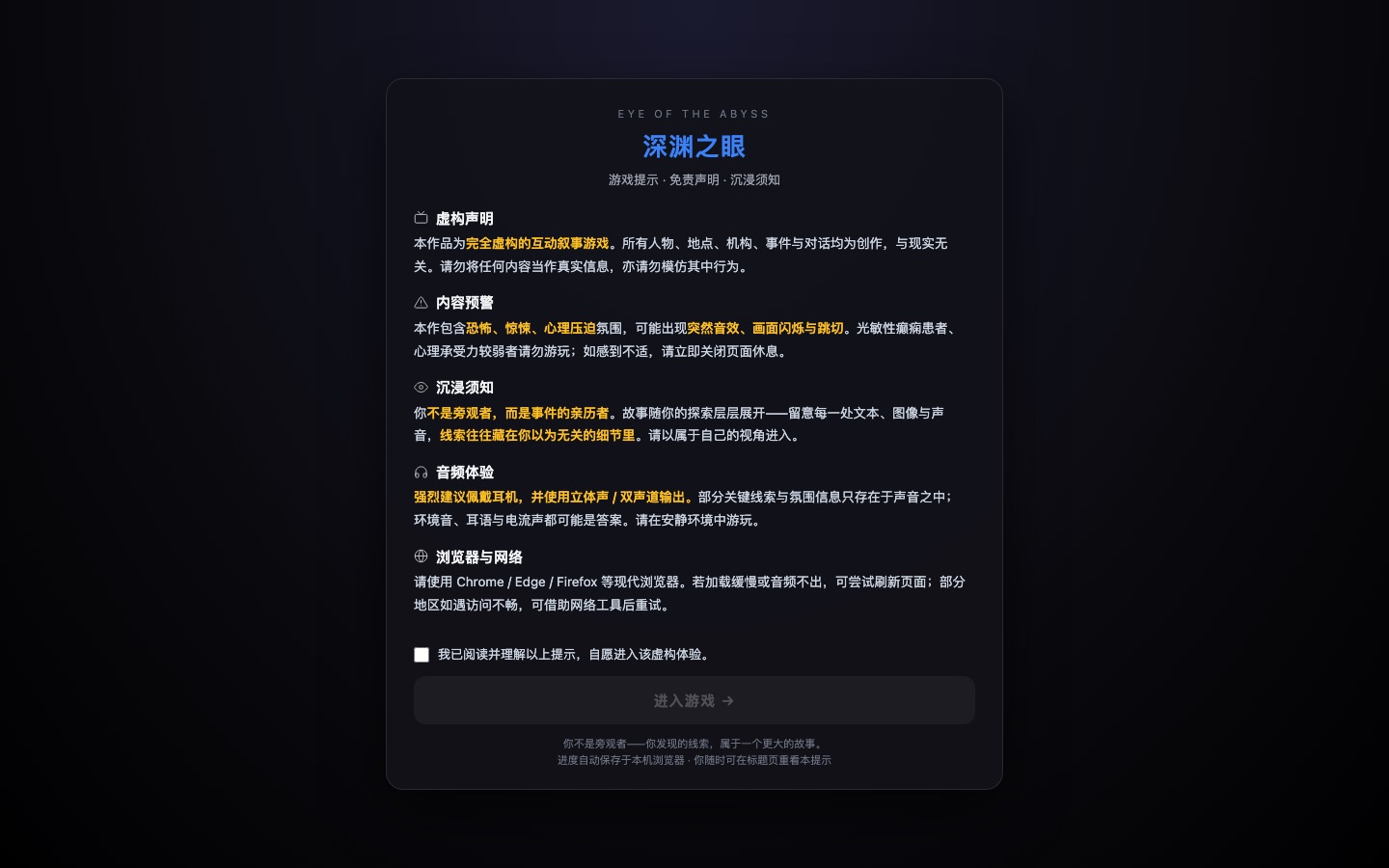
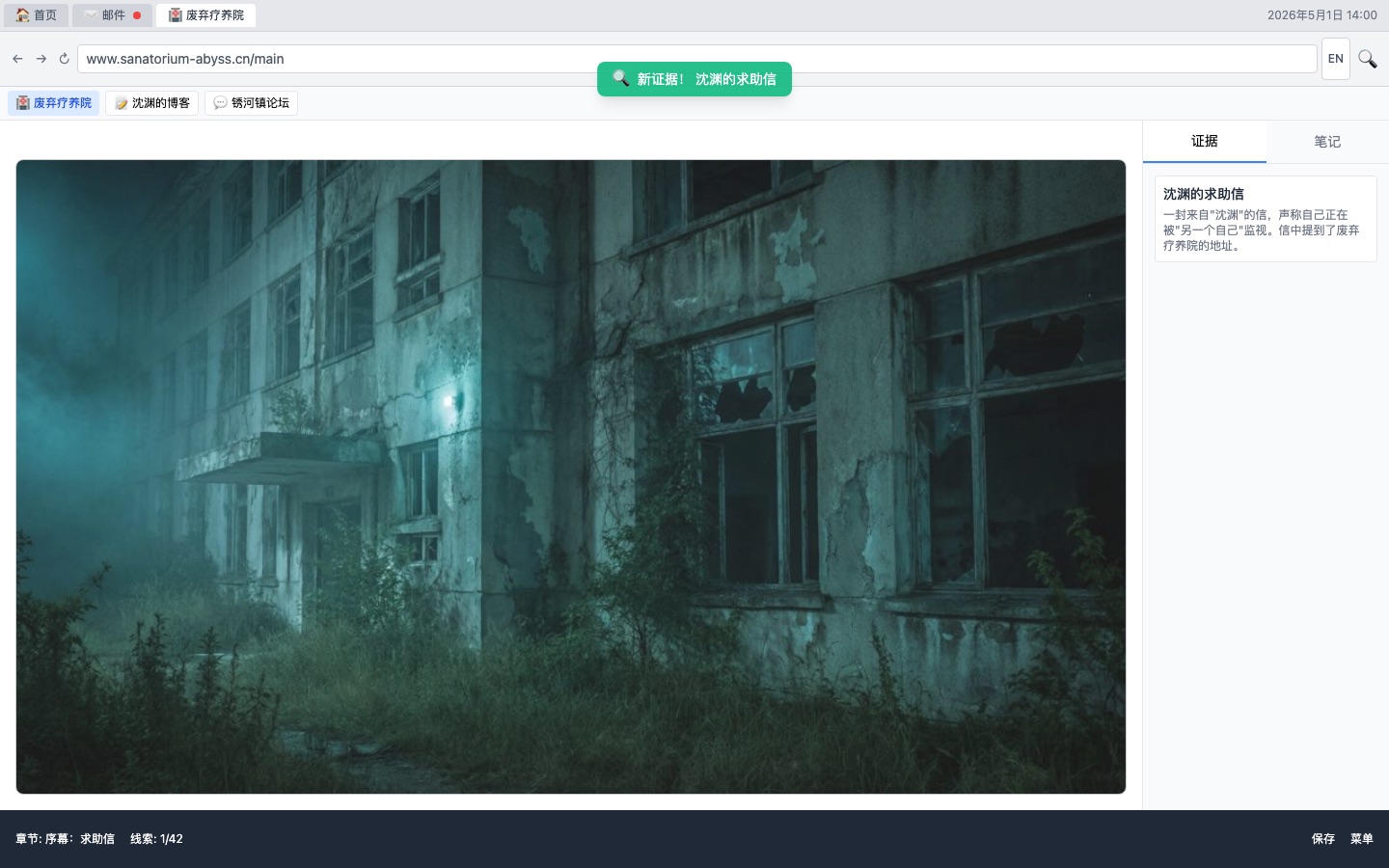
The fiction notice and content warning before entry; the box must be tickedThe abandoned sanatorium inside the fake browser: address bar, site tabs, evidence and notes on the right, chapter and clue counters at the bottom
What it is
You are Lin Mo, a psychologist. One day a mysterious patient named Shen Yuan sends a distress letter: he says he is being watched by “another version of himself”, and that this other self is gradually replacing him. You decide to visit the abandoned sanatorium where he is staying.
The game states the premise plainly at the start: the letter itself is a trap — the moment you read it, you are already part of the Eye of the Abyss. What really sends you is not professional curiosity: lately you have started hearing, in the dead of night, a sound that should not exist — a hum at 18.98 Hz.
It is played as a pseudo-interface investigation: the game is a browser and you hop between twenty-four simulated websites (the sanatorium, Shen Yuan's blog, the Rust River forum, medical records, acoustic research, frequency archives, surveillance, basement blueprints, patient zero, diaries, timelines, treatment logs and more) — 120 pages in all — advancing by keyword search.
The horror is psychological: surveillance, identity replacement, and the suspicion that every time you “treat” someone you are spreading it. It also uses sudden audio and jump cuts; see the next section.
Let us be plain: the content warning
There is a checkbox you must tick before entering, and the warning is the game's own: it contains horror, thriller and psychological pressure, with sudden sounds, flicker and jump cuts; it advises against play by people with photosensitive epilepsy or lower tolerance, and says to close the page immediately if unwell.
The same screen carries the fiction notice: all people, places, institutions and events are invented — do not read them as real information, and do not imitate them.
This page will not soften that. It is the heaviest psychological entry on the site and a different experience from Unclaimed or Last Online.
How to play: one browser, twenty-four sites
The shell is a browser: address bar, back, forward, reload, with sites as tabs at the top left;
On the right are two panels, evidence and notes; the status bar shows the current chapter and “clues n/42”;
At the top of the evidence panel is the Unfiled Session Tapes list: one session per act, each with a transcript and a clinical note;
Progress runs on keyword search: one term returns results across sites, and discovered keywords stay in the search history;
Chapters are clue-driven: each act requires specific clues to have been collected; once they are, the page turns and the date advances (the prologue is 1 May 2026, then day by day);
Emails (17), medical files, diaries and surveillance are four different registers: emails carry relationships, records carry time, footage carries contradiction;
Puzzles are inputs, plus Morse, sound and image types; the last is a choice that decides one of four endings;
Progress saves locally in the browser; Chinese by default with English available.
Nine acts
Prologue · The Distress Letter (1 May): you take the letter, and hear 18.98 Hz for the first time;
Chapter 1 · The Patient: Shen Yuan was once a psychologist at Xinyuan Smelting;
Chapter 2 · Diagnosis: his symptoms match those of the smelter workers;
Chapter 3 · Mirror: surveillance footage shows something that should not be there;
Chapter 4 · Acoustics: research papers on S.P.S. — Sonic Parasitic Syndrome — surface;
Chapter 5 · Patient Zero: the sanatorium opened in 1953 and closed in 2003, and the years between have a hole;
Chapter 6 · Below: basement symbols, blueprints and the parasite's life cycle, recorded in three deliberately reversed sections;
Chapter 7 · Contradiction: blog, diary and timeline refuse each other, and the pattern of the mismatches appears;
Chapter 8 · The Choice: the conditions for reversing infection, the price of each of four endings, and the final decision.
Fifteen puzzles, and what each one tests
Shen Yuan's file number: the rule is on the cover sheet;
The sanatorium's construction year: between 1953 and 2003 there is an earlier mention;
Workers' symptom frequency: convert three shift gaps into one cycle;
Why Shen Yuan really resigned: the letter and the HR record differ by one day;
Surveillance timestamps: the timecode disagrees with the light in the frame;
The shadow's pattern: it appears only within a specific frequency band;
The blog contradiction: two posts from the same day use different persons;
Basement symbols: the key sits in the corner of the blueprint page;
Sound frequency: 18.98 Hz is not the only value — watch the harmonics;
The parasite's life cycle: three sections are reversed; restore the order first;
The pattern in memory gaps: where the contradictions sit matters more than what they say;
Whose handwriting: one diary holds two hands;
Conditions to reverse infection: frequency, duration and being heard, all three;
The price of four endings: this one tests what you read, not a guess;
The truth of the final choice: the choice is itself the last puzzle.
Four endings
The four are decided by the final choice; the hidden and secret endings also require a minimum number of clues, listed in the walkthrough.
With all eight session tapes, every ending gains a page headed “Session Nine.” It changes no branch; it is their shared coda.
Ending · Fragmented Memory (normal): you press “cure” and erase the parasite; you wake remembering nothing except that you are a psychologist, and the friend you failed to save as a child;
Ending · Echo of the Abyss (hidden): you choose coexistence and become the new watcher, holding both sets of memory, appearing in the dreams, hallucinations and mirrors of other infected people — telling yourself you are curing them;
Ending · Identity Death (bad): you are taken over completely and become the parasite's “Shen Yuan”, keeping his memory and losing yours, then writing a distress letter to the next psychologist;
Ending · Eternal Surveillance (secret): you find the trap — the letter, the sanatorium, the parasite, S.P.S. Being a psychologist is exactly why you were chosen: you have to be able to “cure” others for it to spread. And the Eye of the Abyss is not a website; it is an observation living inside every infected mind.
The unfiled session tapes: eight sessions
Lin Mo recorded eight sessions at the sanatorium; none entered the official files. One unseals per act, each with the patient, date, duration, transcript and the clinical note at the foot of the page.
Shen Yuan appears in four of them; a Xinyuan worker and a night nurse take one each; the remaining two patients are Lin Mo. The photo album in session seven and the silence in session eight are the closest this game comes to the doctor being treated.
The entrance is at the top of the evidence panel: “Unfiled session tapes n/8.” All eight are guaranteed before the final chapter; with the full set, every ending gains a page called “Session Nine”: no patient, Lin Mo on this side of the chair, pressing record.
The tapes give no puzzle answers. They fill in what each side of the therapy chair heard.
The eight object photographs are AI-generated illustrations used to fill in the objects, not screenshots of the game.
Where players get stuck
Chapters do not advance because you visited a site; they need the named clues — the status bar and notes say which are missing;
Search takes one keyword; whole sentences return nothing;
The surveillance puzzle hides in the timecode, not the image;
The life-cycle puzzle must be reordered first; a wrong order breaks everything after;
18.98 Hz is an entry point, not the answer; look at its harmonics;
For the secret ending, do not spend the “cure” option early — it leads to the normal ending.
Why it is worth several evenings
It is the largest game here: 10–15 hours, twenty-four sites, 120 pages, 42 clues, 17 emails. The length does not come from puzzle count but from documents that refuse each other.
The subject is rare in web puzzles: it makes the therapeutic relationship itself the horror. The more competent you are, the more you want to help — and the more you spread. Each of the four endings prices that trade differently.
The registers are kept distinct: records are cold timelines, diaries are first-person cracks, the blog is public performance, footage is pure evidence. One event, four versions, is the core loop.
If you want one long game from this site, this and Rust River are two different roads: one inward (identity and surveillance), one outward (pollution and investigation).
How it sits in the shared universe
Xinyuan Smelting, where Shen Yuan once worked, is the company whose bore broke through in Rust River; the Rust River forum is one of this game's sites too.
The same map also holds coastal Lan City (The Sunken City, Tide Sound Archives). This game owns the hillside sanatorium.
No required order. Playing Rust River first makes one institution name recognisable; playing this first means meeting the same low frequency elsewhere.
Recent changes
2026-10-20: the unfiled session tapes add eight sessions, one per act, plus a “Session Nine” page after every ending;
2026-10-18: the final gate no longer rejects normal spellings, a broken image and a phantom “fifth path” were closed, three idle state fields removed; the title screen gained its one intended image; share images standardised at 1200×630;
2026-10-17: trust-page dates now follow real body revisions; the sitemap stopped claiming unsourced lastmod values;
2026-10-16: trust pages gained a content-rating note and a unified credit.
How the numbers on this page are checked
Nine acts come from acts.js, fifteen puzzles from puzzles.js, twenty-four sites from locations.js and 120 pages from the summed entries of the pages-*.js files; 42 clues from clues.js, 17 emails from emails.js and four endings from endings.js.
The 10–15 hours is the game's own stated playtime; 18.98 Hz, S.P.S., and the 1953/2003 dates appear in the game text.
The eight sessions, dates, patients, transcripts and clinical notes come from sessions.js; the build gate checks one session per act, all eight images, and runs negative controls.
Both screenshots were taken from the running game on 2026-10-19. The hero image is an AI-generated illustration, not a game screenshot, labelled at the top of the page. If a number here disagrees with the game, the game is right; tell us in the changelog.
Who it is for
For players happy to read a large volume of contradictory documents and to accept psychological horror; also for readers interested in unreliable narration and identity themes.
Not for players wanting something light, nor for anyone unwilling to tolerate sudden audio, flicker and jump cuts; people with photosensitive epilepsy should not play.
FAQ
Do I need an account or payment? No. It runs in the browser, free, with no account or in-app purchases.
Is there horror content? Yes. The game's own warning states horror, thriller and psychological pressure with sudden sounds, flicker and jump cuts; you must tick it to enter.
How long is it? About 10–15 hours; seeing all four endings takes longer.
Where is progress saved? Locally in the browser. Refresh or close and continue; it does not sync across devices, and clearing site data restarts.
What if I am stuck? Check the clue counter and notes at the bottom; whatever is missing points at the site that holds it. Answers are always in unlocked pages.
Can I switch to English? Yes; the interface and the site content have English versions.
Can I miss the session tapes? No. They unseal one per act and are complete before the final chapter; the full set adds a “Session Nine” page after every ending.
Is this a true story? No. It is an entirely fictional interactive game; the people, places, institutions and events are invented and should not be read as real information.
Start investigation — Runs on its own subdomain · progress saved locally · psychological horror with sudden audio