Where 18.98 Hz Comes From: One Fan, One Label, Nineteen Chairs
The 2026-10-26 rewrite removed the cross-title frequency network. This article explains only 18.98 Hz and S.P.S. inside this work; it does not cite another game’s frequency.
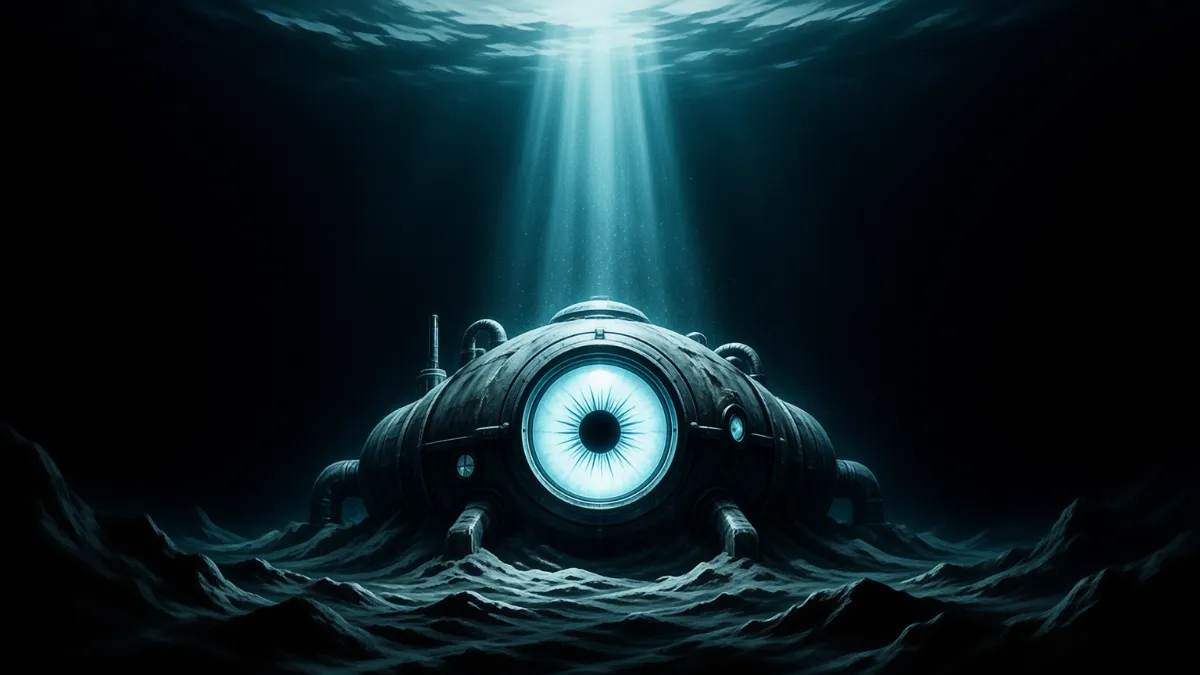
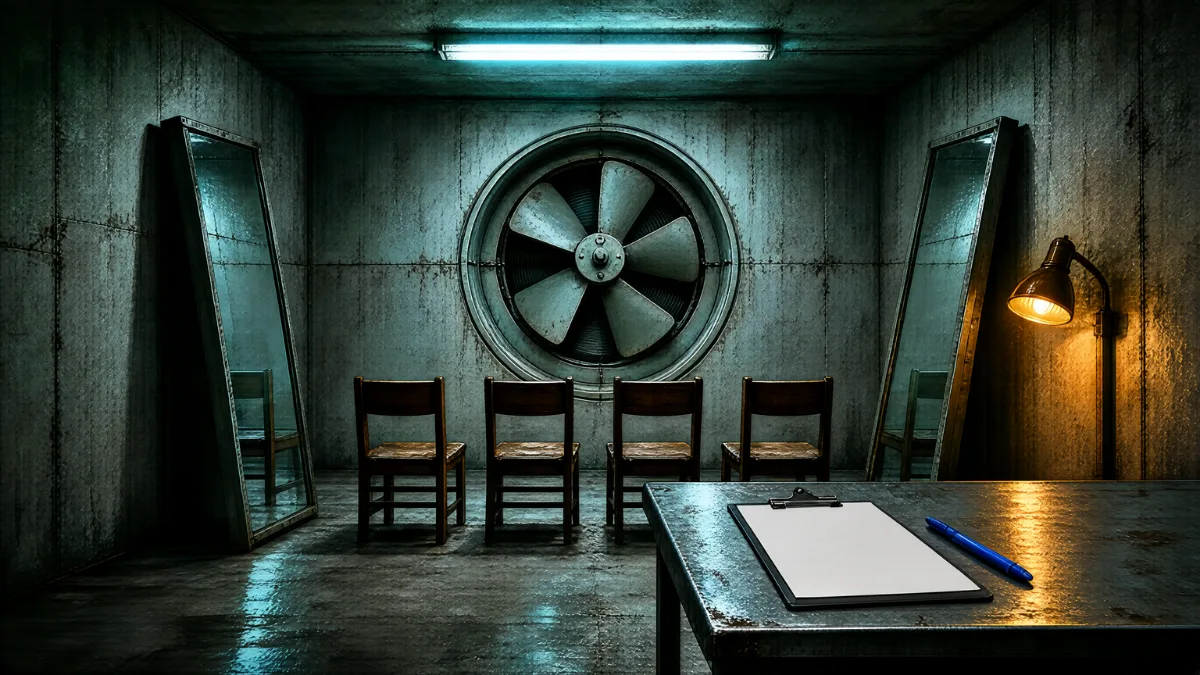
This guide was checked against the game on 31 October 2026. The four screenshots below are real gameplay; the opening image is an AI illustration and is labelled separately.
AI illustration generated with SenseNova. It is not a game screenshot.
1. A sum from primary school
The nameplate on B-3’s extractor reads: six blades, rated speed 189.8 rpm.
Blade-pass frequency = blades × rpm ÷ 60 = 6 × 189.8 ÷ 60 = 18.98 Hz.
So 18.98 is not “the frequency of the abyss”; it is the factory parameter of a T40-6 axial fan built in 1978. And 189.8 is not a mystic design number either: it is the asynchronous speed of this fan on a 50 Hz grid. Another fan of the same model gives 189.8; a different grid frequency changes the number.
On 2 April 1986 the acoustics group ran the simplest possible test: cut the fan, and 18.98 disappears; switch it back on, and it returns. The frequency station’s “18.98 Hz Explained” page prints the sum, the second harmonic at 37.96 and the third at 56.94.
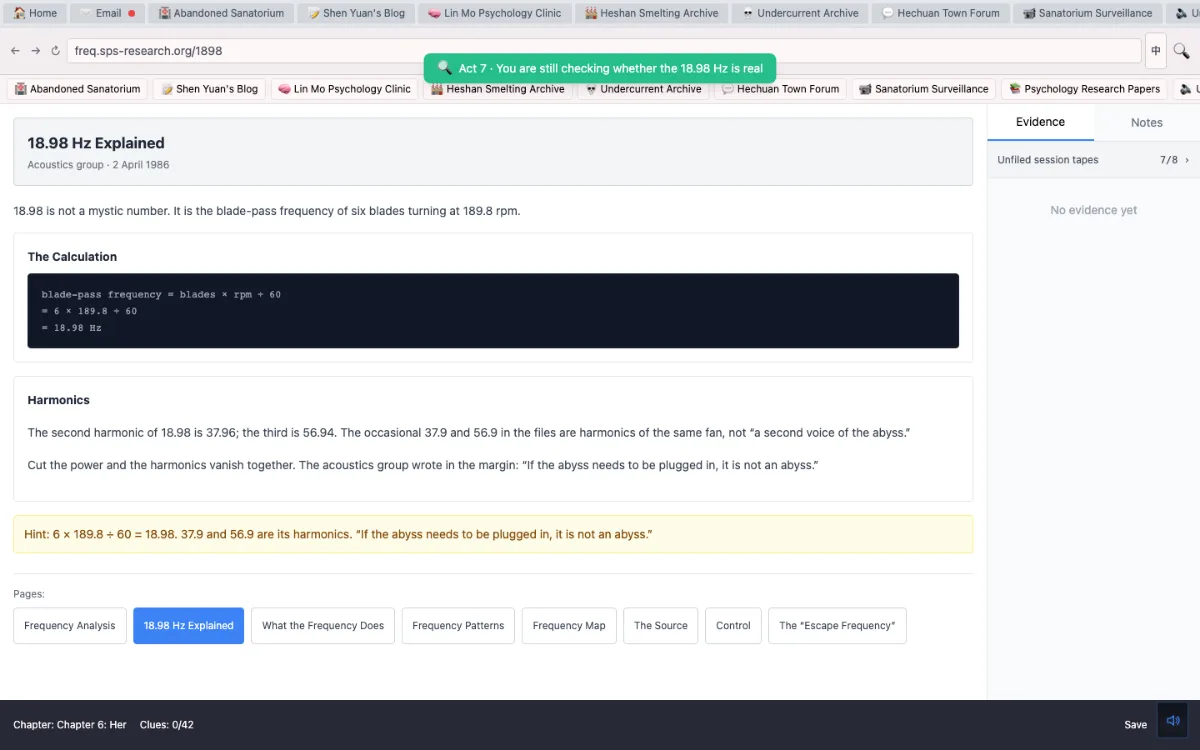
The occasional 37.9 and 56.9 in the files are harmonics of the same fan, not “a second voice of the abyss.” That distinction matters: if a frequency needs mains power and disappears when the fan stops, it is not a supernatural signal.
2. Why the file reads as if it were alive
Because S.P.S. is not a disease name. It is a filing label.
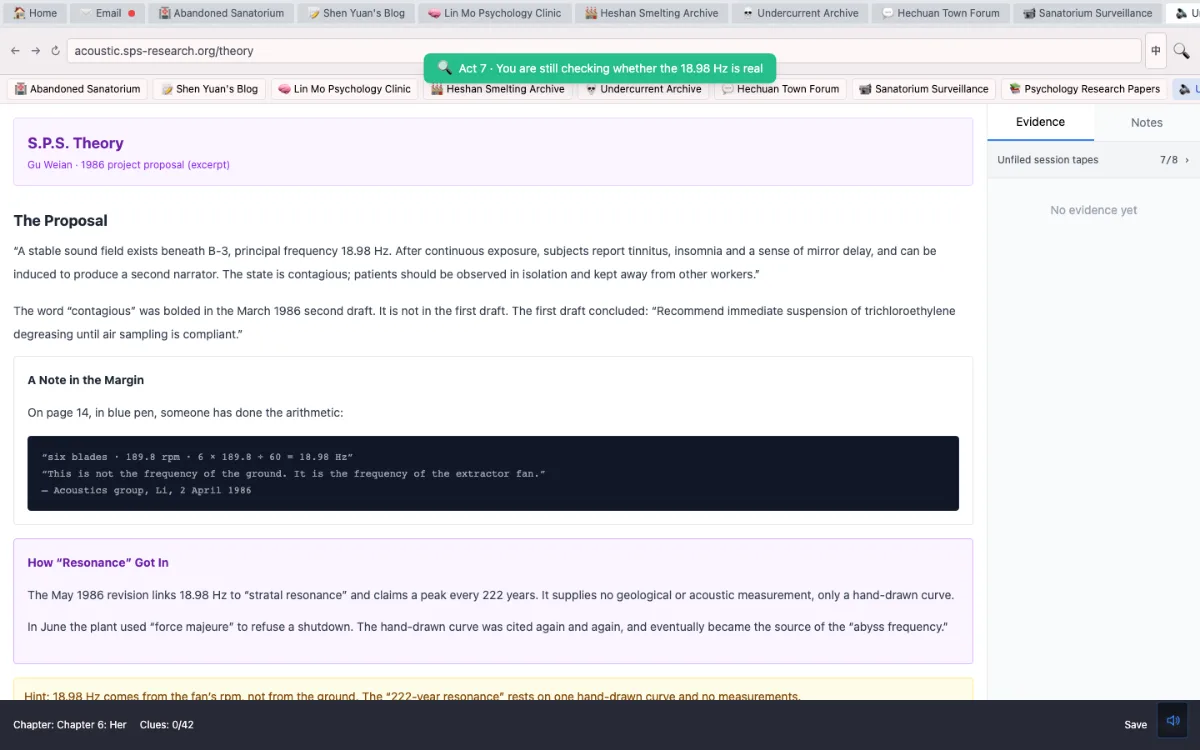
In 1986 Gu Weian wrote up “tinnitus, insomnia and hallucinations among degreasing-shop workers” as “sonic parasitic syndrome,” moving responsibility from the air to an “underground sound field.” That did two things:
- the plant did not have to recognise an occupational disease, stop production or pay group compensation;
- the sanatorium had a reason to concentrate people in B-3 for “observation,” with families signing “voluntary recuperation” and no visits.
The first draft of the proposal said: “Recommend immediate suspension of trichloroethylene degreasing until air sampling is compliant.” Only the second draft bolded the word “contagious.” By the May 1986 revision, 18.98 Hz was linked to “stratal resonance,” with a claimed peak every 222 years. The revision supplied no geological or acoustic measurement, only a hand-drawn curve.
The passage claiming the parasite “predates civilisation” is set in a laser-printer typeface introduced in 2003, yet claims to quote a 1953 manuscript. A reviewer pointed this out; the paper was published anyway. When it was retracted in 2021, only the paper was retracted, not the diagnosis.
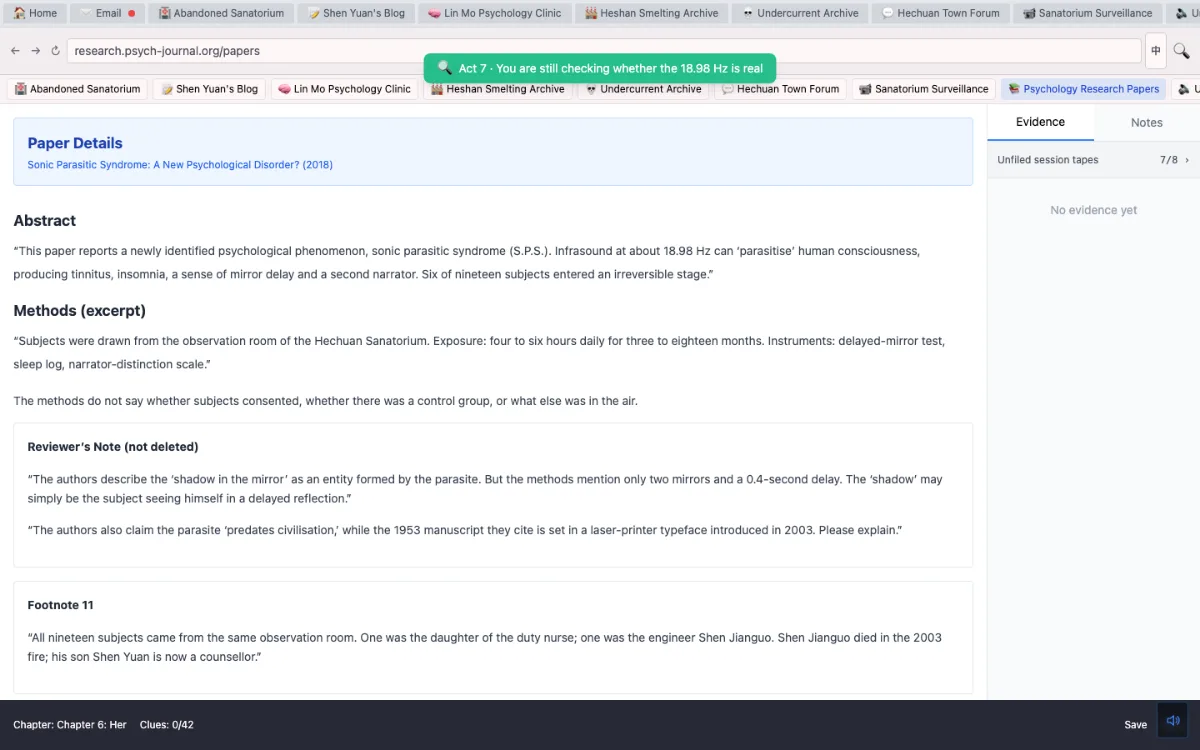
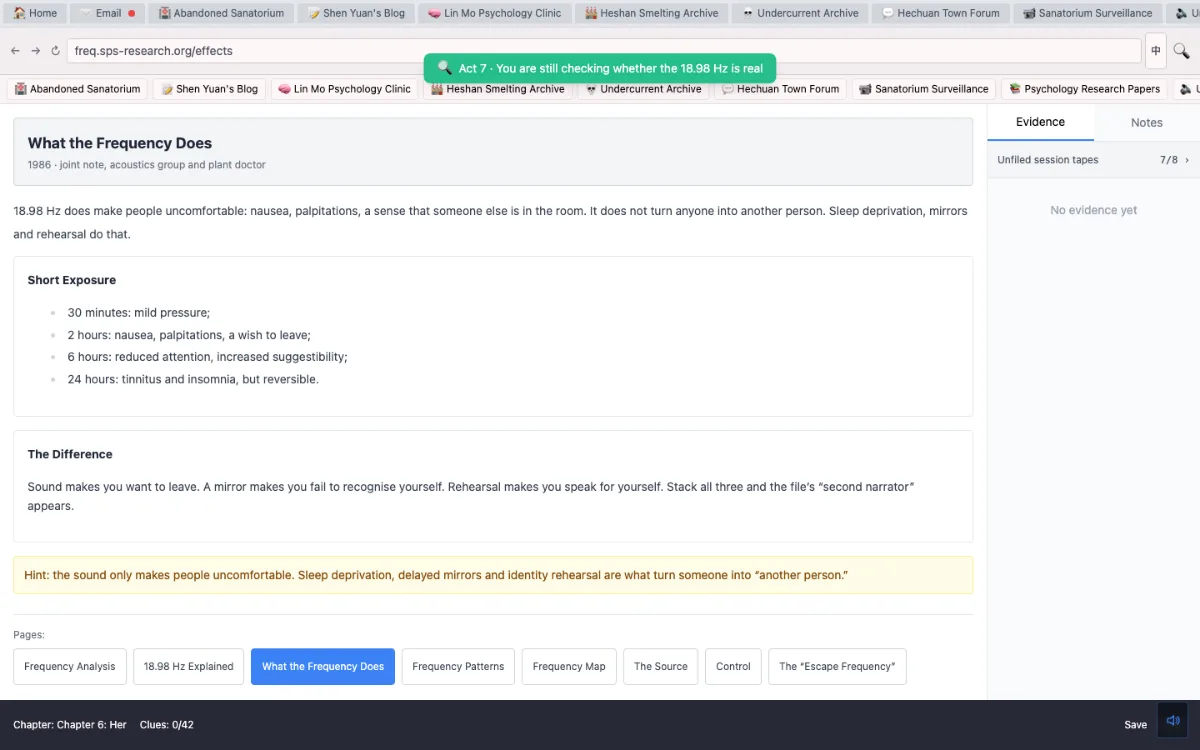
3. 18.98 makes people uncomfortable; it does not turn them into someone else
Short exposure brings nausea, palpitations and a wish to leave the room; six hours reduces attention and increases suggestibility. What actually produces the “second narrator” is three things stacked together:
- sleep deprivation;
- a mirror delayed by 0.4 seconds;
- having the subject rehearse a new identity in front of the mirror.
The observation records call these three steps the “replacement process.” Six of the nineteen subjects did not come out. That is also why “switch off the fan” explains the frequency but not why they speak for another person.
4. Seventy-two hours and an anchor memory
The thirteenth puzzle asks how to pull someone back from an acute episode. The answer is not “cover it with another frequency.” It is three conditions plus one time window, all true at once:
- stop the sound exposure;
- an anchor memory that someone else can check;
- a person who was actually present;
- all of it inside 72 hours.
An anchor without a witness is just a more elaborate hallucination. Shen Yuan has been carrying his for three years, so what he needs is not a “reversal” but someone to catch him.
5. Why the last question is “who is watching whom”
Because “watching” has three layers in this game:
- Gu Weian watching subjects from behind a one-way mirror;
- Shen Yuan watching his own half-beat-delayed shadow on CCTV;
- Lin Mo, twenty-three years later, reading her mother’s backup logs.
The abyss never had eyes. Eyes are human. The last question is not “what is the abyss?” but “who sits behind the mirror, and who finally turns around to look back?”
6. Three texts you can check
- The blue-pen sum in the margin of the acoustics site’s “S.P.S. Theory” page: 6 × 189.8 ÷ 60 = 18.98 Hz;
- The harmonic table on the frequency site’s “18.98 Hz Explained” page: 37.96 / 56.94;
- The 72-hour note on the acoustics site’s “Bring Them Out” page: anchor, witness, stop the exposure.
All three point to the same thing: 18.98 is an equipment reading, not a supernatural signal.
7. Claims that are now obsolete
- “18.98 is the frequency of the abyss”: no. It is the blade-pass frequency of a 1978 T40-6 fan.
- “The 222-year cycle was measured scientifically”: no. The revision has one hand-drawn curve and no geological or acoustic measurement.
- “S.P.S. is a real disease”: in the game it is Gu Weian’s filing label, not a clinical diagnosis.
- “Several works resonate at 18.98”: the old cross-title setting, removed on 26 October 2026.
8. Try it yourself
- In chapter six, open the acoustics site, read “S.P.S. Theory” and “Bring Them Out”, then open “18.98 Hz Explained” on the frequency site.
- The sum, the harmonics and the 72-hour page all open directly — no puzzle to clear first.
- All four screenshots are from that playthrough. The AI illustration at the top is labelled and is never presented as gameplay.
Changelog
- 31 October 2026: added four in-game screenshots and one labelled illustration, and wrote up the harmonics, the 222-year revision, the laser-printer typeface and the 72-hour page's “three conditions plus one time window”. Also fixed a contradiction: the old text said “three things” and then listed four.
- 26 October 2026: rewritten. Removed the cross-title frequency network and kept only this work’s 18.98 Hz and S.P.S.