No Such Number Complete Walkthrough: Ten Cases, Four Endings, and the Line Left Open
Spoilers: this page gives away the correct face for all ten cases, the seven duty rules, the four secret lines, the hidden ending, what each ending costs, and the whole solution. On a first run, read only sections one, two and eight; save the answers for when you are stuck.
Wherever this page says "click such-and-such", that is the word as it appears on screen — click it as written. You do not need to memorise any numbering. Every figure can be counted inside the game itself; section seven gathers them in one place and says where each one is visible.
1. What this is
No Such Number is a mystery you move through by searching for keywords. There is no timer, no jump scare, no fill-in-the-blank, and no fake browser. There is only one place: the night switchboard of Yuguan County's post and telegraph office, built in 1998, forty-eight magneto lines, position three by the window. At 21:50 every night the duty operator logs the calls booked that evening in the long-distance register — one square per call — stamps each one CONNECTED or NO SUCH SUBSCRIBER, and signs. On the night of 6 November 2015 the lines were cut over, the switchboard was withdrawn, and the site has been kept as a duty archive ever since.
You come back in 2026 to look into something small: a printed sheet under the glass on the desk reads "4,018 kept days". Since 6 November 2015 the position-three line has been recopied into that day's register every single night, stamped neither CONNECTED nor NO SUCH SUBSCRIBER, the status square left permanently blank, and always in the same hand. The board was withdrawn in 2015, yet the archive gains a new line every day. Every time you pull an original, part of the site goes dark for good; and at the very end, the back of the plate carries a line cut in 1998: "Keep one line only. One connection, then this number is closed." What you do with that one connection is the question the finale asks.
This is a standalone world. It shares no characters or settings with anything else on this site, and you do not need to have played any of them.
The landing page, the searchable register, the guestbook and the about page are all deliberately ordinary: a note from the office, someone who came to ask about a call and left with a blue cloth jacket, a retired colleague who came back for an enamel mug. The guestbook holds five unsigned lines — "No such subscriber. Not a mistake." — running from 2015 to 2021. There are only a few people in it: Zhou Bingsheng (Old Zhou, a temporary worker taken on when the board was built in 1998, never on the establishment), you (the sixteen-year-old substitute operator of 2015, staff number 1128, logged that night and cancelled the next day), and the subscriber who can never be found in the directory. Section nine lays the solution out.
2. The four moves: read, search, turn the plate, make the entry
Reading and searching
Read: read a few pages until the nouns stick. Search: type a word into the box and the record opens; if you would rather not think of one, click the small to-look-up tags at the foot of a record and one fills the box for you. Turn the plate: each case asks whether its square is KEEP or CUT — the plate has only those two faces, and rule two says an engaged line counts as KEEP and no answer counts as CUT. The right face comes from the evidence, not from what feels merciful: in the first two acts you check against the plate, from act three against the original. Make the entry: with all ten turned, you come back to the blank entry and decide what that one connection is for.
The seven duty rules were drafted in 1998 and recopied in 2014. All seven are in the book:
| Rule | What it says | What it is for |
|---|---|---|
| One | Take over at 21:50 and count the lines first | The time and the gesture that open the game |
| Two | Log only KEEP or CUT; engaged counts as KEEP, no answer as CUT | The first four squares are KEEP, read off the plate |
| Three | A cut gets the NO SUCH SUBSCRIBER stamp and the operator's name; no blank squares | Why that one square stayed blank, and why an entry is owed |
| Four | A subscriber not in the directory is never connected | The basis for every CUT from act three on — and the truth of that night |
| Five | Call slips are destroyed after three months | Why the slip from 6 November 2015 still exists |
| Six | A substitute signs "sub." | The first four squares carry your "sub."; so does the approval line of the hidden ending |
| Seven | The plate must never be left blank (the only rule the book never explains) | Written by the same hand as the line on the back of the plate |
Four acts: act one, the switchboard — one case (001); act two, the register — three (014, 027, 041); act three, the machine room — four (058, 063, 077, 089); act four, the back of the plate — two (102, 110). One, three, four, two: ten in all. Every square in the first two acts is KEEP; from act three you turn them to CUT yourself.
The limited resource is worth stating plainly, so it does not get confused with One Clear Day. That game is a single day owed back for a shift you missed; this one is a single connection. The back of the plate has said since 1998: "Keep one line only. One connection, then this number is closed." The switchboard has one last pair of cords and one blank call slip left — not a gift from somewhere, just stock. One slip, one connection, then it is closed. It is not "one day", and it does not put you back in 2015 to live there; you plug in the last pair of cords, connect once, and hand it back. All four endings are ways of spending that one connection, or of not spending it.
Six pulls, none of them refunded
From act three you pull originals: one square per pull, no refunds. Six in total, exactly the six CUT squares. The rule never punishes you and running out never blocks progress; what cannot be undone is that a square you have turned stays turned. Each pull darkens part of the site for good, and the red busy lamp's circle of light shrinks square by square, down to a single point by record 110.
3. The ten cases at a glance
The first four squares are KEEP, the last six CUT; the first four fall in acts one and two, and from act three you turn them yourself. The "where to click" column names the word on the page you are standing on before that case opens. Case names, faces and evidence are quoted as they appear on screen.
| No. | Case | Where to click | Right face | The evidence |
|---|---|---|---|---|
| 001 | Today's disconnected number | "Today's disconnected number" in the duty rules you start on | KEEP | The plate says KEEP and so does the register, so rule two applies; the printed sheet under the glass reads "4,018 kept days" |
| 014 | 4,018 kept days | "Kept days" on 001, on the switchboard, on the register or on the handwritten calendar | KEEP | The small print says "counted from 6 November 2015", and 11×365+3 = 4,018 checks out; this act is only verification, so read the plate |
| 027 | The substitute's line | "Substitute" on 014 | KEEP | The operator column holds one character, "sub.", with no name and no staff number; this page is about a substitute being logged, not about a cut, so the plate still says KEEP |
| 041 | The no-such-subscriber stamp | "No-such-subscriber stamp" on 027 | KEEP | The rubber stamp has been used exactly once in eleven years, on 6 November 2015; today's plate says KEEP, and holding the stamp does not let you change that square |
| 058 | 6 November 2015 — the original | "The original" on the page where that sentence is written five times | CUT | On the 22:41 line the original first reads KEEP, then the whole square was rubbed out and stamped NO SUCH SUBSCRIBER; the dent of KEEP is still there, and rule four was followed to the letter |
| 063 | Who was on the board that night | "Who was on duty" on 058 | CUT | The duty sheet reads "Zhou Bingsheng, sub."; the substitute's square has been rubbed so often the paper has gone thin; the original line ended as a cut |
| 077 | Three months of stubs | "Three months of stubs" on 063 | CUT | All 181 stubs on the destruction list are ticked but one — 6 November — marked "keep"; that "keep" was written by hand, not by a plate |
| 089 | Cutover and filing | "Cutover record" on 077 | CUT | The finding reads "cut as no such subscriber under rule four, formalities complete, no error"; the night log is filed with only its first page |
| 102 | Recopied | "Recopied" on 089 | CUT | Eleven ledgers in the steel cabinet, 4,018 squares, every one a KEEP in the same hand; the truth of that night is in the finding |
| 110 | The back of the plate | "Back of the plate" on 102 | CUT | The CUT face has been nailed to the wall for eleven years, the aluminium dry, the lettering still sharp; the face in your hand is CUT |
The four that are easy to get backwards are still the first four: read what the plate said that day, not what the night deserved. The figure on 014 is correct — what is wrong is eleven years without a single break and without a single cut. 058 is the dividing line: the moment it turns to CUT the whole site cuts over, and there is no coming back. The entry only opens once all ten are turned; that page turns no square of its own, it is the pen, and the choices appear after you have read it. After the ending there is one more page, "Tomorrow morning", which does not count towards the ten.
4. The lit world and the dark one
The first cut: no transition
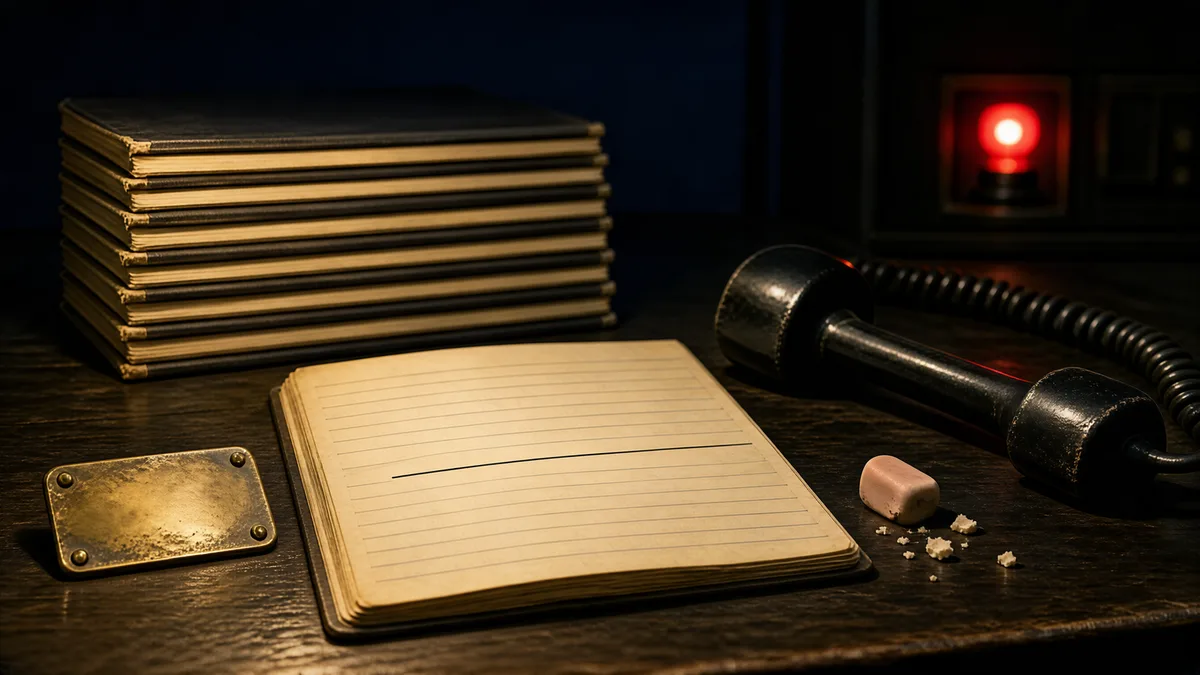
Before that square is turned the whole site is a machine room still on watch: grey panels, one amber desk lamp, monospace type everywhere, the handwritten calendar, the enamel mug, the rota under the glass, the 1998 photograph of the board on its first day. The instant 058 turns to CUT there is no transition and no sound: the desk lamp goes out, and with it the calendar on the wall and the amber circle it threw across the desk — only a darker room is left, one red busy lamp, the lettering on the plate rubbed white, a small drift of eraser crumbs on the desktop, the handset off its cradle, a busy tone. Note that it is one red busy lamp, not water, not ink bleeding; the lettering has been rubbed white with an eraser. It is not a cutscene. It is a hard cut.
Erased copies, and going back to act one
Each further CUT darkens the site a little more — six in all — until the lamp's circle is a single point at record 110. Every record also holds an erased version: open it again after the site has gone dark and that is what you get — the same sheet, the same objects, the paper dry, the writing gone. The erased versions use only "rubbed white", "rubbed out", "empty", "eraser crumbs". Nowhere do they say damp, wet, water stain, mildew or bleed. This is the exact opposite of One Clear Day, which is soaked through.
So when you go back to the lit pages of act one after act three, they are not wet — the names have been erased. On the note pressed under the glass at position three, "Zhou Bingsheng" is rubbed white and only a dent is left; the last line of the temporary-staff page in the staff register is still blank; in the 1998 photograph the face by the window in the back row has been rubbed into a faint shape of a person. Once 077 is turned the screen simply tells you: "You go back to the note from act one. The three characters of 'Zhou Bingsheng' have been rubbed white. The paper is dry." Nobody did this to them. You turned them out yourself, square by square. Act four has two more pages about it: the calendar is still on the wall, a broad patch of pencil rubbed white, only the rule for 6 November 2015 still pressed into the paper; between the glass and the photograph there is nothing but air.
5. Four secret lines and the hidden ending
All four sit off the main line. You reach them through the to-look-up tags, or by thinking of a word yourself; none of them counts towards the ten cases, and one of them opens the hidden ending.
| Secret | How to find it | What it tells you |
|---|---|---|
| "Not a mistake" — who wrote it first | Turn 089 to CUT, then click "not a mistake" | Half a torn line from the night log, found in the wastepaper basket: the child kept asking whether he had stamped it wrong, the man on watch followed rule four, and it took three tellings before the jacket was handed back. Those five lines are one sentence, written eleven years running |
| The keys by the machine-room door | Click "machine room keys" on the page above | Five keys on a card of brown paper, rubbed down to four characters: "keep one line". The main breaker was pulled that night so that position three would not go down with the rest |
| The third name | With both of the above read, click "third name" | Three dents from one pen and one hand spell three characters — Zhou Bingsheng. He is the no-such-subscriber himself |
| The back of the registration form | See below | The key to the hidden ending |
The hidden ending: the form that was never handed in
The hidden ending is called "Leave it to him", and it is hidden in one sheet of paper: a Temporary Operator Registration Form that Old Zhou filled in in 1998 and never handed in. On the front, the name field stops after two characters; the date reads 1998; the staff-number field is blank, because temporary workers were never given one. On the back, low down, in pencil: "If only one square could have my name on it. Just one." Find that sheet and "Leave it to him" appears among the finale's choices.
There are two routes up, and you need both:
- By way of the finding: turn 089 "Cutover and filing" to CUT, click "not a mistake", then "machine room keys", then "third name".
- By way of the blank square and the eraser: on 063 "Who was on the board that night" click "blank square"; on 102 "Recopied" click "Old Zhou's hand", then "eraser". "The third name" only opens once both sides have been read — one route alone is not enough.
- Go to the back of the plate for the sheet: on 110 "The back of the plate" click "registration form" — it is the paper pressed behind the plate.
- The last step: on "the third name", click "back of the registration form". The two sheets match, and only then does that page open; its "blank entry" tag takes you straight to the entry page.
What this line is for: it explains why the hidden ending is not about spending the connection yourself. The line cut into the plate says only "one connection, then this number is closed" — it does not say the entry has to be yours, and it does not say the square can only hold a number. Fill the form in and hand it over, and position three no longer has to be recopied every night.
6. The four endings and what each costs
The resource again, so it does not turn into One Clear Day's single day: "Keep one line only. One connection, then this number is closed" is about the last connection, not about a day. Rule three ("no blank squares"), rule seven ("the plate must never be left blank") and the line on the back of the plate are all in one hand — dated 1998, cut long before that night in 2015 — and the blank square was always left for someone to come back and fill. The page about the connection puts the cost most plainly: it is not going back to live in 2015, it is plugging in the last pair of cords, connecting once, and handing it back. There is no second pair of cords in the switchboard.
To reach the choice you need all ten cases turned and the blank entry read. Three options are there by default — rewind, rewrite, keep — and the fourth, "Leave it to him", only appears once you have found the line above. All four cost something. The game does not mark any of them as the good one; it only says what is left on the desk, on the board and in the register the next morning.
| Option | What the connection is spent on | What it costs |
|---|---|---|
| Rewind | Connect back to the call at 22:41 on 6 November 2015 and let that night run again as it really was; this time the substitute does not stamp it, and it stays KEEP | A connection has to be paid for: those eleven years go back with it — the schools, the moves, this morning's soy milk, the very urge to come back and look into this. The night log is left with four lines |
| Rewrite | Do not connect that night at all; change the number on the slip to someone still in the directory, so the connection is regular and no error is logged | This volume is closed and everything written into it that day comes back out: your name leaves the substitute's line, staff number 1128, the lost-property loan record. Old Zhou is still not on the establishment |
| Keep (the hardest) | Do not spend the connection; put the cords back where they were and leave the plate blank | You stay on in his place, recopy that line every night, learn to start the KEEP a little to the left, and never fill the last square — fill it and the number closes, and once it closes it is really gone. You become the next person who writes that line |
| Leave it to him (hidden) | Fill in the registration form that was never handed in and hand it over for him, signing "sub." on the approval line under rule six | This connection carries a name instead of a number; the square is filled, the number closes, and position three is never recopied again. He has a name, so he no longer has to come in every night |
Keep is the hardest of the four: the other three spend the connection on something, and it spends it on nothing — the price is staying to copy that line for the rest of your life. The last line is still "the plate must never be left blank."
7. The numbers
All of these can be counted inside the game. They are gathered here so they can be checked at a glance.
| Item | Value | Where you can see it |
|---|---|---|
| 4,018 = 11×365+3 | Three leap years — 2016, 2020, 2024 — from 6 November 2015 to 6 November 2026 | The printed sheet under the glass, the body of 014, the counter on the home page |
| Forty-eight lines | A forty-eight-line magneto switchboard | Rule one, the "machine room" page, the about page |
| 22:41, forty-seven minutes dark | The breaker trips at 22:41; power returns at 23:28 | The handwritten calendar, the "twenty-two forty-one" page, the note in the duty room |
| Staff number 1128 | Substitute operator, logged 6 November 2015, cancelled 7 November: one night only | The "staff number 1128" page, the body of the Rewrite ending |
| Forty-two records | Beyond the ten cases: the rules, the notes, the guestbook, the photographs | The footer of the register, "N of 42 records on this machine" |
| Ten cases | 001/014/027/041 take KEEP; 058/063/077/089/102/110 take CUT | "Ten squares to stamp", 0 / 10, on the register |
| Six pulls | Exactly the six CUT squares, none refunded | "Pulls N / 6" at the foot of the search desk |
| Four endings, one hidden | Rewind, rewrite, keep, leave it to him | The choices on the blank entry; the hidden one appears with the form |
| Nineteen AI images | Eight in the lit world, eight in the dark, two at the finale, one on the home page | Every image is captioned "an AI-generated fictional image" |
A few more that check out: the spring duty sheet has 181 squares and one blank at position three; the destruction list on 077 also has 181 stubs; "No such subscriber. Not a mistake." appears five times in five hands. None of these is a puzzle answer. They are there to hold the story down.
8. When you are stuck
- Start with the to-look-up tags. Each record carries a few clickable words at its foot; clicking one fills the search box and jumps to that record. They are the "where to click" column in section three.
- Then use the three hints. Every square has three, from direction ("look at the sheet under the glass, then at today's square in the register") through specifics ("rule two: read the plate") to the flat answer ("this square is KEEP / this square is CUT"). Take them one at a time; none of them costs anything.
- A wrong face is not punished. Each case has a line that turns you back to the evidence — 001's is "The plate says KEEP and the register says KEEP. Under rule two, read the plate; do not correct it yourself." You can try again, and the game does not count how many times you got it wrong.
- Some words are worth asking. The search box answers "duty", "register", "KEEP", "CUT", "Old Zhou", "no such subscriber", "4018", "one connection" and a few more; some of them keep quiet until you have read the right record ("Old Zhou" needs the page where that sentence is written five times; "4018" needs 014).
- Out of pulls? Running out never blocks progress — the quota is exactly the six CUT squares — and the rule says plainly that it is not refunded. Fill the rest from what you have already read.
9. Why Keep is the hardest
The solution can be laid out here, because it is what you are meant to see once you have finished.
Zhou Bingsheng — Old Zhou — is the no-such-subscriber himself. He came in as a temporary worker when the board was built in 1998, never on the establishment, never in the staff register; even the last line of the temporary-staff page is blank, and the paper there is a shade paler than the rest. He worked seventeen years of night shifts without missing one, and taught one generation after another of substitute kids. After the cutover and the withdrawal he still came in every night and recopied the position-three line without ever cutting it — not to cover anything up, but to keep one line open that a man who was never on the books could still be reached on. He turned that plate every day of his life: four thousand and eighteen times. He kept a line open for eleven years for everyone else, and had not one square of his own; under rule four he was never allowed to be connected.
Nobody did anything wrong that night. You were the sixteen-year-old substitute operator in 2015. At 22:41 the machine room breaker tripped and the power was out for forty-seven minutes; the position-three line genuinely had no subscriber in the directory, and you stamped NO SUCH SUBSCRIBER under rule four and cancelled the slip — no malice, no negligence. The lost-property book reads "put it round the kid, he's sixteen, he didn't say a word, he was that frightened". The finding reads "cut under rule four, formalities complete, no error", and the night log is filed with only its first page. The four KEEPs the player turns in the first two acts are stamps of approval on that account; only from act three do you rub the names out yourself.
"No such subscriber. Not a mistake." Five times, five hands. The first was not written for outsiders: Old Zhou wrote it for the sixteen-year-old who had stamped the square as the rules required and was too frightened to speak — not to blame you, but to say it was not your fault. It gets written again every year because someone has to keep saying it.
Three of the four endings hand that one connection away: one buys back the night, one changes the number, one puts his name on the form. Only Keep puts the cords back and buys nothing. It is called the hardest not for effect but for arithmetic: the other three live once, and Keep lives a lifetime. You take the chair on the inside of the window, take over at 21:50 and count the lines first, forty-eight of them, position three yours, recopy that line into the register every night, write KEEP on the plate and KEEP in the book, leave the status square blank as always, and learn to start the KEEP a little to the left so that eleven ledgers look like one man's writing. The sheet under the glass is reprinted once a year and the number climbs above 4,018. Long after, someone opens this site and the counter on the home page is still running: the number is right, the paper is dry, and position three has been recopied again tonight — you became the next person who writes that line. The other endings are losses. Keep is staying.
Links
Changelog
- 7 November 2026: the route was walked again step by step. Every step now names the page you are standing on and the words you click, matching what the game actually shows. No case, figure or search chain changed.
- 6 November 2026: first published.