Tide Sound Archives is our first-party investigative ARG: an anonymous email leads you to Lan City and the seven people who vanished from its lighthouse district in 2003. 7 chapters, 7 puzzles, 6 simulated websites (55 pages), 12 collectible clues, 4 endings, 1–2 hours.
Illustration (AI-generated), not a game screenshot
An anonymous email draws you into the fictional coastal city of Lan City, where seven people vanished from the lighthouse district in 2003. Search hidden information, decode classified files and tune abandoned broadcast frequencies across 6 simulated websites and 55 pages to uncover Project Tide. 7 chapters, 7 puzzles, 12 collectible clues, 6 emails, 10 searchable tapes, 5 endings, 1–2 hours; collecting all ten tapes takes about 2–2.5 hours.
Chapters:7
Puzzles:7
Simulated sites:6 / 55 pages
Collectible clues:12
Emails:6
Endings:5 (one requires all ten tapes)
Tapes:10, found by searching the right term
Length:1–2 hours
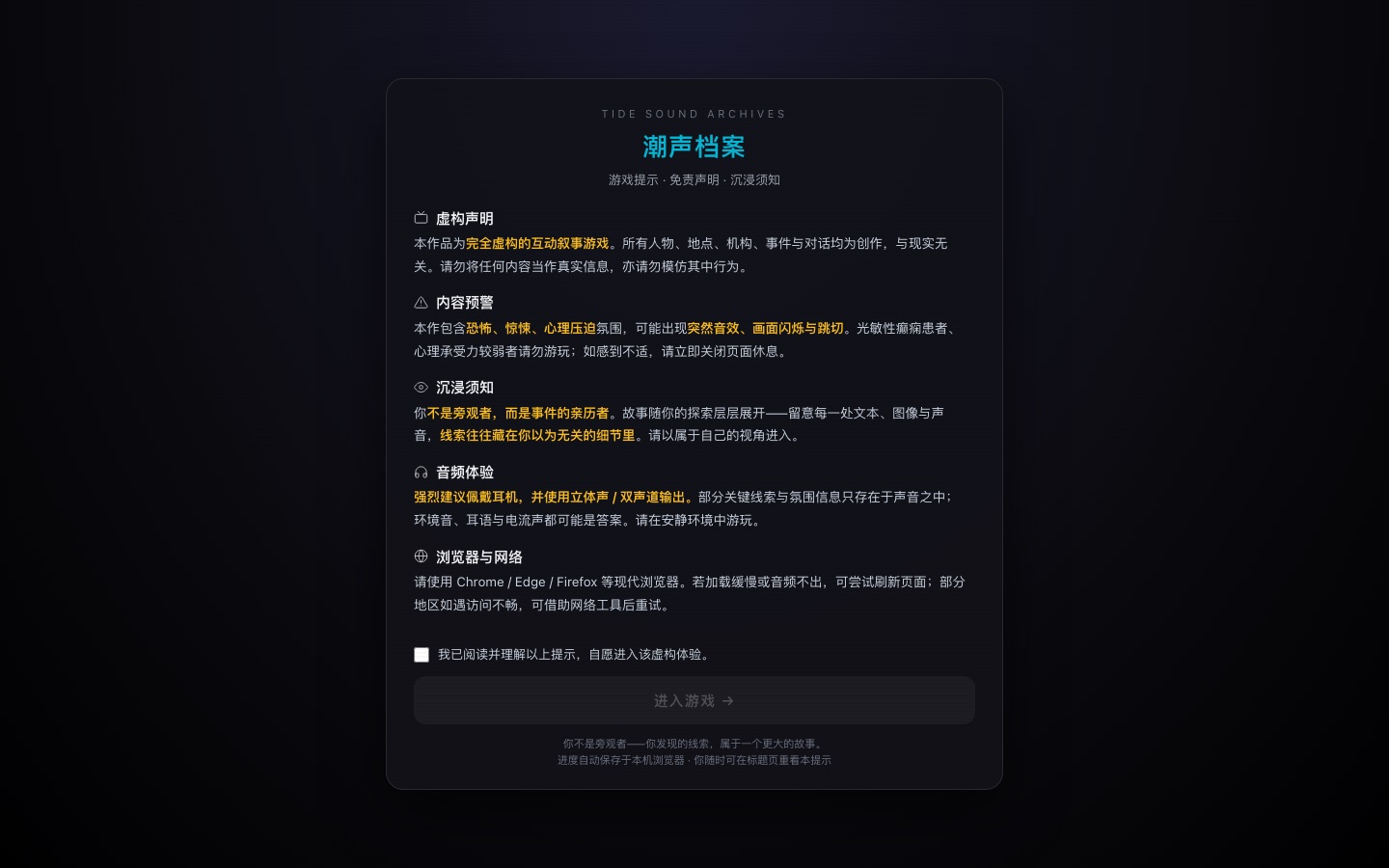
Content:Horror and sudden-audio warning before entry
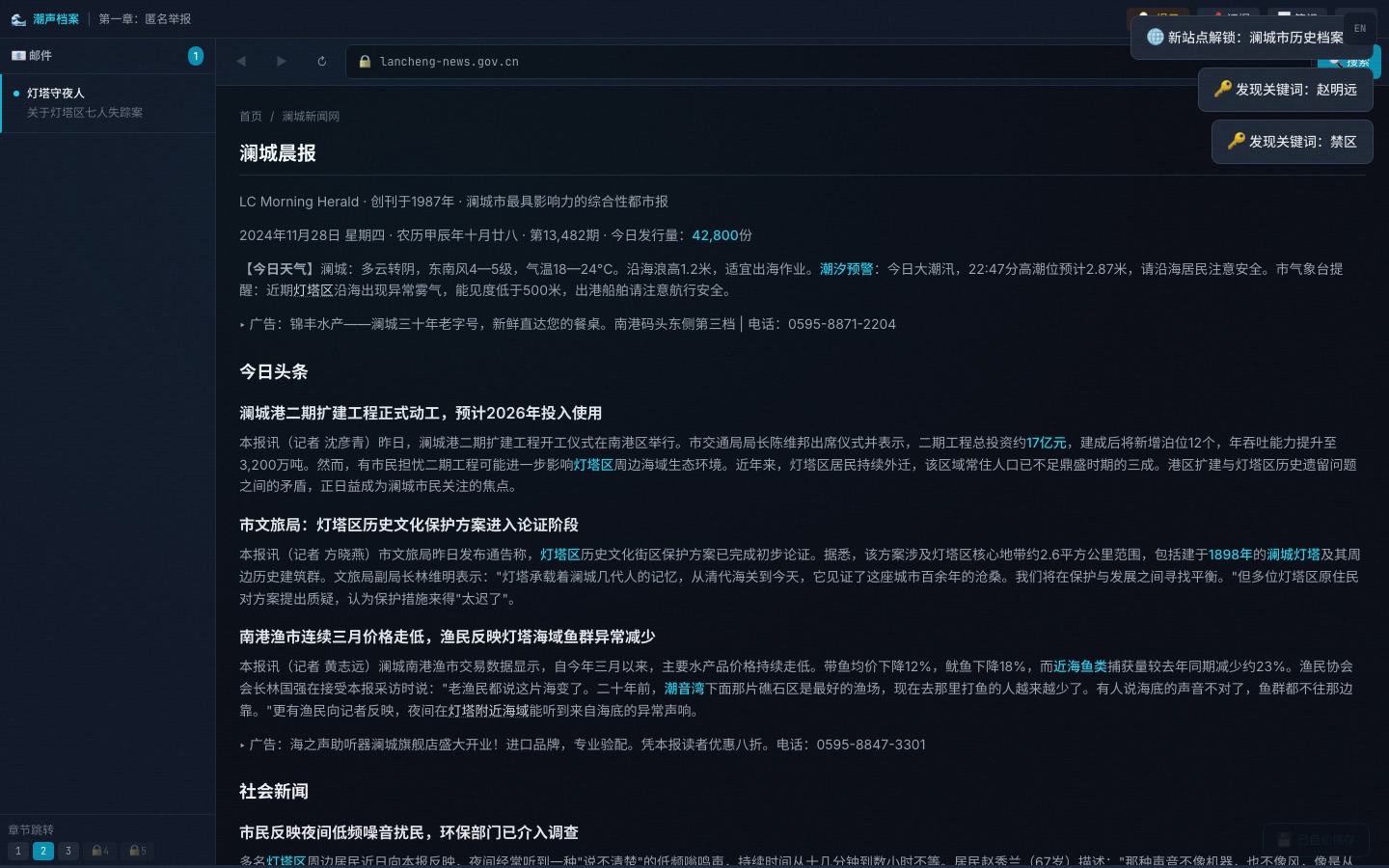
The title screen before entry: an anonymous email that opens onto Lan City’s sonic experimentsThe Lan City news site inside the fake browser: emails and chapter jumps on the left, address bar and reachable sites in the middle
What it is
An anonymous email arrives from someone calling themselves the lighthouse keeper, subject: “On the disappearance of seven people in the lighthouse district.” In 2003 seven people vanished from that district in a single night: three researchers, two maintenance workers, one local-history scholar and one journalist. More than twenty years later there is still no finding.
It is played as a pseudo-interface investigation: the game is a browser and you move between six simulated websites — the Lan City news portal, the city forum, the municipal history archive (a digital collection of 42,713 documents), the city government data centre, the maritime culture museum and the people’s radio station (FM 101.3 / AM 1170) — 55 pages in all.
The loop is three verbs: search for hidden information, decode classified documents, and tune abandoned broadcast frequencies. Nothing asks for reflexes or shape-matching; what it asks is whether you can find the sentence inside an official statement that contradicts another official statement.
It is one of the doors into this site’s shared frequency network: Project Tide, the 222-year cycle and 18.7 Hz all echo through The Sunken City, Eye of the Abyss and Rust River.
How to play: search, decode, tune
The left panel holds emails and notes: six emails advance the story in order, each pointing at the next step;
The middle is the browser shell: address bar, back, forward, reload, with sites as cards and padlocks on the ones not yet open;
Progress runs on keyword search: one term in a site’s box; a hit moves a clue into the evidence panel;
Chapters are clue-driven: each requires named clues before it turns the page, and the chapter jump in the corner is not a shortcut;
Puzzles are inputs and frequency tuning: numbers, call signs, frequency values and years each take a share;
The hint button gives direction, never the answer, and using it does not change the endings;
Progress saves locally in the browser; Chinese by default with English available.
Seven chapters
There is one chapter after the finale: the main line closes at the choice, and chapter six pulls the camera back to the whole network — which is also where the four endings get re-read.
Prologue · An anonymous email: the keeper writes in, and the first contradiction sits in the date of the official notice;
Chapter 1 · The tip-off: the list of seven takes shape; the last article journalist Zhao Mingyuan filed becomes a clue;
Chapter 2 · Beneath the light: the laboratory under the lighthouse and the keeper’s testimony turn “accident” into “programme”;
Chapter 3 · Project Tide: programme files, the truth of the sonic experiments, and what the 1998 “renovation” actually was;
Chapter 4 · Signal and echo: the mysterious FM 91.7 recording, evidence from the tunnels, and who the anonymous IP really is;
Final Chapter · Truth and choice: the whole picture assembles and you decide where the evidence goes;
Chapter 6 · Beyond the tide: the 222-year cycle, the global frequency network, what changed after the resonance, and the keeper’s last message.
The twelve things you can collect
The evidence panel’s denominator is twelve: the list of seven, the underground laboratory, the keeper’s testimony, the tunnel evidence, the Project Tide files, the truth of the sonic experiments, the truth of the 1998 renovation, the FM 91.7 recording, a line from the keeper’s log, the identity behind the anonymous IP, the 222-year cycle, and the complete truth.
Three further entries belong to the last chapter — the global frequency network, the change after resonance, and the keeper’s final message. They do not fill those twelve slots, but they change how you read the endings.
None of them is a reward; each is an input to the next puzzle. Without the 1998 renovation, the tuning in chapter four has no reference value.
Ten tapes: a past you can search for
The main line answers what happened; the ten tapes answer who heard what, and when: Chen Zhou’s first recording of the hum in 1983, the 1998 renovation crew opening TD-1998, the dispatch call on the night of the disappearance, Zhao Mingyuan’s voice recorder, the infrasound experiment log, the dialogue between 18.7 and 52.9, the note under the door, the FM 91.7 listener call, the keeper’s monologue, and a final tape left for “the next courier”.
Type the matching term into the search box and the tape surfaces in the Tape Cabinet on the toolbar; when you are stuck, the cabinet names the next term rather than making you guess. Each tape has an object photograph.
Collect all ten and the final chapter gains a fifth choice — not another road, but permission to play all ten voices back to it.
Five endings
The five are decided by the choice in the final chapter: ending D needs the FM 91.7 loop decoded; ending E needs all ten tapes.
Ending A · The Tide Does Not Stop: you publish everything; the military is forced to release the full Project Tide archive; Zhao Mingyuan’s wife says at the press conference, “at least we know he is still alive”; the keeper finally walks out of the lighthouse, whiter than moonlight;
Ending B · The Silent Light: you protect the keeper’s identity, publish an edited piece and point the blame at a dissolved institution rather than a person; public attention fades, and his last email reads: “some truths are a burden when too many people know them”;
Ending C · Echo: you take the third road — through Zhao’s old mentor you hand the evidence quietly to an international research-ethics committee; two years later an anonymous paper appears in a journal, with no headlines and no press conference;
Ending D · The Tide Protocol: you neither expose nor compromise. You sit down in the lighthouse, put on the dusty headphones, tune to 18.7 Hz — and hear further out: the 52.9 Hz island heartbeat, the 18.98 Hz eye of the abyss, the bell of a sunken city, the current in room 404, the low hum of Rust River.
Ending E · The Last Slot in the Cabinet: you lay the ten tapes out by year and play them all for it, starting with 1983. For the first time the sound under the lighthouse is not a solo — 18.7 follows the tape, 52.9 answers from far off, and the noise of the intervening years peels away. The keeper takes off the headphones and says the first complete sentence in twenty-one years: “So it was waiting for us to finish listening.”
Where players get stuck
Site search takes one keyword; whole sentences return nothing;
The archive and the government data centre contradict each other often — the contradiction is the clue, so do not just trust whichever looks more official;
The tuning puzzle wants a frequency value, not a call sign; fix FM or AM before entering;
The anonymous-IP puzzle needs you to find a second post from the same address on the forum first;
Chapter jump is not a level selector; it refuses to turn the page without the named clues;
For ending D, do not treat “Beyond the tide” as skippable bonus material.
Why it is worth an evening
It is the shortest of our long pseudo-interface games: 1–2 hours, six sites, 55 pages. Good first contact with “research inside a fake browser”, and a cheap way into the frequency network.
The subject is investigative reporting and public archives; the dread is documentary: it comes from statements contradicting each other, until ending D hands you the sound itself. There is still a content warning before entry (horror atmosphere, sudden audio, jump cuts) — see the FAQ.
The four endings are four professional ethics: publish, protect, submit quietly, or stop being a journalist and become a listener. None of them is free.
If you plan to play The Sunken City or Eye of the Abyss, starting here saves you the trip back through the setting notes.
How it sits in the shared universe
Lan City is the coastal one: the seabed structure in The Sunken City and the hillside asylum in Eye of the Abyss sit on the same map, and 18.7 / 18.98 / 52.9 Hz is a shared table.
This game owns the archives-and-statements layer. Project Tide and the 222-year cycle are things other games experience; here they are recorded, redacted and corrected.
No required order — but it is the shortest path to the underlying settings.
Recent changes
2026-10-18: chapter jump is no longer a shortcut past the requirements, the finale is no longer used as a menu, and the mobile HUD is no longer buried under toasts; the title screen uses a live in-repo bay photograph with three overlay layers holding body text at 7.97:1 contrast, bilingual captions and alt text added; share images standardised at 1200×630;
2026-10-17: og:image switched to the WebP already served by this repo instead of a 3.2 MB PNG; trust-page dates follow real body revisions;
2026-10-16: trust pages gained a content-rating note and a unified credit.
How the numbers on this page are checked
Seven chapters come from the acts array, six sites from locations and 55 pages from the pages entries; five endings from endings and ten tapes from tapes.js; six emails from storyEmails, and seven puzzles from the game’s puzzle table.
Twelve is the evidence panel’s denominator — clues the player can collect. The data holds fifteen entries in total, three of which belong to the final chapter and do not fill those slots. The 1–2 hours is the game’s own stated playtime.
Both screenshots were taken from the running game on 2026-10-19. The hero image is an AI-generated illustration, not a game screenshot, labelled at the top of the page. If a number here disagrees with the game, the game is right; tell us in the changelog.
Who it is for
For players wanting an introduction to pseudo-interface investigation without committing seven or eight hours, and for readers who enjoy notices, archives and broadcast copy as a register.
Not for players wanting action or immediate feedback, nor for anyone with no patience for reading long documents and finding the mismatch.
FAQ
Do I need an account or payment? No. It runs in the browser, free, with no account or in-app purchases.
Is there horror content? There is a warning you must tick before entering: horror, thriller and psychological pressure, with sudden sounds, flicker and jump cuts; it advises against play by people with photosensitive epilepsy. In subject terms the pressure comes from statements contradicting each other rather than the supernatural.
How long is it? About 1–2 hours; seeing all four endings takes longer, and ending D requires the last chapter.
Where is progress saved? Locally in the browser. Refresh or close and continue; it does not sync across devices, and clearing site data restarts.
What if I am stuck? Check which emails and evidence slots are still empty, then change the keyword; answers live inside already-unlocked pages.
Can I switch to English? Yes; the interface and the site content have English versions.
Is this a true story? No. Lan City and every institution, person and event in it are fictional; do not read it as real information.
Start investigation — Runs on its own subdomain · progress saved locally · Chinese and English