Tide Sound Archives FM 91.7: What the Signal Actually Contains — and What It Unlocks
The short answer: the Morse code on FM 91.7 spells T, I, D, E, and the answer is
TIDE. Decode it and the game remembers you did, which opens a hidden option in the finale — ending D, The Night Watch. The old “Tidal Protocol / seven worlds” ending is gone.
This guide was checked against the game on 31 October 2026. The four screenshots below are from that playthrough; the opening image is an AI illustration and is labelled separately.

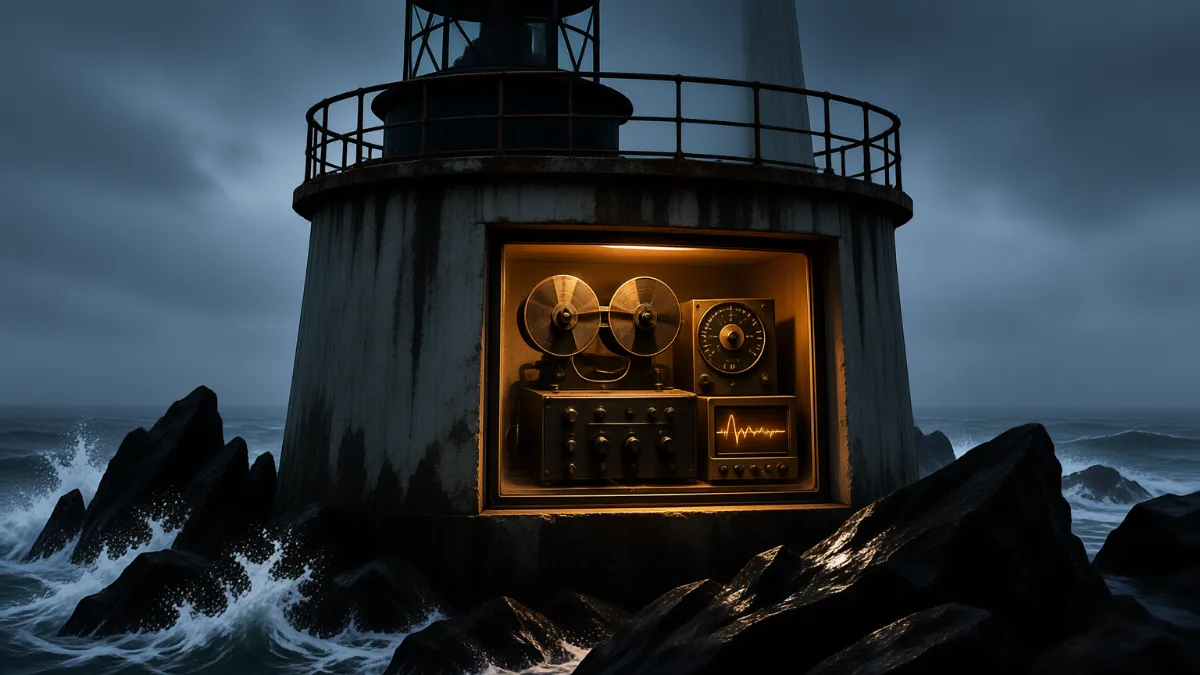
AI illustration generated with SenseNova. It is not a game screenshot.
1. Make sure you are in chapter four
The tuner is not there from the start — it opens in chapter four. Set the dial to 91.7 before that and nothing happens at all. Plenty of people take this for a wrong frequency and keep hunting for the right one, when the chapter simply has not arrived yet.
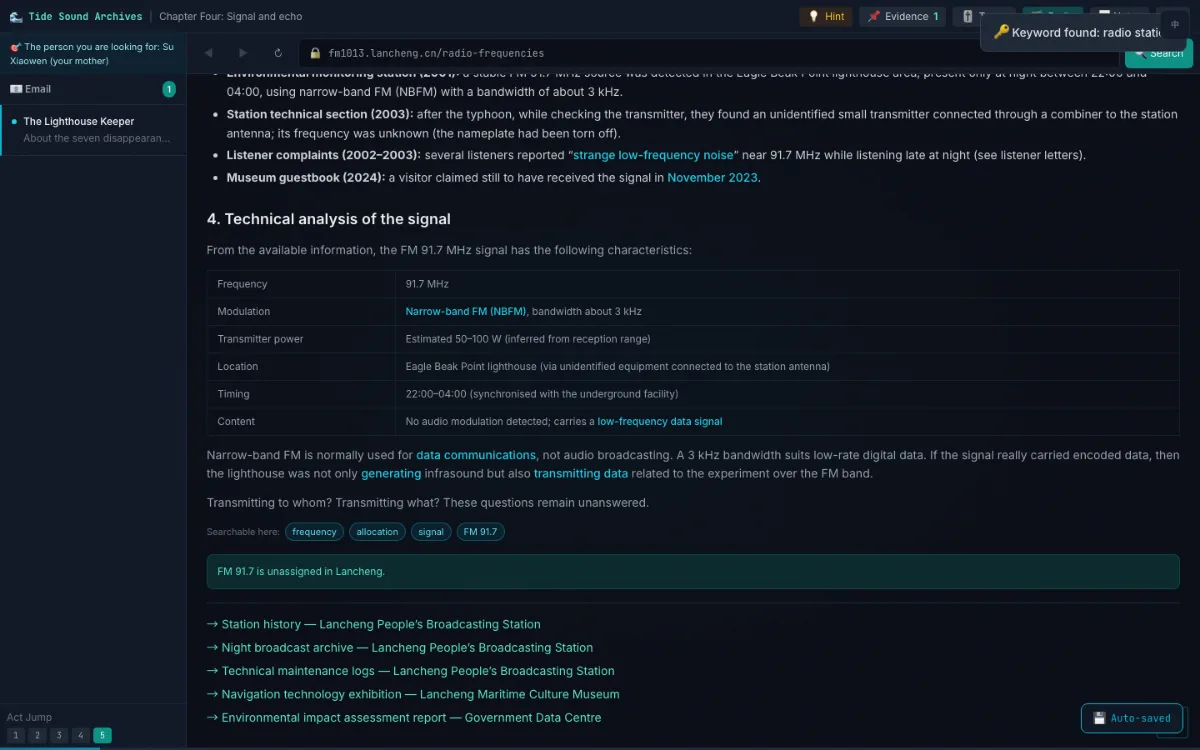
Once chapter four begins, the top bar gains a Radio button. Open Lancheng People’s Radio and read the Frequency Allocation Table first. It is evidence, not decoration: it records FM 91.7 as unallocated in the Lancheng area, transmitting only 22:00–04:00, using narrow-band FM (NBFM) with about 3 kHz bandwidth, from the Eagle Beak lighthouse.
If you continue an old save, the tuner may open once by itself when chapter four loads. That is just the game reminding you to tune, not a bug. Close it and reopen it from the Radio button whenever you like.
2. Move the slider from 103.9 to 91.7
The tuner opens at 103.9. The slider runs from 80 to 110 in 0.1 steps. The hit test is one line:
Math.abs(radioFreq - 91.7) < 0.3The accepted ticks are 91.5, 91.6, 91.7, 91.8 and 91.9. 91.4 and 92.0 are exactly 0.3 away, which fails the strict less-than. This is not a loose “close enough” tolerance; it is a five-tick window.
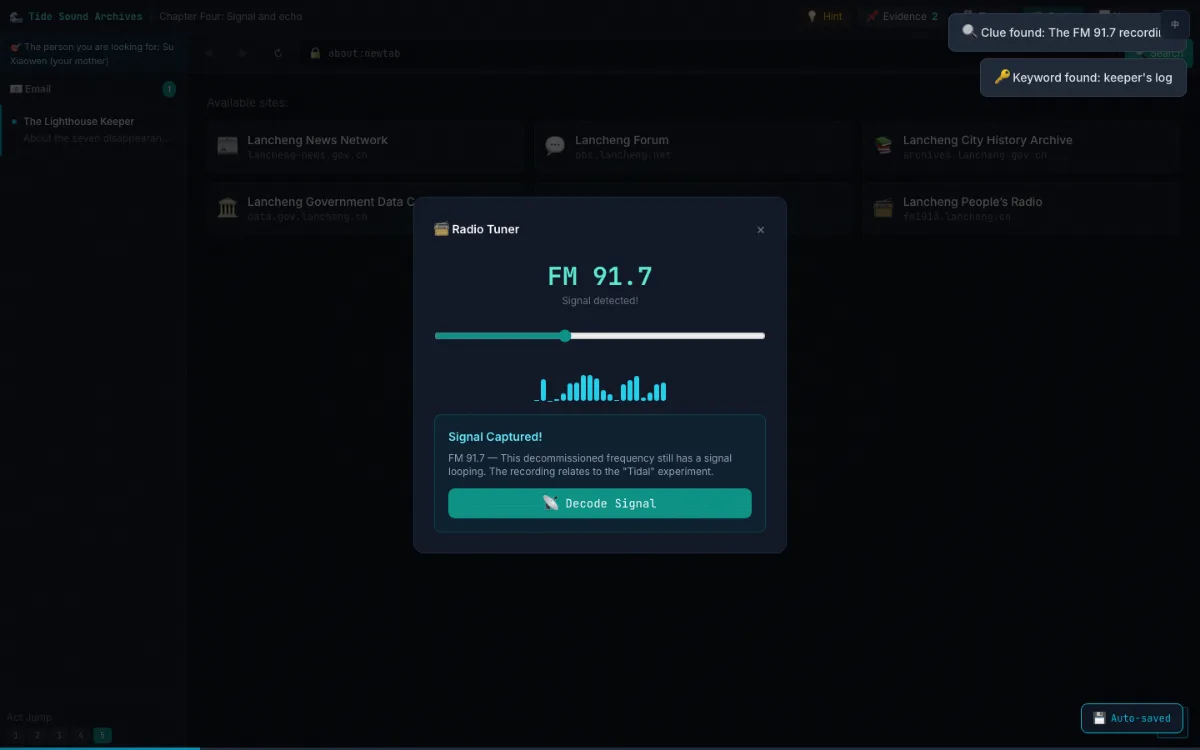
Stay on a hit tick for about two seconds. Only then does the game record the signal and deliver the FM 91.7 recording. Sweeping past and dragging away immediately leaves nothing behind.
3. The Morse is four letters, not a sentence
After capture, the panel shows four Morse groups:
—    ••    —••    •
T    I     D      E
— is T, •• is I, —•• is D and • is E. Together: TIDE. The game uses an on-screen letter grid, not the keyboard; you can clear a mistake, and the field caps at 12 characters.
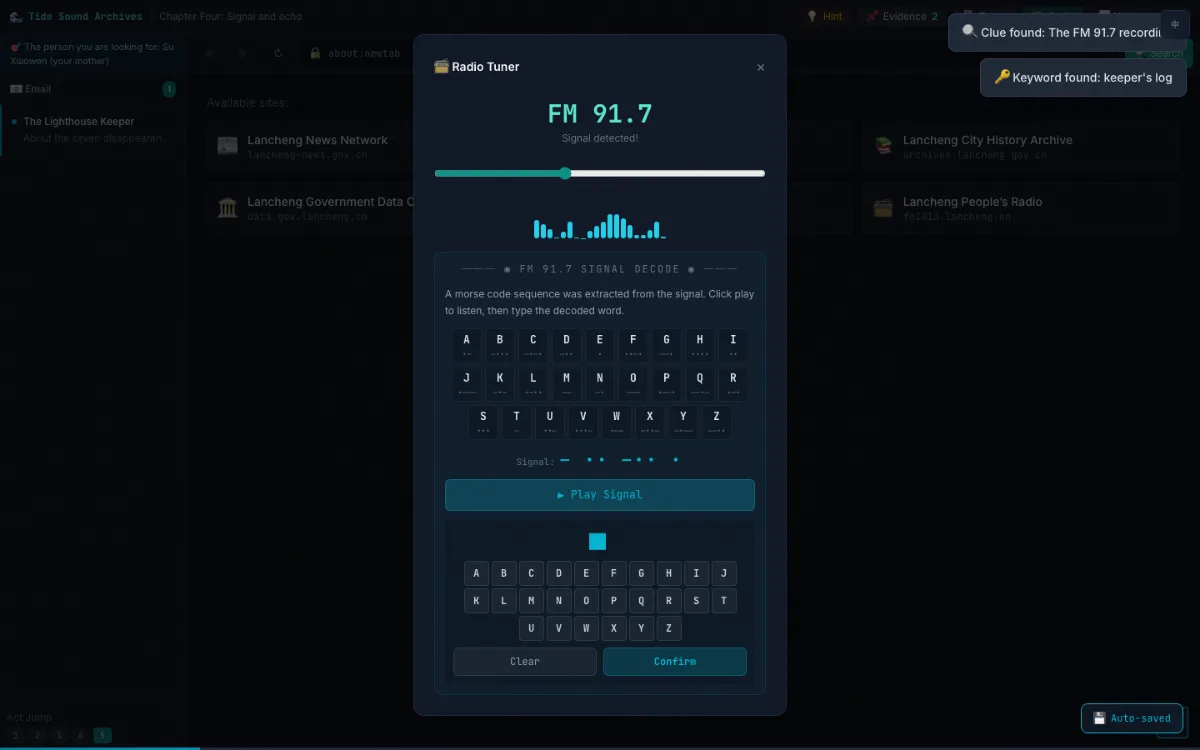
One common misread: an in-game newspaper expands the signal into “THE TIDE WILL OPEN THE DOOR. 18.7 HZ.”, but the only accepted input is TIDE. The newspaper is a second-hand report inside the story, not the answer box. Uppercase TIDE only — no lowercase, no spaces, no full sentence.
4. What actually changes after the correct answer
Click T, I, D, E, then Confirm. The success message appears, and the game remembers you solved it — refresh or come back later and it still counts.
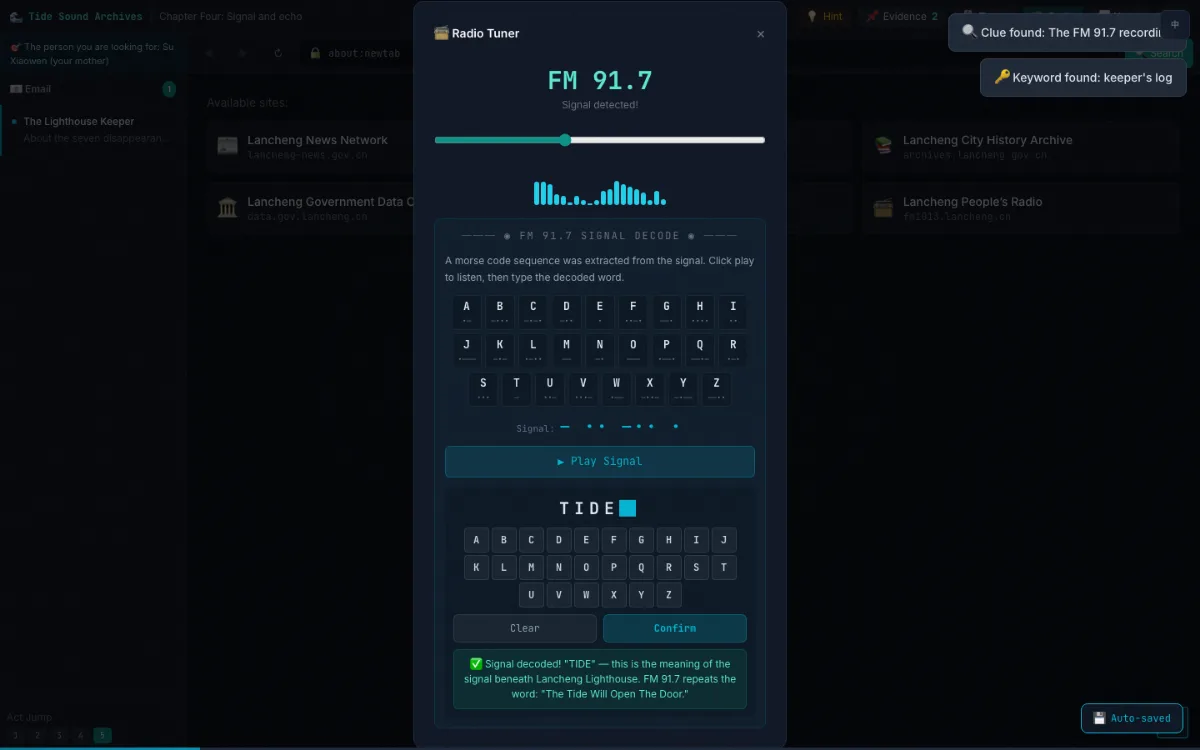
It does exactly three things: the game remembers the decode, a hidden finale option D, The Night Watch, appears, and A/B/C are left alone — nor does it replace E, The Roll Call, which needs all ten tapes.
Solving TIDE is not enough on its own. The finale also wants you to have read “The 222-Year Frequency Cycle” in the history archive. Both have to be done: decode the signal without that page and D still will not show up. E is a separate line and only counts whether all ten tapes are in, nothing to do with TIDE.
5. Why 91.7 and not 18.7
Because 18.7 Hz is infrasound, not a broadcast frequency. A forum thread in the game states it plainly: 91.7 MHz is only a shell that fits an ordinary FM radio band; the 18.7 Hz component is modulated inside the signal. A radio tuned to 91.7 and playing aloud is transmitting 18.7 Hz into the room.
That is also why the scene requires night, an ordinary radio and a pause rather than a sweep. It is not a maths puzzle that only exists on an oscilloscope; it is an action performed on a real device. 91.7 sits in an unallocated part of the band so any household radio can receive it; NBFM and 3 kHz bandwidth make it sound like data, not a station.
6. How it connects to the mother thread
The last page of Su Xiaowen’s notebook holds one sentence: “FM 91.7 — they are signalling from in there.” On TD-03 she reads the seven names, does not switch the recorder off, and in the last ten seconds uses your childhood name. Tuning here is not just solving a puzzle; it is walking the last stretch of your mother’s work again.
That is why D, The Night Watch, costs something: you stay and keep listening for Zhou Qiming. TIDE is the key, not the answer.
7. Common stuck points
- 91.7 does nothing: make sure you have reached chapter four. Tuning in chapters one to three never fires.
- TIDE solved but no D: go and read “The 222-Year Frequency Cycle” in the history archive. The signal and that page — you need both.
- Expecting TIDE to open E: it does not. E only checks whether all ten tapes are collected.
- Keyboard input does nothing: the letter grid is click-only. Clear restarts it; the cap is 12 characters.
- 91.4 / 92.0 rejected: the test is strictly less than 0.3; only 91.5–91.9 pass.
- Old guides calling 18.7 Hz a “bridge” or listing six frequencies: that was the pre-26-October-2026 setting and has been removed. This work now keeps the signal local to the lighthouse.
8. Try it yourself
- Reach chapter four, ease the tuner from 103.9 down to 91.7 and hold for about two seconds until “signal captured” appears. Then click T/I/D/E and Confirm.
- A wrong answer does not stick. Hit Clear and try again.
- All four screenshots come from that playthrough. The AI illustration at the top is labelled and is never presented as gameplay.
Changelog
- 31 October 2026: added four in-game screenshots and one labelled illustration, and wrote up the chapter-four precondition, how close to 91.7 you have to tune, what opens D and E, and the places people tend to get stuck.
- 24 July 2026: first version, documenting the FM 91.7 Morse answer and its relationship to ending D in the 26 October 2026 rewrite.