Renew for One Day
A district library closes on 30 June 2026. Return a book thirteen years overdue, and find the librarian missing from the register.
A district library closes on 30 June 2026. Return a book thirteen years overdue, and find the librarian missing from the register.
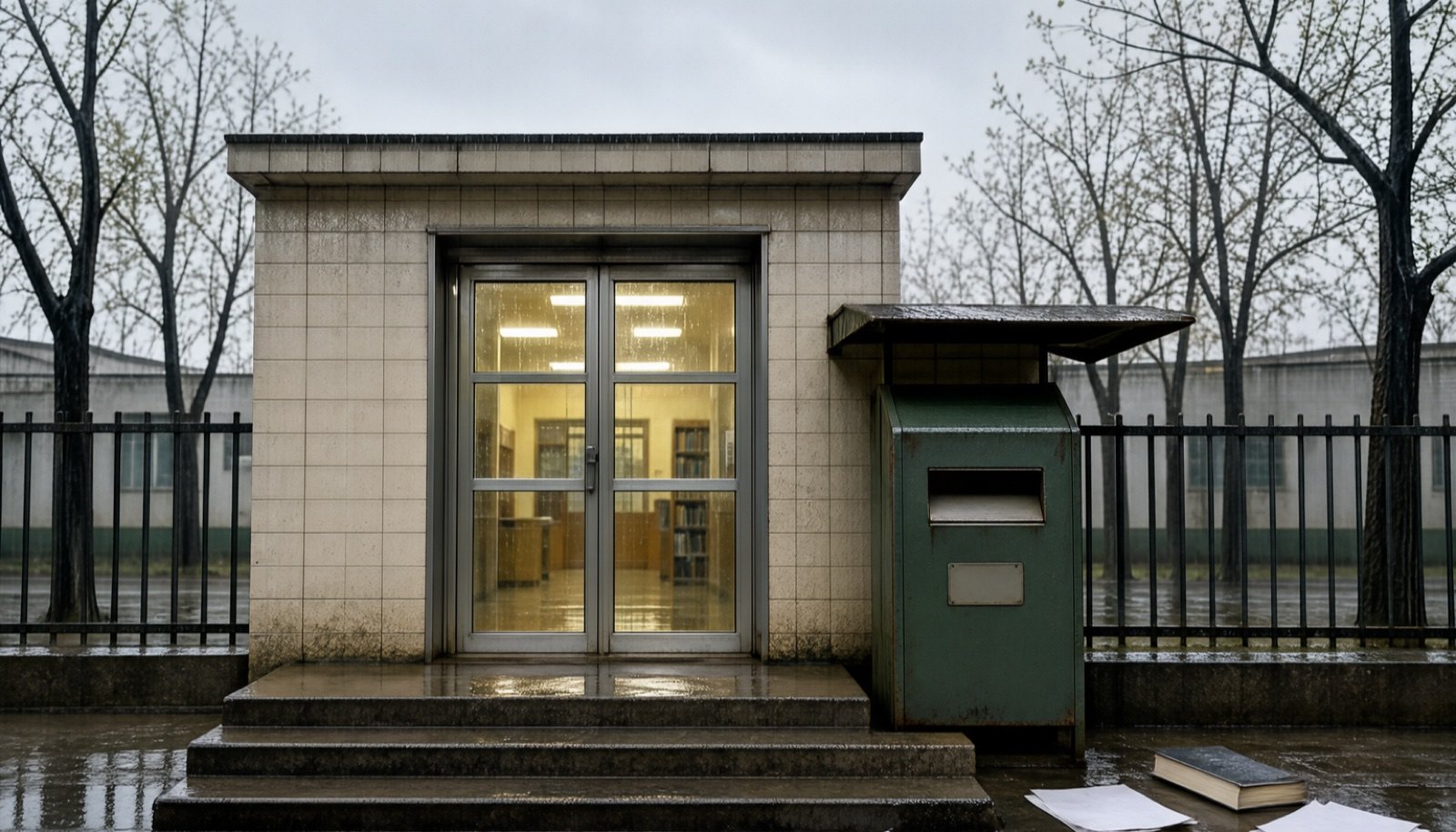
30 June 2026 is the last day the Luwan District Library will be open. You have come to return a picture book thirteen years overdue: borrowed 14 June 2013, due 14 July 2013, and still marked “not returned”. The librarian who dropped the flood gate that night and pushed six children out through the vent is missing from the staff register — but one card in the access log goes in at 23:41 every night, for thirteen years, and never comes out.
Released 2026-11-05 · Version 1.0.0 · Updated 2026-11-05
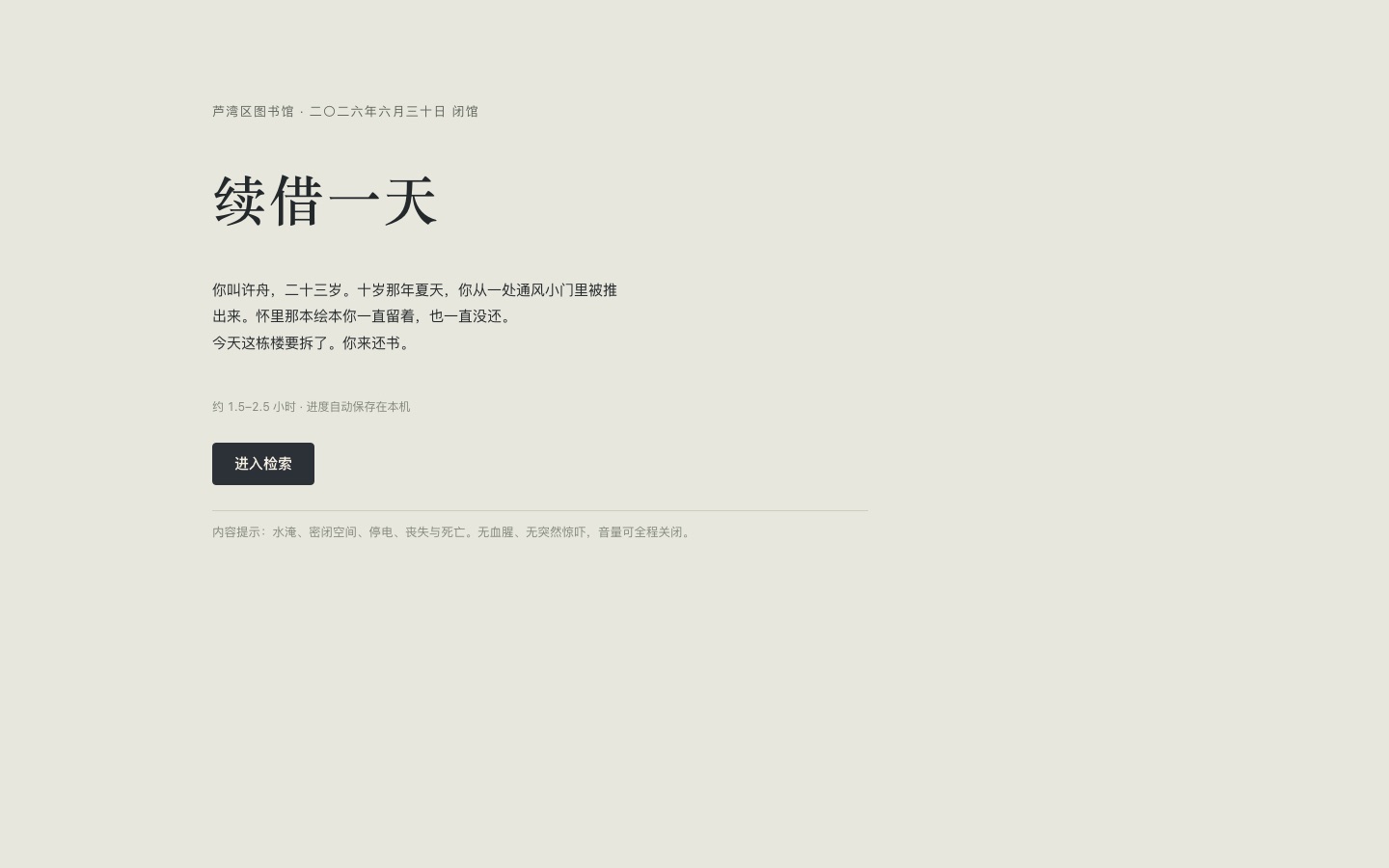
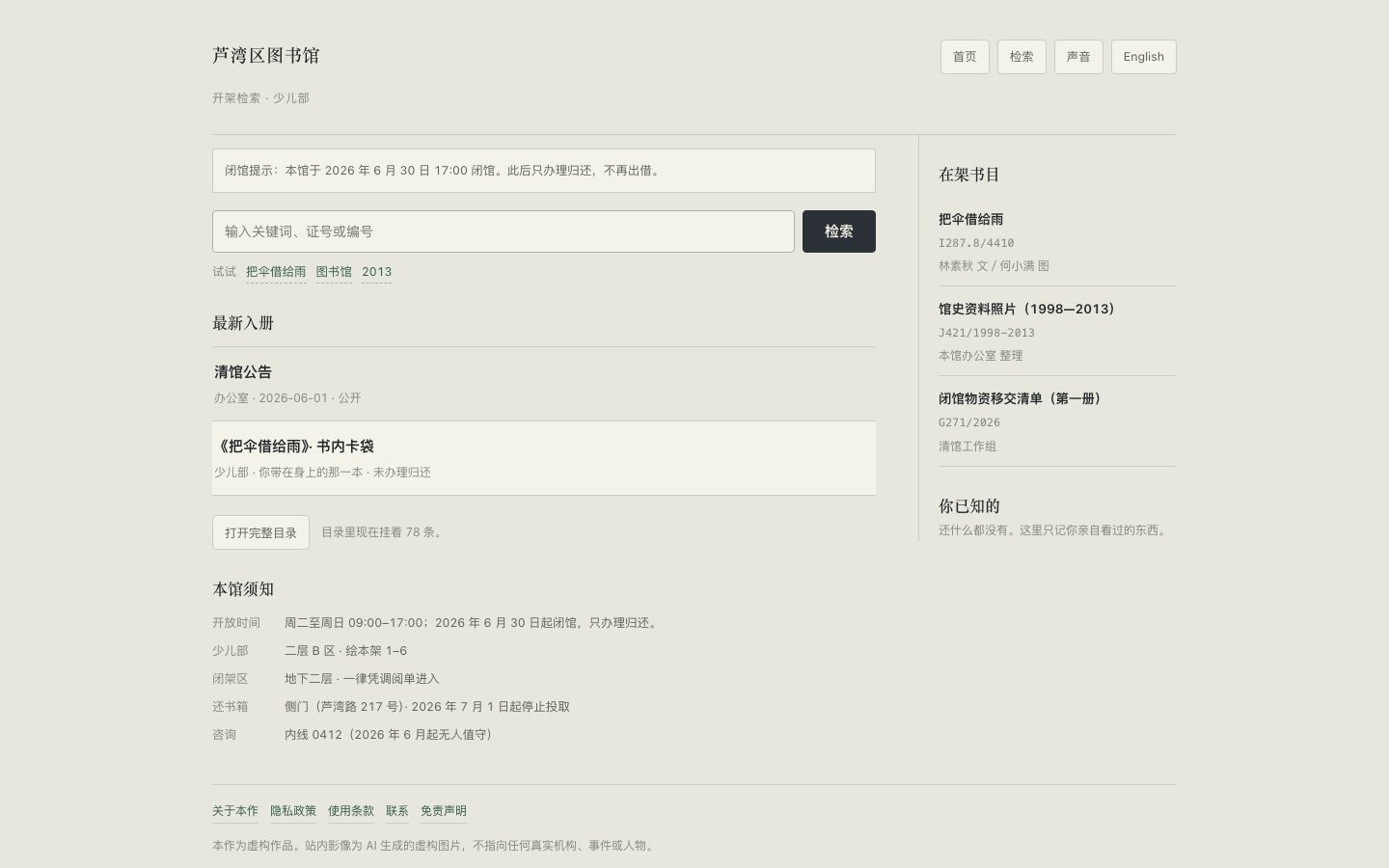
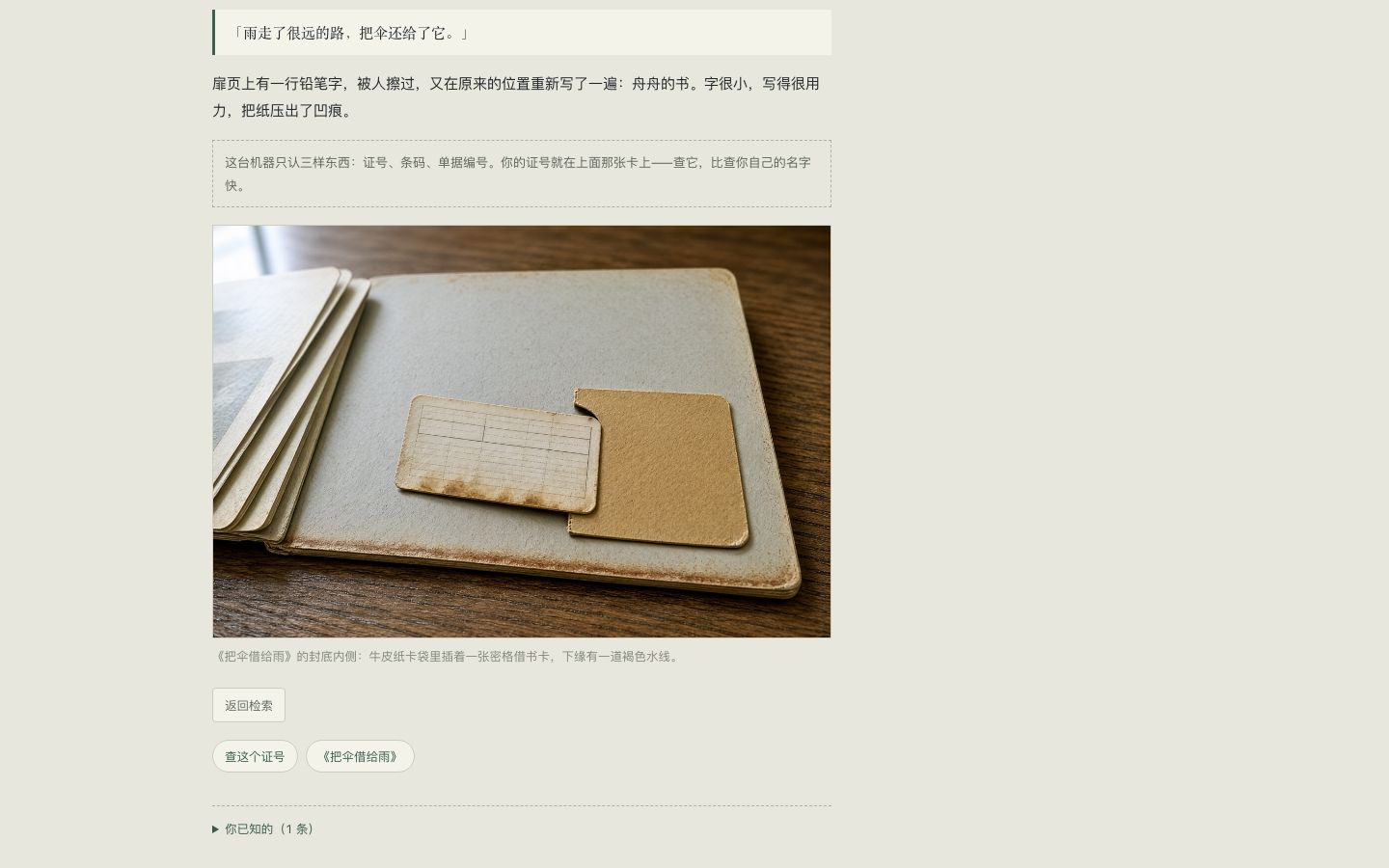
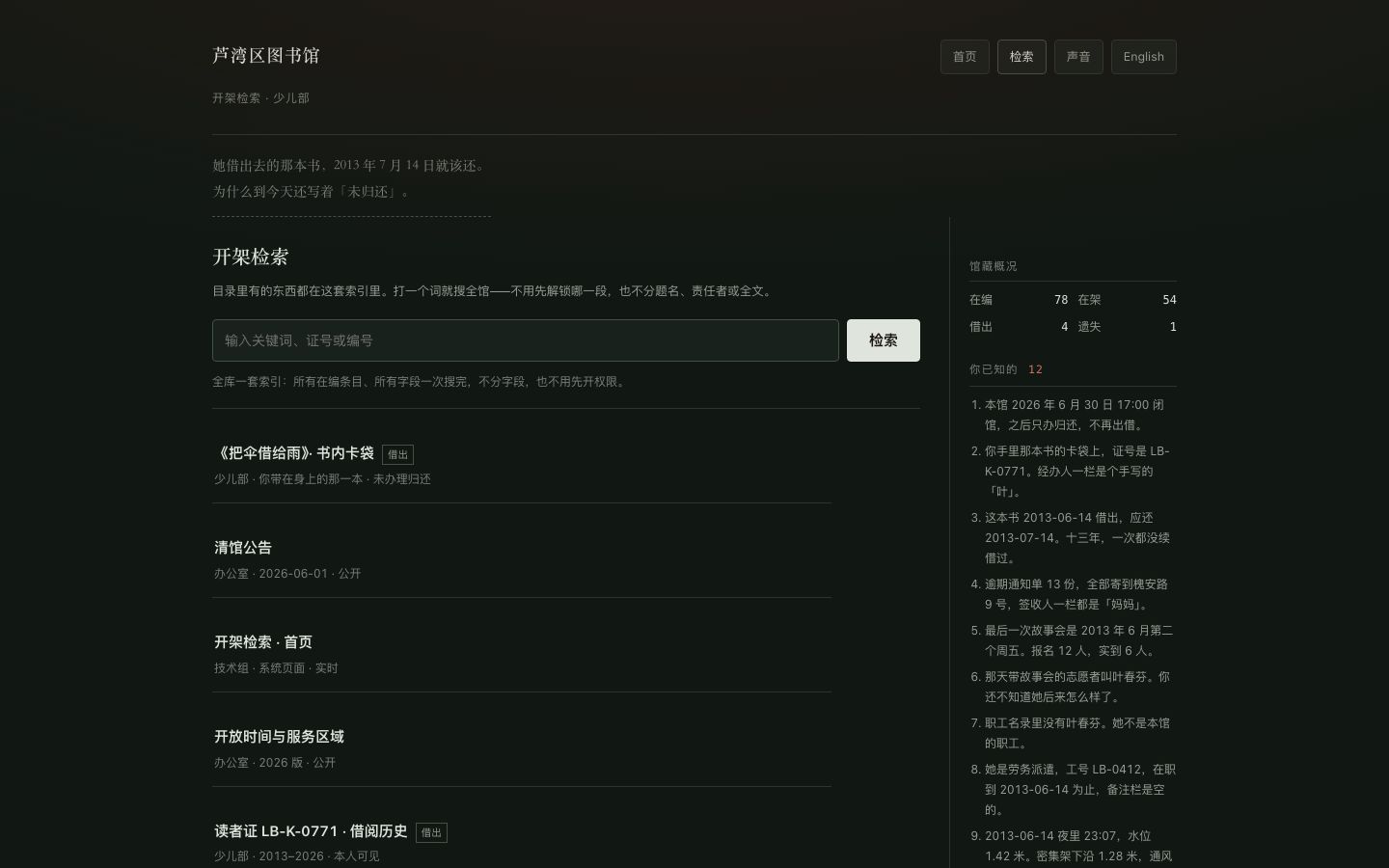
Renew for One Day is a fictional district-library website and a return that is thirteen years late. You are Xu Zhou, twenty-three. On the night in 2013 you were ten, one of six children at the summer evening story session, and the first one out through the vent. You do not remember the face; you remember a picture book pushed into your arms and the words “hold this for me”.
Thirteen years later the closing notice says the book drop stops taking returns on 1 July 2026 — so here you are at the side entrance with An Umbrella for the Rain in your hands.
There are no levels and no quest list. You read a website: notices, annual reports, rota sheets, lost property, access logs, and set the two versions of events against each other. Reading all of the text at 300 words a minute is about an hour; with the puzzles and the re-reads after each request, expect one and a half to two and a half hours.
Under the terminal sit two layers. One is the narrative: every record is in the same index from the start, no earlier page to read first. The other is twenty-six catalogue cards that are listed from the first minute, searchable by anyone, and never readable in full — they exist so that the library is real outside the story too.
Your reader-card record: issued in 2011, ending in thirteen overdue notices, all posted to your childhood address and signed for by “Mum”.
The children’s department files: the annual report, twelve photographs from the story-time wall, the ballot-box count, the volunteer rota. She came first every year; one year the vote tally is written wrong.
The lost-property register: a pair of bunny-ear slippers (a 舟 scratched inside the left one) and staff badge LB-0412 — both unclaimed.
And the staff register, a dispatch-worker pay sheet, the 2013 Safe Unit commendation list, a parent’s complaint (“why did you let the children crawl out by themselves”), a fire inspection form, the access log, thirteen years of pump run sheets, the gauge photograph, the closed-stack inventory variance sheet, her staff card K-0000, the story-session transcript, and the vent maintenance record.
And a case file of your own: thirteen lines, none of them there at the start. Each one lights up only after you have done something — read that page, obtained that slip, requested that item. It offers no conclusion; it just puts the things you have confirmed side by side until you see the line between them.
You type a number, date, count or phrase you read in the evidence, and the system answers with a business record — not a narrator praising you. Each of the eleven puzzles accepts at least two spellings (the last four digits of a card, or the name). Wrong answers never lock you out and are not counted as failures.
The terminal has one box: title, author, call number and full text in a single pass, with no field selector and no “narrow it down” — only the number of hits at that moment.
An empty result is not a dead end: it answers with “did you mean”, drawn from the whole catalogue (Chinese has no word boundaries, so the comparison is by longest common substring). Pages you have not read yet show up too, and clicking one opens it.
What is irreversible is requesting a closed-stack item. Eleven damaged items can be requested; each one turns that record permanently into what it looks like now, removes the surface version from the catalogue, and darkens the site by one more panel.
The history pages keep the old version, though: you can go back and look at the dry photograph, knowing it is wet now. That is the point of the game, not a bug.
When you are stuck the terminal surfaces a hint of its own: direction first, then a narrower term, never the answer.
A, Overdue: you do not stamp anything. At 05:40 you carry the book out of the side door and drop it in the bin. Her record still reads “not returned”; the last screen is the delivery log of thirteen notices.
B, Renewed: you stamp the date 14 June 2013 and fill the “handled by” box with your own childhood card number. One day rewinds: you are ten again, you stay twenty-four hours in the closed stacks, and you are the one who drops the gate from the inside.
C, On the Shelf, is hidden: first find the unclaimed badge in lost property, sign in with it, and stamp twice — 14 June 2013, then 14 July 2013 — to renew for one day the book she borrowed from herself.
There is no bad ending. The three differ not in winning or losing but in how far you are willing to take this; the choice cannot be undone, and to see another one there is a “start over” button on the ending screen that asks twice.
The 53 images in the game and the hero are AI-generated illustrations, not photographs; every caption and alt text says so, and so does this page. Paperwork, screens and gauges in the images are deliberately photographed so they cannot be read — the numbers and words come from the text, so an image can never contradict the answer.
Luwan District Library, Ye Chunfen, Xu Zhou, Shao Bingwen, Han Lei and every reference number, card number, date and form are fictional, and unrelated to any real library, event or person.
The game asks for no name or contact details. Progress lives only in your browser; clearing it means starting over.
The 5 acts, 52 records, 26 catalogue cards, 13 clues, 11 requestable items, 11 catalogue puzzles, 3 endings and 53 images are registered in renewal/src/data/ (records-act0–4.js, holdings.js, clues.js, closed.js, puzzles.js, endings.js, art.js); the rules for searching, requesting and stamping are in src/game/engine.js; saving is in src/game/save.js.
The 17,864 characters of prose (14,414 surface, 2,944 inner, 506 endings) are counted at build time and any single change makes the numbers disagree. Twenty assertion families run at build time: record count, per-page length floors, zero Chinese characters in English, the independence red lines, irreversibility, ending reachability and real image dimensions each have one. Two of them exist for arithmetic you can see on screen — every catalogue card must carry a readable call number and summary, and the search desk is one index for the whole library (no field selector, no filters), with every registered record falling into surface / inner / ending.
All of it was re-walked on 6 November 2026: starting from the search box on the homepage and clicking through to the closed-stack request in act 3 and the site-wide cut to dark, using only actions a player can take, at desktop and 390 wide; the four screenshots were taken from the built game the same day, and the hero is cropped from the game’s AI background and labelled as an illustration.
Do I need an account or payment?
No. It runs free in the browser and asks for no personal information.
How long does it take?
One and a half to two and a half hours. Reading all the text at 300 words a minute is about an hour; the puzzles and re-reads add half an hour to an hour.
Can I get stuck?
Every one of the eleven puzzles accepts more than one spelling; an empty search offers “did you mean”, and after a few misses the terminal surfaces a hint you can deepen. Every number you need is written on a document you can reach — the card pocket of the book you start with already carries the card number.
Is it scary?
No jump scares, no blood, no bodies. What is frightening is that the paperwork keeps running normally; the telling is quiet.
Does it work on phones?
Yes, portrait-first; record pages drop secondary columns on narrow screens.
Where is progress saved?
On this device. Reload and continue; it does not travel between devices.
How is it different from the other ARGs here?
It shares a base with One Clear Day — two worlds, and a darkening you cannot undo. But this one builds the whole search layer as a working library system: two catalogue layers (narrative records plus twenty-six cards you can never read in full), a single full-catalogue index with no field selector, matching that accepts variant spellings, and a case file that only lights up when you act. Act 1 opens six doors side by side and you choose which to pull, instead of clicking next. And beyond the requests there are three renewals and a date stamp: in the end you spend a day to buy a person one.
Open the library site — Runs on its own subdomain · progress saved on this device
Since the first version on 2026-11-05, this page records what changed in each version of this game.