Last Online is our first-party pseudo-interface ARG: eleven days after your sister vanished, her phone still reads online in the family account. 5 devices, 6 console apps, 12 puzzles, 8 unsent drafts, 3 endings, 120–180 minutes, no jump scares.
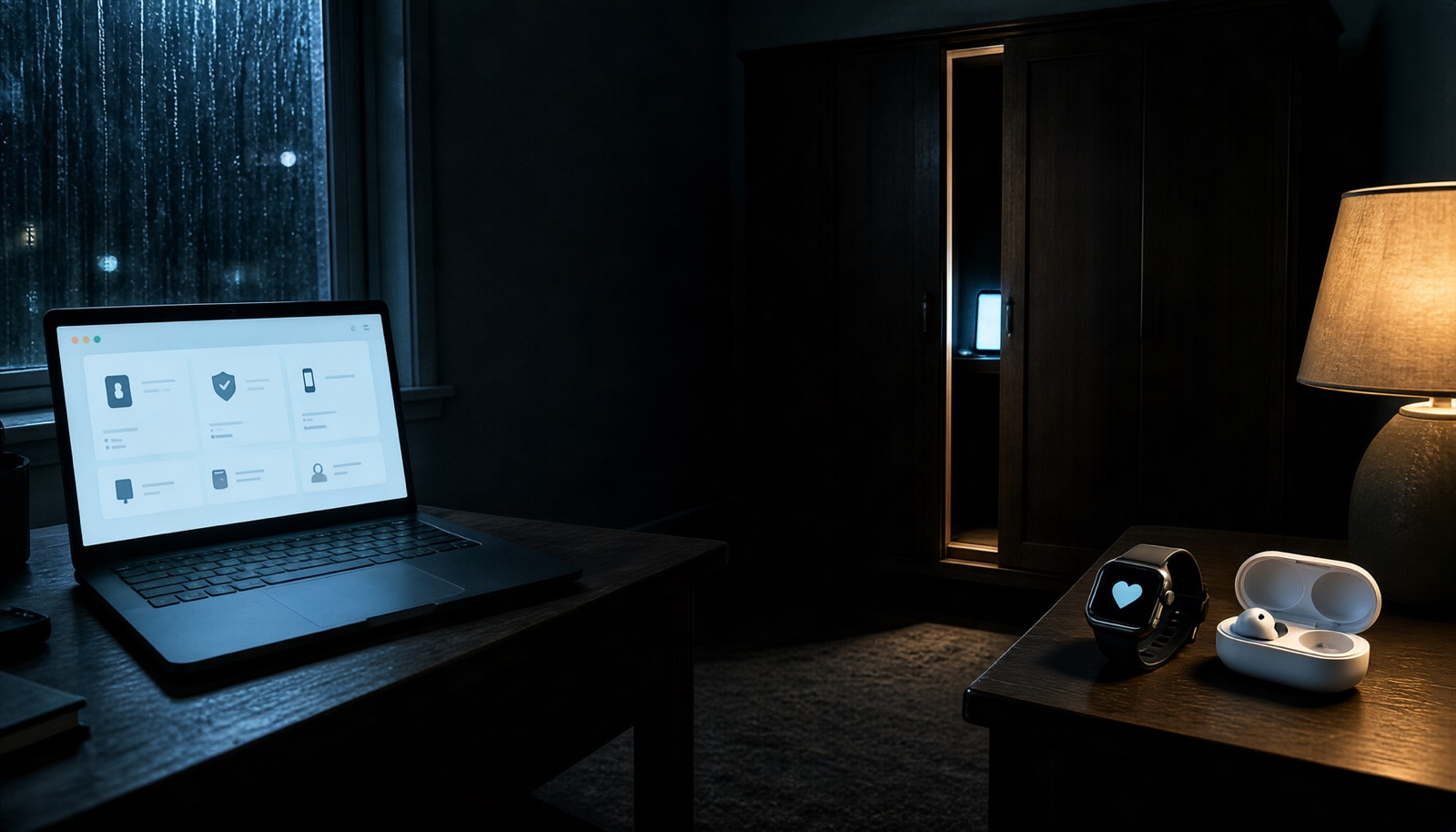
Illustration (AI-generated), not a game screenshot
Day eleven since your sister disappeared. Your mother asks you to factory-reset her old phone for resale; you press Erase and the console answers: erase failed — this device is locked by another administrator. 6 acts, 12 puzzles, 8 unsent drafts, 3 endings, 120–180 minutes; collecting all eight drafts takes about 150–210.
Acts:6
Puzzles:12
Endings:3 (one requires all eight drafts)
Unsent drafts:8, found by typing the right word into the console
Devices:5 (4 online, 1 offline)
Console apps:6, unlocked per act
Length:120–180 minutes
Difficulty:★★☆☆
Horror:No jump scares; sustained pressure
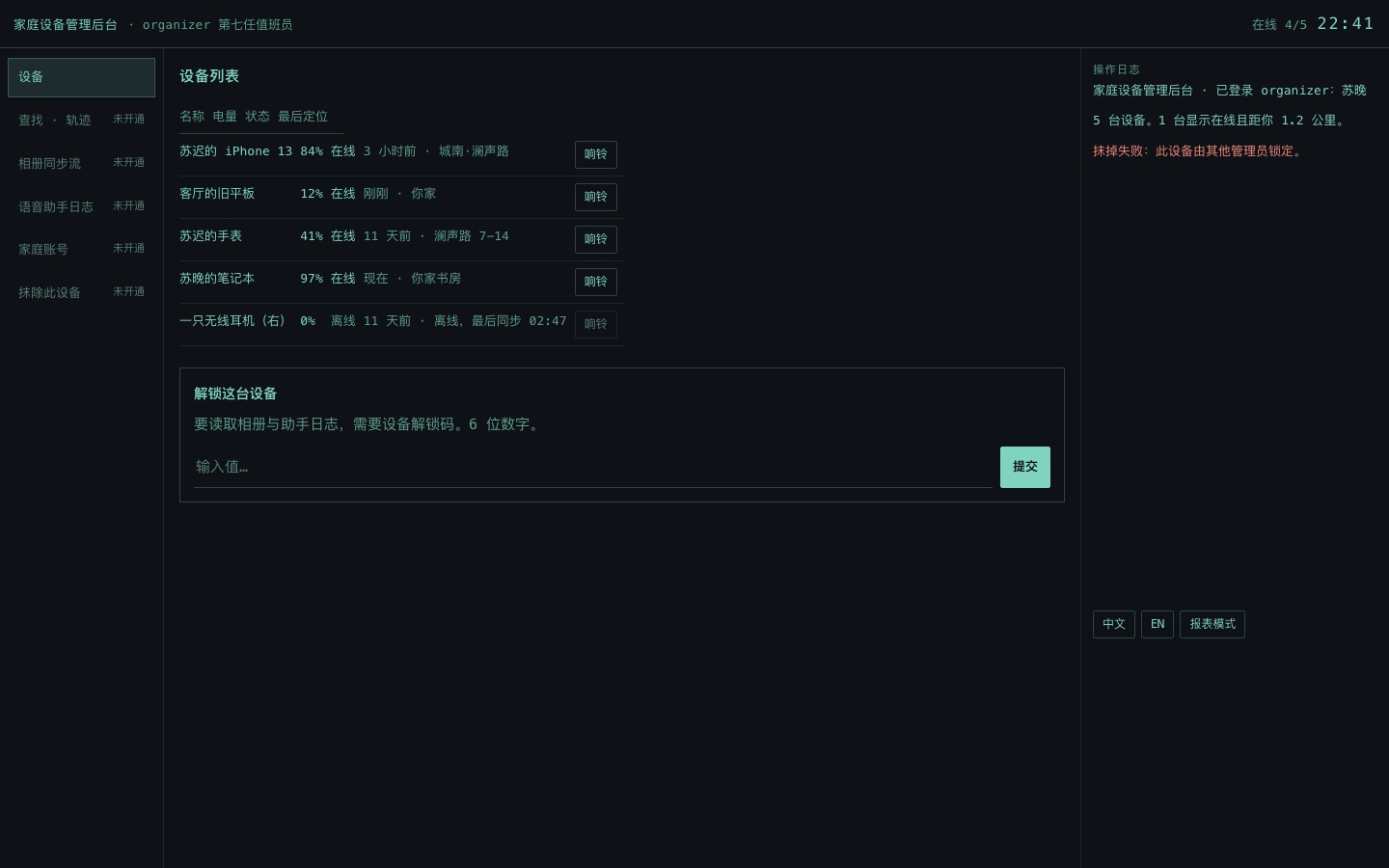
Before entry: erase failed — this device is locked by another administratorThe family device console: battery, status and last fix for five devices, with the operation log on the right
What it is
Day eleven since Su Chi disappeared. Your mother asks you to factory-reset her old phone for resale. You press Erase in the family account and the console answers: erase failed — this device is locked by another administrator.
Then you see the line: Su Chi's iPhone · online · 84% · last fix 3 hours ago · 1.2 km from you.
The whole game is one family device-management console. There is no scene to walk and no inventory; everything you can do happens inside six apps: Devices, Find · Trail, Photo Stream, Assistant Logs, Family Account, Erase This Device.
There are no jump scares. The pressure comes from the console itself: battery percentages, last-fix times, returned decibels — every number reported faithfully by the system, and you are the one who puts them together.
How to play: one console, six apps
The six apps unlock per act: act 0 gives you Devices only, each act opens one more, and Erase This Device arrives last;
Ring is the most important action: make a device ring and read the returned decibels and ambience — 63 dB is an occupied room, 3 dB is a living room with nobody in it, 41 dB is waterside, 27 dB is the empty garage behind you;
Puzzles are inputs and choices: a 6-digit unlock code, gap nights in the trail, which device is waterside, a plate number in a glass reflection, ordering, a four-digit calibration;
Before entering you sign an operator name; that line goes into the audit log and into the ending;
A wrong answer does not restart: the console only says it does not accept, with tiered hints; matching is strict, so mashing cannot reach an ending;
Progress saves locally in the browser; Chinese by default with English available.
Six acts and twelve puzzles
The twelve sit on a dependency chain: each one unlocks the app or field the next needs, so there is no route that skips ahead.
Act 0 · Takeover: unlock this device — a 6-digit code before you can read photos or assistant logs;
Act 1 · Every Night at 02:11: the gap in the trail (which nights have no fix), which one is waterside (41 dB of wind and slapping water);
Act 2 · Three Thousand Frames: the plate in the glass (one frame in a three-thousand-photo stream), the impossible one (a device at 0% cannot take a photo);
Act 3 · False Wake: at 41 seconds (three knocks inside a six-second recording), put them back into one night (ordering four false-wake clips);
Act 4 · The Second Admin: the third administrator (who is the supervisor in the family account), the four-digit calibration;
Act 5 · 1.2 Kilometres: 1.2 kilometres (what the last fix distance means), before it is erased, wipe it or don't.
Returned decibels: the testimony of this game
Five devices, five returns. Su Chi's iPhone returns 63 dB with fabric rustle and footsteps — an occupied room. The old living-room tablet returns 3 dB, dead silence, not a living room with people in it. Su Chi's watch returns 41 dB with rhythmic wind and slapping water — waterside. Su Wan's laptop returns 27 dB with a short echo: the empty garage behind you.
The fifth returns nothing: one wireless earbud (right), battery 0, offline for eleven days, last sync 02:47.
The decibels are not decoration. Which device is waterside, which is in an occupied room, which is nowhere near where it should be — all of it follows from these numbers and the ambience notes. The system does not explain; it reports.
That is also what separates it from hidden-object puzzles: the evidence is telemetry, not pixels.
Three names and a device that should not be online
Three identities recur in the console: organizer (you, Su Wan), supervisor (your mother), and a second administrator who should not exist. After you revoke the supervisor, the system quietly adds it back once.
Su Chi's iPhone is online at 84% with a fix three hours old — though it should be in an evidence bag, or nowhere at all. The old tablet on the top shelf of the wardrobe reads 12% and has sat in that cupboard for eleven years, and it keeps ringing.
The game never tells you who operates that phone. It only opens the audit log: who signed in, who locked, who revoked, who was added back. The reader draws the conclusion.
This is where the pressure of a disappearance story lives: no ghost, only a device that should not be online and one line — erase failed.
Eight unsent drafts
Su Chi otherwise exists in this game only inside logs and footage. The eight drafts let her speak: osmanthus cakes by the alley, a last bus that changed its timetable, an earbud with only the left side left, a workbook never returned, a promised trip to the sea, a key under a flowerpot, an apology, and what the six-second recording was really trying to say.
Type the matching word into the console input and the draft surfaces in the Unsent drafts panel; each comes with a snapshot, unlocks with progress, and when you are stuck the panel names the next word.
Collect all eight and the final choice gains a third button — send them.
Three endings
The final question has no right answer: every button ends the night, and your name goes on whichever you press.
None is a good ending. In A you take over the device; in B you remove your sister from the family with your own hands; in C nothing is fixed — you only let someone who could not finish speaking finish. The game hands you the choice and refuses to judge it for you.
Ending A · Follow It: find the device and keep going. The tablet on the top shelf reads 12%, its rubber seal brittle; you turn every device in the family account off except your own — because after you revoked the supervisor, the system added it back once. You become the administrator who stays online;
Ending B · Silence: press factory reset. The bar takes four minutes and twelve seconds; the tablet stops ringing, the watch's 41 dB stops, and the earbud you never found changes from offline to removed. The last log line: DEVICE UNBOUND · Su Chi · executed by organizer.
Ending C · Send It: you lay the eight drafts out by time and send them one by one. None of the recipients exist any more, or ever did; the last goes to the tablet in the wardrobe, addressed to Su Chi. The bar takes six seconds, and three knocks come from the living room, exactly as in the recording. Your mother listens from the doorway, then says: that osmanthus cake place — I'll go tomorrow.
Where players get stuck
The unlock code is six digits and lives in a field on the Devices page, not in the photo stream;
The trail gap counts nights with no fix, not nights with one;
The waterside question reads the ambience note, not the battery; the wind-and-water return appears on exactly one device;
The ordering puzzle follows timestamps and wake reasons, not clip lengths;
The four-digit calibration needs the third administrator identified first; reversed, it keeps refusing;
Read “before it is erased” before the final choice, or you will not feel the weight of the two buttons.
Why it is worth an evening
It turns the dullest interface there is — a device management console — into the tensest narrative space: every status line is testimony, every ring is a question.
None of the twelve puzzles asks for reflexes; the obstacle is patience with telemetry and logs. Most of the 120–180 minutes is you comparing numbers.
Both endings leave a tail: A's “the system added it back once”, B's “executed by organizer”. After finishing you will reopen the console and read the log again.
If the pressure of a disappearance story is too much: there are no jump scares, but the whole night is that quiet kind of weight, and the landing page says so.
How it sits with our other games
It is listed with Unclaimed and Changming Inn: Night Shift Rules in the site's ARG catalogue; saves, language and progress are independent, and nothing needs to be played first.
Place names like Chengnan and Lansheng Road appear in other games here too; a deliberate shared geography, not a prerequisite.
The full walkthrough states every answer and its basis; on a first run, use it only when stuck.
Recent changes
2026-10-18: answer matching no longer accepts “contains and length within 4”, so mashing cannot reach an ending; share images standardised at 1200×630 and compressed;
2026-10-17: the trust page's last-updated date follows the actual body revision; the sitemap no longer claims a lastmod without a source;
2026-10-16: trust pages gained a content-rating note (disappearance subject, sustained pressure) and a unified credit; new trust-rating check script.
How the numbers on this page are checked
Six acts, twelve puzzles, three endings and eight drafts come from the entry counts in acts.js, puzzles.js and drafts.js; five devices and six apps from world.js and acts.js; 120–180 minutes, ★★☆☆ and “no jump scares, sustained pressure” from the game's landing page.
The returned decibels (63 / 3 / 41 / 27 dB and no response) come from the device data in world.js; both screenshots were taken from the running game on 2026-10-18. The hero image is an AI-generated illustration, not a game screenshot, labelled at the top of the page.
If a number here disagrees with the game, the game is right; tell us in the changelog and we will fix it.
Who it is for
For players who like reading logs, comparing numbers and accepting quiet pressure; and for anyone who enjoys pseudo-interfaces and device simulation.
Not for players wanting action and immediate feedback, and not for those who cannot take a disappearance subject — the entire tension rests on “a person is gone, the device is not”.
FAQ
Do I need an account or payment? No. It runs in the browser, free, with no account or in-app purchases; the operator name you enter stays on this machine.
Is there horror content? No jump scares. The landing page states “no jump scares; sustained pressure”; the subject is disappearance and family, and the pressure is the quiet kind.
How long is a run? 120–180 minutes. One run reaches one ending; replay or load a save for the other.
Where is progress saved? Locally in the browser. Refresh or close and continue; it does not sync across devices, and clearing site data restarts.
What if I am stuck? The console gives tiered hints; matching is strict, so go back to the fields and logs rather than trying spelling variants.
Can I switch to English? Yes; the console and logs are fully translated, and the signature and ending text follow the language.
What if it will not open? Try a current Chrome, Edge or Firefox. If it still fails, email contact@gamestrategists.com with your device and browser version.
Sign in to the console — Runs on its own subdomain · progress saved locally · Chinese and English