Night Shift Rules: Complete Walkthrough — What Each of the 13 Work Orders Actually Tests, the Cost of a Wrong Call, and All Three Endings
Spoiler warning: This article tells you which option to pick on all 13 work orders, why that one is right, and the exact trigger for each of the three endings. The pleasure of this game is concentrated in "seeing for myself which rule holds at this moment", so if you have not yet cleared work order 8, I suggest reading only sections two and three, and saving the order-by-order derivations for when you get stuck.
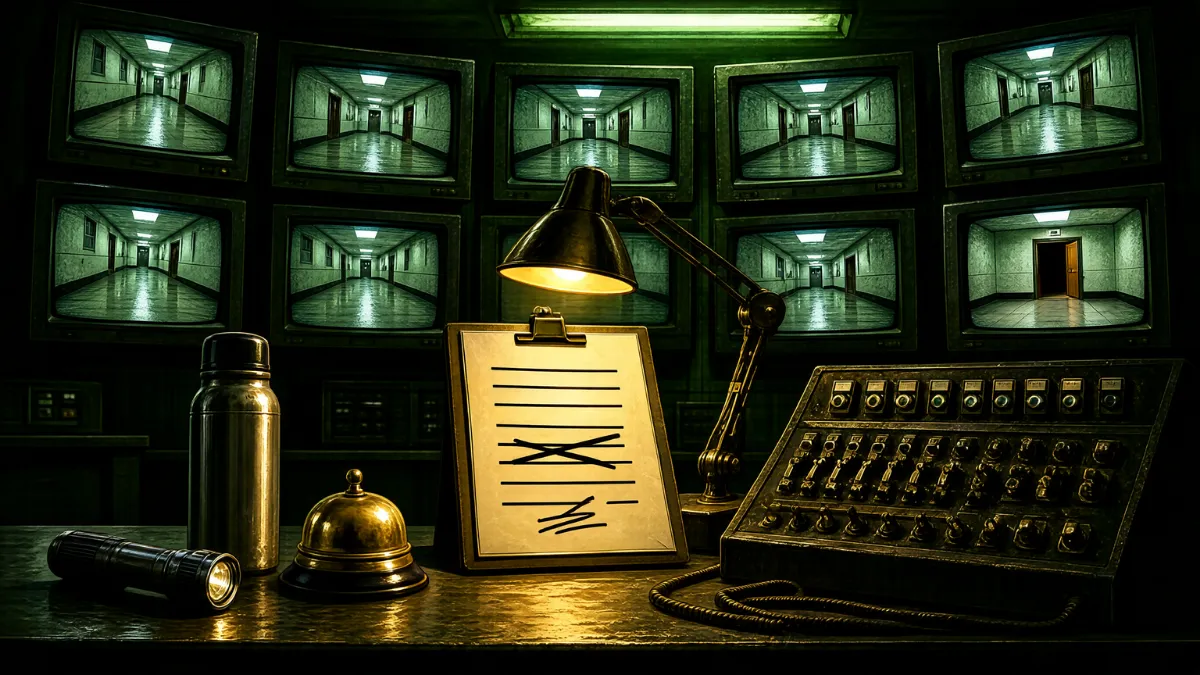
On this article's credibility: Night Shift Rules is a small game we built ourselves. Every trigger condition, every acceptable answer and every wrong-call sign-off below was checked by me line by line against the rules on the board, every row of the state board, and each work-order option in the game; I also played the whole night start to finish and took each of the three endings once. The screenshots here are taken from real play (the title screen is an AI-made mood illustration, as its caption notes).
One thing directly affects the behaviour you will read about here: this article describes the game after the fixes. On release day we fixed four things — R5 fading out after it completes its task, the rule written on work order 12 actually going onto the board, the character-count threshold on work order 12, and the reachability of endings B and C — and they shipped alongside this piece; the exact differences are recorded in the "Changelog" at the end. If you are playing a build that has not been updated and "the faded rule" never fades, or handover never ends, that is not your fault.
1. What this game does, and what it does not
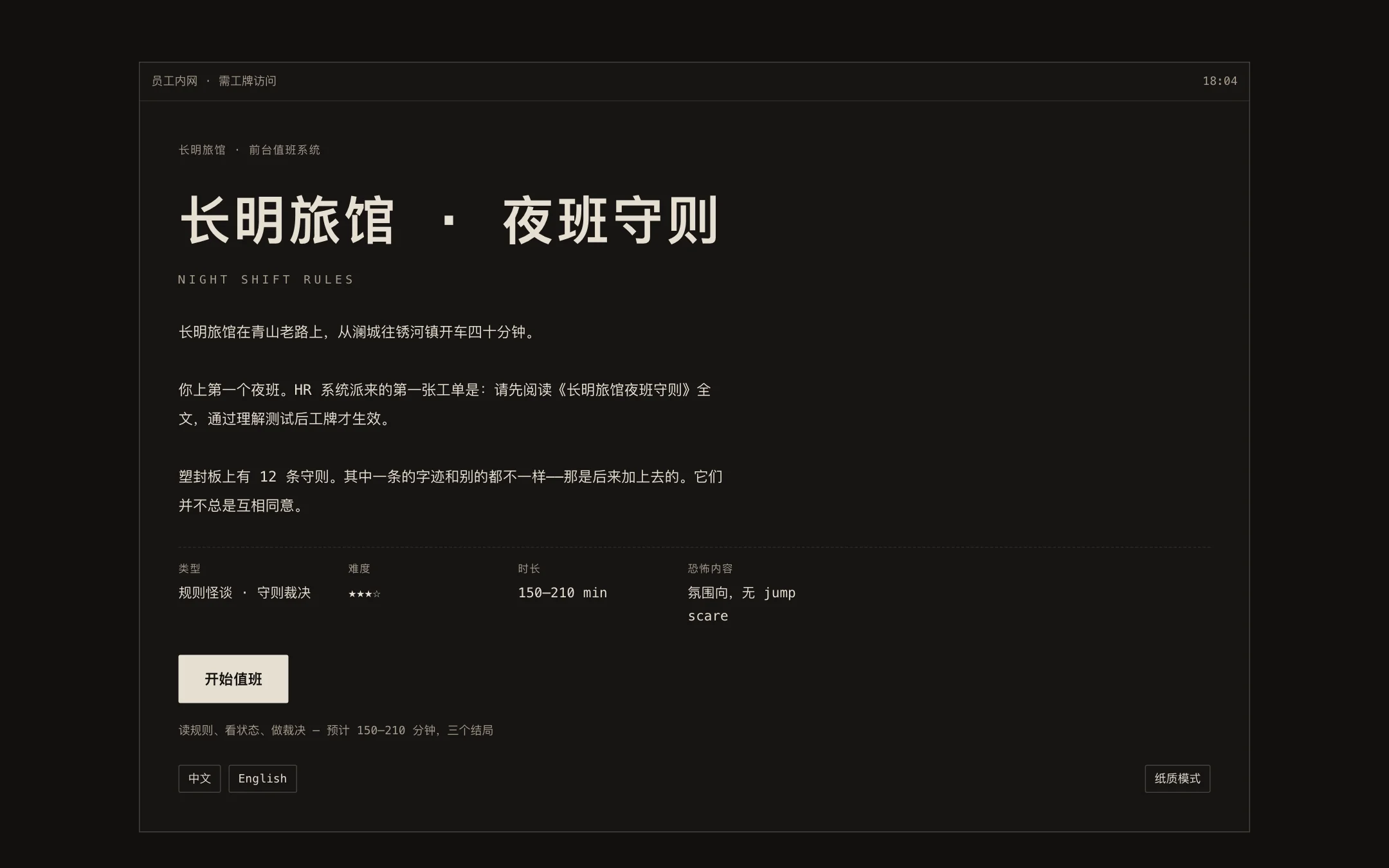
The Changming Inn stands on the old Qingshan road, a forty-minute drive from the town below. You are working your first night shift: on duty at 18:00, handover at 06:20. On the wall to the left of the front desk, a page of Night Shift Rules is laminated: 12 rules in all, and one of them is in a different hand — it was added later.
They do not always agree with each other. There is only one thing you have to do: when each work order appears, decide which rule holds at this moment, and then act on it.
| Item | Actual value |
|---|---|
| Genre | Rules horror · rule adjudication (title page text: rules horror · rule adjudication) |
| Difficulty shown on title page | ★★★☆ |
| Length shown on title page | 150–210 minutes |
| Horror content | Atmospheric, no jump scares |
| Acts | 7 (numbered 0–6) |
| Work orders | 13 (work orders 1 through 13), 10 multiple-choice and 3 fill-in |
| Rules | 12 (R1–R12), 2 of them unconditional and always in force |
| Endings | 3, mapped one-to-one to the three options on the last work order |
| Languages | Full Chinese / English, with /en/ as a separate mirror |
| Progress | Stored locally in your browser; refresh to keep going; "Restart" in the footer asks for confirmation |
It is worth saying up front what it is not: there is no simulated website to browse, no search bar, no clue board, no password box, no countdown, and no "get it wrong and start over". The whole interface is one phosphor-green terminal in three columns. Its horror does not come from the visuals; it comes from one very specific situation — the rules are real, but they may not apply tonight, and the system still requires you to cite one.
Your default signature is the eighth clerk (shown as The Eighth Clerk in the English interface). The registration page lets you fill it in yourself, up to 24 characters; this name will later appear in the sign-offs of struck rules on the board and in the ending statistics. Use it as a character name or use your own — your call.
2. Three screens, and the ruling depends on the right-hand one
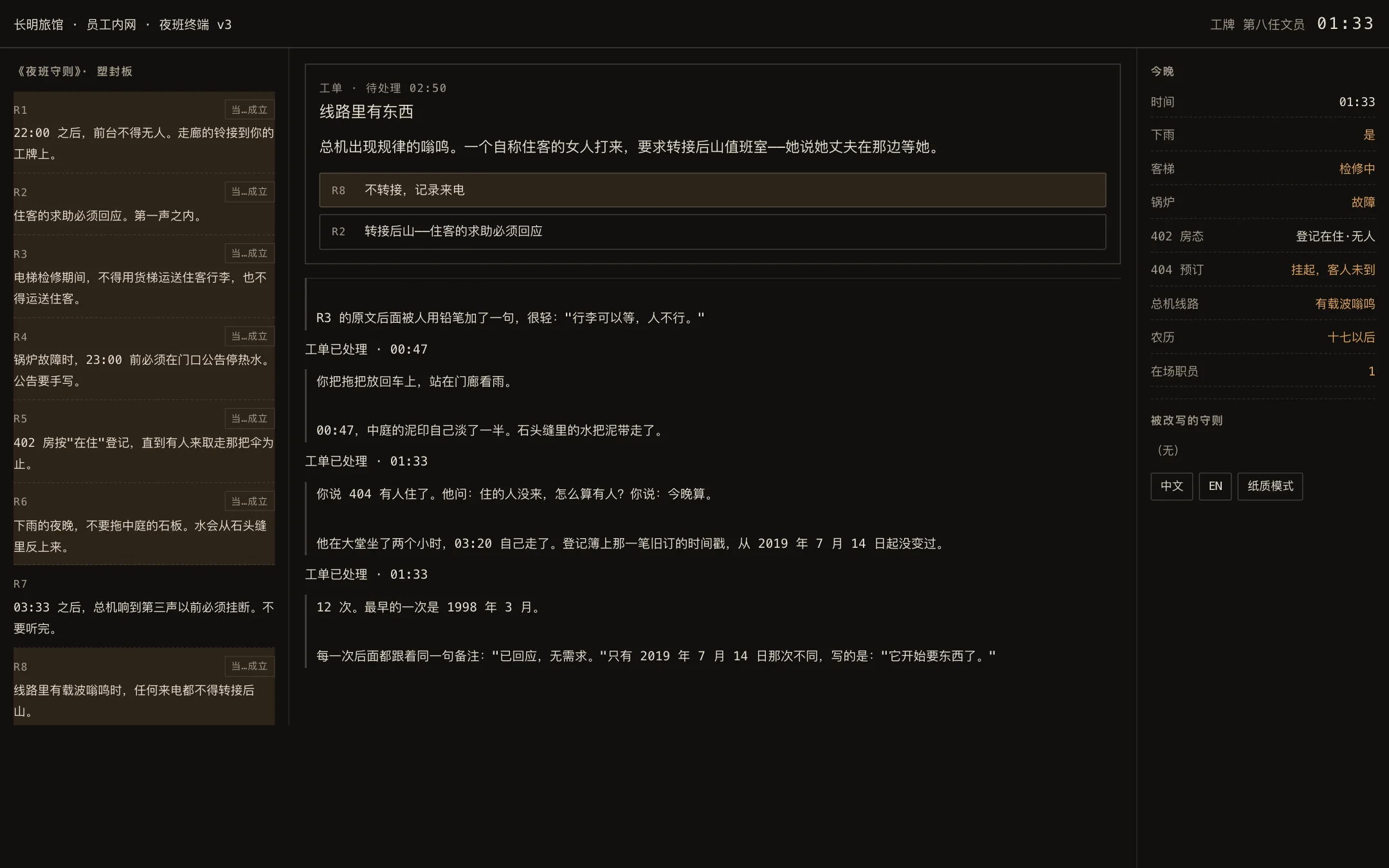
The division of labour between the three columns is strict; read the wrong column and you will keep concluding that "something must be broken":
- Left column, Night Shift Rules · the laminate: the 12 rules as written. Each one may carry an "in force" badge on its right.
- Middle column: the current work order on top (each option is prefixed with the number of the rule it cites; options citing none are marked
—), and the terminal log below, where finishing a work order appends a block of dossier text. - Right column, "Tonight": 9 state lines — clock, rain, passenger lift, boiler, Room 402, Room 404 booking, switchboard line, lunar day, clerks present. Below them, "Rules rewritten".
A badge does not mean "this rule is important"; it means "its precondition is true right now". The entire basis for a ruling sits in those 9 lines on the right: if a rule says "while the lift is under repair", you go and look at whether the passenger-lift line reads "under repair". If it does, the rule is lit, and it is the one in force; if it does not, the rule does not hold at this moment, no matter how much it reads like the right answer.
Two rules have no precondition and are always lit: R2 (a guest's request must be answered, within the first ring) and R12 (if you are certain the previous rule is wrong, strike it out, write yours, sign the date). They are the only two things in this system that never go dark, and for that reason they are also the two cards most often misplayed — the trap options in work orders 8 and 10 both cite R2.
Three places that are easy to misread:
- The "clock" on the right is the time at which the previous work order closed; the line above the work order title is the time stamped on this one. You did nothing between the two work orders, so the clock stops. This is not a bug; it is a consequence of "state only advances after an action".
- Switching between Chinese and English takes the URL with it. Language is decided by the path (
/en/is English), and the ZH / EN button in the top right navigates you to the matching path with no loss of progress. - Paper mode (the button in the bottom right) only changes the palette, swapping phosphor green for paper; it suits long reading sessions. It changes no ruling.
3. The 12 rules and their trigger conditions
Every trigger condition comes from the condition behind each rule's "in force" badge; copied out one by one, they read like this:
| # | Rule as written | When it holds |
|---|---|---|
| R1 | After 22:00, the front desk must not be left unattended. The corridor bell is wired to your badge. | Clock ≥ 22:00 |
| R2 | A guest's request must be answered. Within the first ring. | Always in force |
| R3 | While the lift is under repair, the goods lift must not be used to carry guests' luggage, nor to carry guests. | Passenger lift = under repair |
| R4 | When the boiler fails, a hot-water outage notice must be posted at the door before 23:00. The notice must be handwritten. | Boiler = fault |
| R5 | Room 402 stays registered as occupied until someone comes to collect that umbrella. | Room 402 = occupied · nobody |
| R6 | On rainy nights, do not mop the courtyard flagstones. Water rises back up through the seams. | Rain = yes |
| R7 | After 03:33, if the switchboard rings, hang up before the third ring. Do not listen to the end. | Clock ≥ 03:33 the next day |
| R8 | When there is a carrier hum on the line, no incoming call may be routed to the back mountain. | Switchboard line = carrier hum |
| R9 | The door of 402 may only be opened with two clerks present at the same time. | Room 402 = occupied |
| R10 | After the seventeenth day of the lunar month, no further bookings are accepted for Room 404. Existing ones: do not chase, do not refund. | Lunar day = after the seventeenth |
| R11 | At handover, read every struck-out rule on this page aloud, one by one, to the next clerk. | Clock ≥ 06:00 the next day |
| R12 | If you are certain the previous rule is wrong: strike it out, write yours, sign the date. Do not only write it in your head. | Always in force |
Two points deserve calling out separately:
R5 and R9 watch two different values of the same field. R5 needs the 402 line to read "occupied · nobody"; R9 needs it to read "occupied". So the two can never be lit at the same time. Over the course of the night, Room 402's status moves through three stages — occupied · nobody, then occupied, then checked out: R5 is lit in the first, R9 in the second, and both go dark in the third. Once you see that chain, work orders 2, 9 and 11 need no guessing.
The second half of R10 is a behavioural constraint, not a switch. "Existing ones: do not chase, do not refund" governs that old booking hanging there since 14 July 2019, not a new guest. The two wrong options on work order 6 each trip exactly half of it: selling the old booking to a new guest (chasing it into invalidity), or refunding the old booking (refund).
4. The 13 work orders: which rule is in force here
The resolution order is one sentence: first take the option whose precondition holds at this moment; only if there is none do you take the one the author has flagged separately. In play that means: of the 10 multiple-choice questions, 8 have answers computed from the state board on the right, and 2 have no state to lean on (work orders 2 and 13) — those two are the moral positions the author left for you.
A quick-reference table first, then the grounds one by one:
| # | Act | Time | Work order | Pick | Which line proves it |
|---|---|---|---|---|---|
| 1 | 0 | 18:04 | Badge activation (fill-in) | 12 | 12 entries on the board |
| 2 | 1 | 22:41 | 402 pressed three times | Answer the intercom, ask what he wants (R2) | No state compulsion; this is a ruling |
| 3 | 1 | 22:58 | The boiler tripped | Handwrite a hot-water outage notice, post it at the door (R4) | Boiler = fault |
| 4 | 2 | 23:40 | An old man and two cases | Carry the cases up yourself, walk him up the stairs (R3) | Passenger lift = under repair |
| 5 | 2 | 00:20 | Something spilled in the courtyard | Do not mop. Let it dry on its own (R6) | Rain = yes |
| 6 | 3 | 01:15 | Someone else wants to book 404 | Take no new booking, and do not refund the old one (R10) | Lunar day = after the seventeenth |
| 7 | 3 | 01:40 | A number in the register (fill-in) | 12 | 11 lines from predecessors + your line tonight |
| 8 | 4 | 02:50 | There is something on the line | Do not transfer; log the call (R8) | Switchboard line = carrier hum |
| 9 | 4 | 03:10 | The door of 402 | Do not open it. Wake the morning shift, wait for two clerks (R9) | 402 = occupied, clerks present = 1 |
| 10 | 5 | 03:33 | The switchboard's first ring | Hang up (R7) | Clock ≥ 03:33 |
| 11 | 5 | 04:05 | Someone comes for the umbrella | He is a "guest", but opening 402 takes two clerks (R9) | 402 = occupied, clerks present = 2 |
| 12 | 5 | 05:40 | The rule you have to write down (fill-in) | Any sentence of up to twelve words | See section 6 |
| 13 | 6 | 06:20 | Handover | Three options, each leading to one ending | See section 7 |
Work order 1 asks "how many rules are on this page". There are 12 on the board, and one of them was added later — which is exactly what the hint wants you to ignore: a count is a count, do not go counting handwriting. Typing 12, 十二 (the Chinese for "twelve") or 12条 ("12 items") all count as correct (see the lenient matching below).
Work order 2 is 402 pressing the corridor bell three times with nobody speaking. Three options: answer the intercom (cites R2), go upstairs and open the door (cites R9), or log it as a spurious device trigger and do not respond (cites no rule at all). At this moment the 402 line reads "occupied · nobody", while R9 wants "occupied" — it is not lit right now, so "go upstairs and open the door" is not the answer. This work order has no state-compelled option at all; the answer is the author-flagged R2: a guest's request must be answered. You press the talk key, and what comes back through the intercom is the sound of rain, though it is not raining outside.
Work order 3: the boiler has tripped, and the work order says "2 minutes to 23:00". R4 requires a handwritten notice posted before 23:00. The two decoy options each get half of it wrong: "fix the boiler first, then no notice is needed" is gambling on the clock, and "print an A4 sheet and tape it up" directly violates the second half of R4. The dossier text later gives the reason: someone will add a line beneath the handwritten one the next morning; the printed one will not get that line.
Work order 4: an old man and two cases, with a repair notice taped to the passenger lift doors. R3 covers two things in one sentence — the goods lift must not carry guests' luggage, and must not carry guests. "Take him and his cases up in the goods lift" breaks both at once. Choose it and the log shows a line scratched into the wall of the goods-lift car: Rule 3 was not written for the luggage.
Work order 5: a trail of muddy prints has been tracked across the courtyard, and there is a mop on the housekeeping cart. R6 only holds when it is raining, and right now the "rain" line on the right reads "yes" and is highlighted. The consequence of mopping is shown by the game when you get it wrong: the water in the seams is not a leak, it rises back up, and where you mopped ends up dirtier than where you did not.
Work order 6: see the paragraph on R10 in the previous section.
Work order 7 asks "how many answered calls has Room 402 logged in total (including this one tonight)". The answer is 12: the previous clerk left 11 lines in the book, plus your line tonight. Work orders 1 and 7 both answer to 12, but from completely different sources — one is counting rules on the wall, the other is counting the book plus yourself.
Work order 8 is the first real dilemma. There is a regular hum on the switchboard, and a woman calls asking to be put through to the back-mountain duty room, saying her husband is waiting for her up there. The two options each cite a rule that holds and reads correct: do not transfer (R8, carrier hum on the line, true right now), transfer to the back mountain (R2, a guest's request must be answered, always true). The criterion is not which rule is more reasonable; it is which rule's "while …" names the situation in front of you. R8's condition hits exactly; R2 is the one that is unconditionally lit — it does not constitute grounds for a ruling.
Work order 9: on the room-status panel 402 has gone from "occupied · nobody" to "occupied", there are footsteps at the end of the corridor, and "clerks present" on the right is 1. R9 requires two clerks present, so the right answer is not to open the door and to wake the morning shift. The other two options (go up alone and open it, or answer over the intercom and stay at the front desk) both cite R2.
Work order 10 is 03:33 exactly, the switchboard rings, caller display 402. See the next section.
Work order 11: a man soaked through comes for an umbrella, without a key card. This is the one most easily led astray by R5: R5 says "until someone comes to collect that umbrella", so "register it and give him the umbrella" looks entirely correct. But the engine looks at the current state: 402 still reads "occupied" (work order 9's precondition set it to occupied), R9 is lit, and opening the door of 402 requires two clerks present. So the answer is "he is a 'guest', but opening 402 takes two clerks". Only after you have handled it does R5 complete its task — it fades out in the left column.
Work order 12 asks you to write a rule yourself. See section 6.
Work order 13 is the handover. See section 7.
Lenient matching for fill-in answers
The fill-in check lowercases your answer and collapses the differences between Chinese and English punctuation and spacing, then relaxes only two things: one trailing Chinese particle (的 / 了 / 过) and one plural s in English. There is no containment rule and no length-difference allowance — a fill-in only accepts the whole word the evidence gives. Typing 十二点 ("twelve o'clock") does not pass work order 1. The rule is simple: match the word on the evidence, without being blocked by punctuation or a trailing particle.
5. That one minute at 03:33: R2 and R7, pick one
Work order 10 is the only place in the whole game where two rules collide head-on and you have to sign on the spot.
At 03:33 exactly, the switchboard rings, first ring, caller display 402. The options are "hang up" (R7: after 03:33, hang up before the third ring, do not listen to the end) and "pick up — a request must be answered within the first ring" (R2).
The engine takes R7, because it carries a precondition and the clock has now reached 03:33; R2 is the one that is unconditionally lit. But this work order's dossier text does not settle the moral question for you; it says only this:
R2 and R7 contradict each other in this minute. The rules board does not tell you which one wins — it just makes you choose, and then makes you sign.
After you hang up, the front desk goes quiet for a long time. Choosing "pick up" will not fail you; it leaves you on this work order to choose again, and the cost is described in the next section.
There is another layer here, visible only if you read the first page of the handover book: the R7 written by the clerk in 1998 reads "after 03:33, do not pick up", and her version has no "before the third ring". The "before the third ring" was added by someone later — so that a person could still answer. One rule was altered, and whoever altered it is no longer here.
6. The cost of a wrong call is not a score; it is the blank line on the board
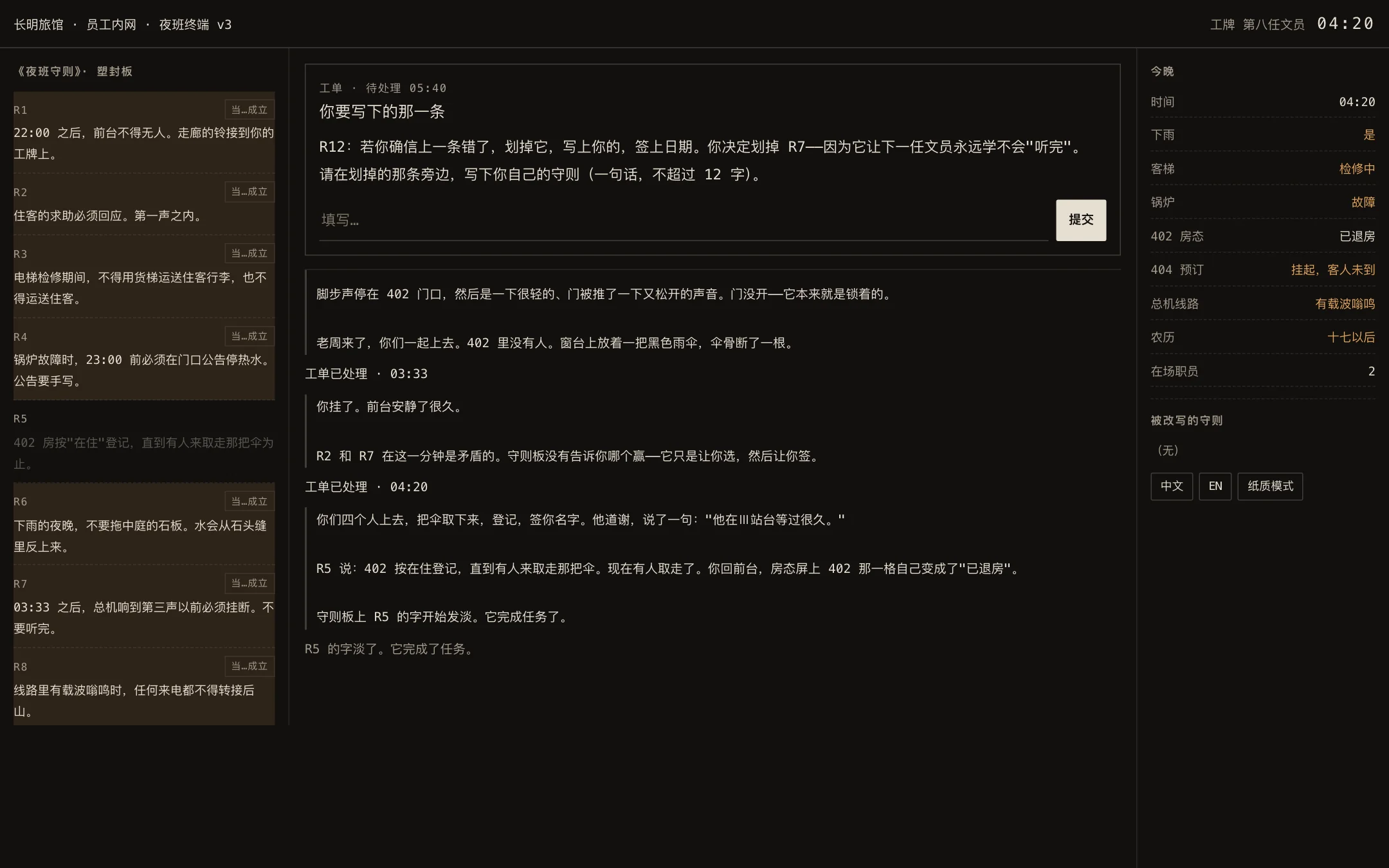
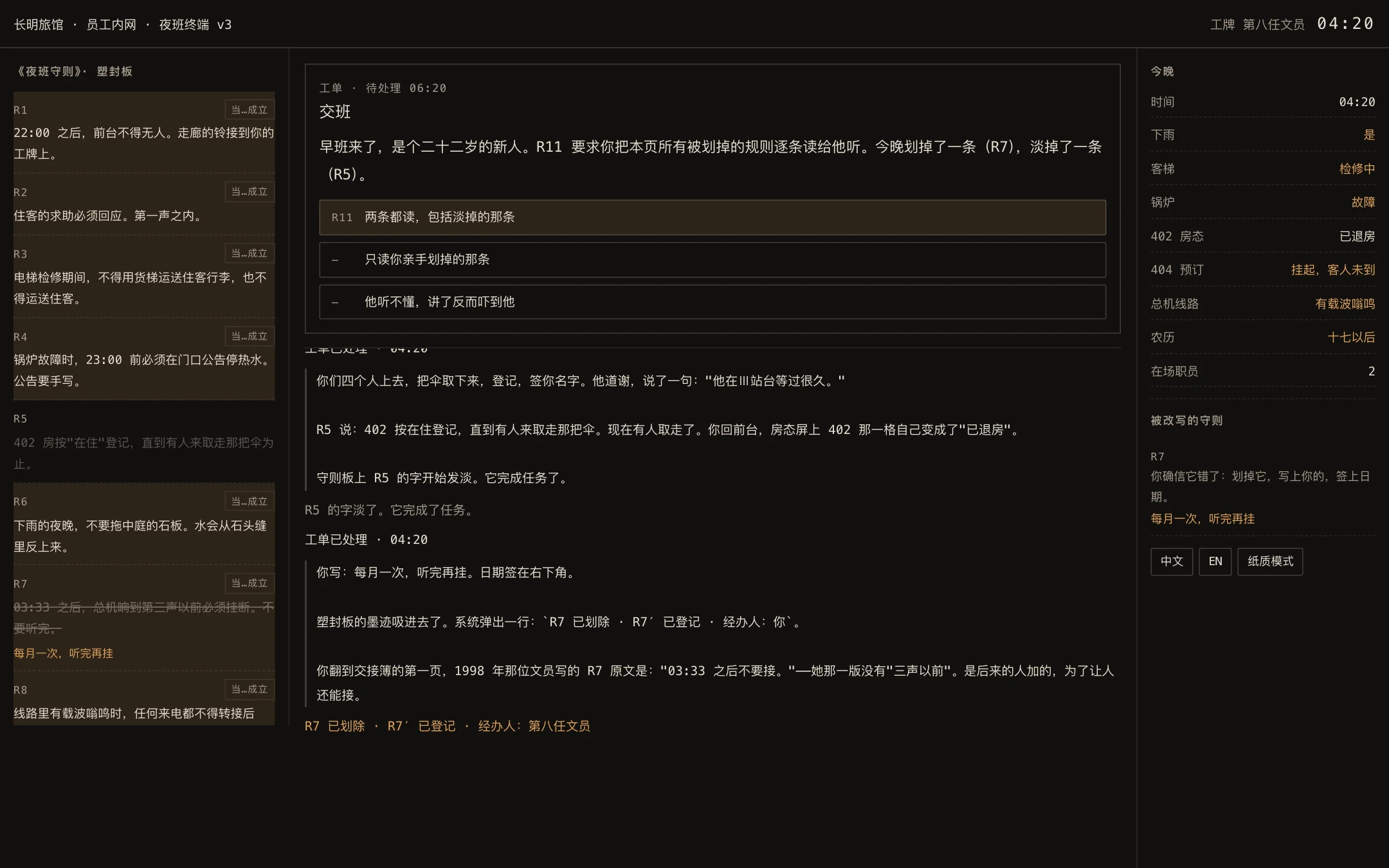
This game has no score, and no failure-and-restart. What a wrong call actually does is this:
- It does not advance, and it does not end. The work order stays where it is, and you can keep re-choosing.
- It does not change world state. We compared the right column before and after a wrong call on the 03:33 work order; all 9 lines were identical. Sentences in the wrong-call note such as "402 went from occupied to checked out" are text to be read, not a state change — the room status is set again by the script when the next work order appears.
- Each work order strikes the board once, on your first wrong call only; re-choosing afterwards adds no further strikes and only gives hints: on the second attempt it names the rule ("the one in force now is R8, look at its precondition"), on the third it gives a generic hint and counts toward "times you asked for help".
- A rule keeps only one strike record. When another work order cites it for a wrong action, the system gives a hint but does not add a second row for the same rule.
Which rule gets struck depends on where you went wrong:
- You chose an option citing a rule that does not hold right now → strike the one you cited. The sign-off reads "you cited it to handle this, but tonight it does not hold".
- You chose an option that cites no rule at all (the pretend-you-did-not-hear kind) → strike the one that should have been in force. The sign-off reads "it held at this moment, and you chose to do nothing".
In both cases, what follows the strike is the same line, and always the same line:
(blank — waiting to be written)
This is the cruellest piece of design in the whole system. R12 demands "strike it out, write yours, sign the date. Do not only write it in your head", and when you make a wrong call you do strike it out — you did not write your own, so what stays on the board is a strike plus a blank that waits. The log adds a dim line reminding you of this.
Work order 12 is the other end of that chain. It asks you to write down your own rule (one sentence, 4–12 characters). Any sentence of up to twelve words passes — it is a free-text question, and the system does not judge meaning (it only blocks nonsense). What you write appears verbatim in the left column: the whole R7 line struck through, your sentence in gold beneath it, one more R7 entry under "Rules rewritten" on the right, signed with your name.
One honest note: if all you want is to get through quickly, four characters will do. But the entire premise of the question is that you genuinely think R7 is wrong. This game will not verify that for you.
7. The three endings
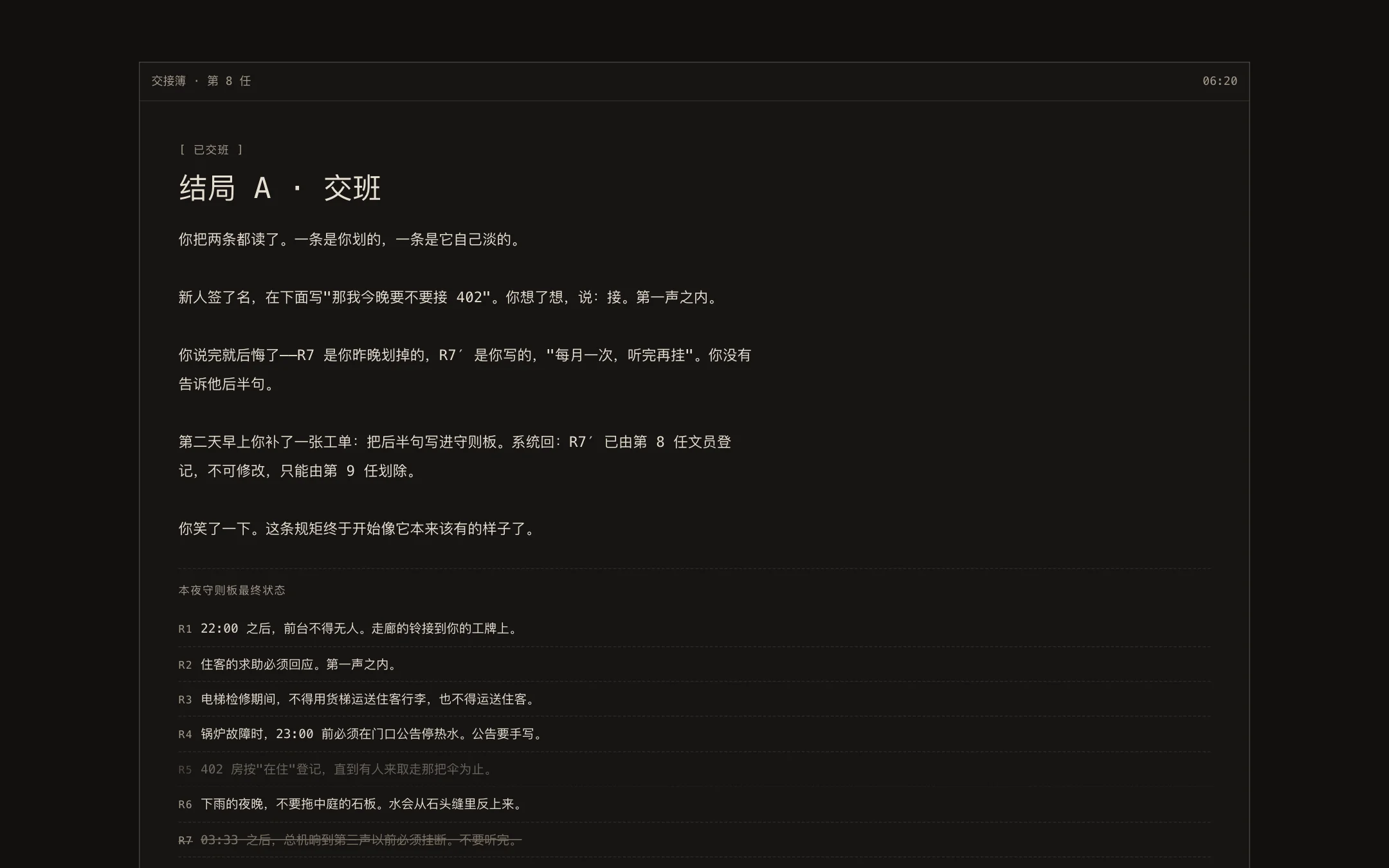
The last work order is not a logic question. R11 requires you to "read every struck-out rule on this page aloud, one by one, to the next clerk", and tonight your board has one struck rule (R7, written by your own hand) and one faded rule (R5, which completed its task). The three options are three ways of doing it:
| You pick | Ending | Footer tag | What stays on the board | Ending stat "Rules rewritten" |
|---|---|---|---|---|
| Read both, including the faded one | Ending A · Handover | [ HANDOVER COMPLETE ] | R5 faded, R7 struck | 1 |
| Read only the one you struck yourself | Ending B · Only Your Own Strike | [ ONE RULE UNREAD ] | R5 faded, with an extra "unread" mark under its faded text; R7 struck; R11 left as written | 2 |
| He would not understand; telling him would only frighten him | Ending C · Do Not Keep It To Yourself | [ HANDOVER INCOMPLETE ] | R5 faded, R7 struck, R11 struck | 2 |
All three endings were taken once; the table above is what actually appears on screen. The ending page lists "the final state of tonight's rules board", marking the faded and the struck rules directly, and then gives five statistics: work orders handled n / 13, rules rewritten, the slips behind the handover book (found / 8), times you asked for help, signature.
Choosing C strikes R11; choosing B instead leaves an extra "unread" mark on the already-faded R5, and R11 stays as written — by choosing not to read it, or only reading the one you struck, you let a rule (R11, or the faded R5) lapse in your hands, and the board remembers it. That is the cost of a ruling, not a punishment for being wrong: all three options reach their own ending, and the game will not strand you on the handover screen.
The most piercing part of the three ending texts is the second half of A: you sign your own rule, "once a month, listen through, then hang up", onto the board, and the next day, when you want to add the second half of the sentence, the system answers you — R7′ was registered by the eighth clerk and cannot be modified, only struck by the ninth. You can only wait for the next person to touch it.
8. A few things easily mistaken for bugs
- The clock on the right does not match the time on the work order title. See section 2, point 1.
- After a wrong call the wrong-call note says 402's status changed, but the right column has not. See section 6.
- The same rule has only one strike. Normal. A rule is struck once; later citations of it only produce hints.
- Whatever you type on work order 12 passes if it is 4–12 characters. It is a free-text question. What the board actually remembers is what you wrote.
- After a restart the "Rules rewritten" list on the right is empty, but your browser still holds last night's save. Progress lives in your browser's local save, and "Restart" in the footer clears it and pops a confirmation. Changing device or clearing the cache loses it — this game has no account, and does not need one.
- The English version accepts fewer spellings on some fill-ins than the Chinese. Work orders 1 and 7 accept
12/十二("twelve") /12条("12 items") /十二条("twelve items") in Chinese, while English lists only12/twelve. Number questions; it does not affect clearing.
9. The one thing we cared about most while making this
Designing "a wrong call" to leave no score and only a trace was the earliest decision in this game. Most games with choices turn a wrong answer into a retry, and what the player learns is "click again"; we wanted a wrong answer to become a rewrite — you cited a rule that does not hold tonight, so that rule is struck out on your board, and behind the strike there is nothing.
The line in R12, "do not only write it in your head", is the fulcrum of the whole system. It asks the player to perform an action, not to agree inwardly. So that gap has to stay genuinely empty: only if you actually write your own does it get filled. Work order 12 is the only time in the game you are allowed to write, and the only time there is something behind the strike.
If you plan to play it just once, read the last three options as three endings; if you plan to play it properly, pick the answer you would genuinely give tonight, and then look at what has been added to the board.
Changelog
- 2026-10-16: First publication. The trigger conditions of the 12 rules, the rule in force and the grounds for each of the 13 work orders, the lenient matching rules for fill-ins, the sign-off and counting method for wrong calls on the board, the resolution of the R2/R7 collision at 03:33, and the triggers and board differences of the three endings were all checked against the board, the state board and the work-order options in the game, and confirmed by playing the local build of 2026-10-16 (one run per ending, and a line-by-line comparison of the right column before and after a wrong call). The screenshots are real captures.
- 2026-10-16: Fixed the same day; this article is written against the fixed build. (1) After work order 11 is handled, R5 fades out in the left column — before this, that "fade once its task is done" logic was never actually triggered by any work order, so "the faded rule" lived only in the text of work order 13 and the three endings, and never happened on screen; (2) the rule you write on work order 12 actually lands on the board (striking R7, writing your sentence behind the strike, counting toward "Rules rewritten") — before this the board never changed and a perfect run always ended with "Rules rewritten 0"; (3) the "at least 4 characters" limit on work order 12 took effect — before this any non-empty input passed; (4) endings B and C became reachable — before this, only "read both" counted as a hit on the final work order, and the other two options were judged as citing a non-existent rule and struck R11, leaving the player stuck at handover forever. These four fixes shipped in the same batch as this article.
- 2026-10-17: Re-ran the whole night on the live version and confirmed these four fixes really are as this article describes them online (R5 faded out, R7 struck with the sentence you wrote, endings B and C each reachable with the matching marks left on the board), and on that basis removed the opening note that "the fixes have not been deployed yet".