Changming Inn: Night Shift Rules is our first-party rules-horror ARG: twelve rules that do not always agree, and thirteen work orders that each ask which rule holds right now. 7 acts, 3 endings, 150–210 minutes in the browser, with a full walkthrough.
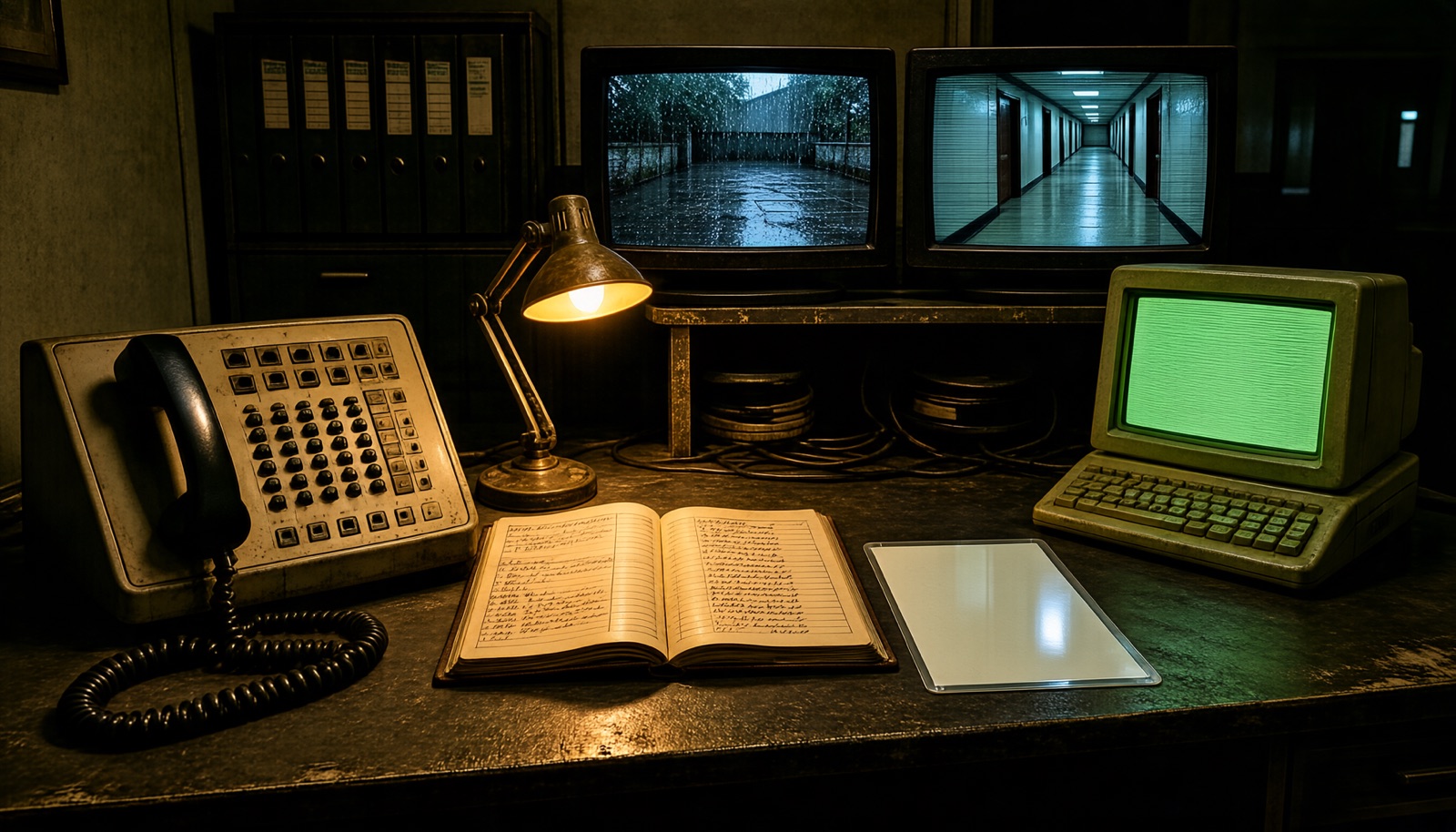
Illustration (AI-generated), not a game screenshot
The Changming Inn sits on the old Qingshan road, forty minutes from Lancheng toward Rust River. It is your first night shift, and HR's first work order is to read all 12 rules on the laminate and pass the check. 7 acts, 13 work orders, 3 endings, plus 8 slips tucked behind the handover book, 150–210 minutes.
Acts:7
Work orders:13
Rules:12
Slips:8, one falls out for each correct ruling
Endings:3
Full set:Opens a shared back page after the ending
Length:150–210 minutes
Platform:Browser, nothing to install
Saving:Automatic, local to your browser
Content:Atmospheric horror, no jump scares
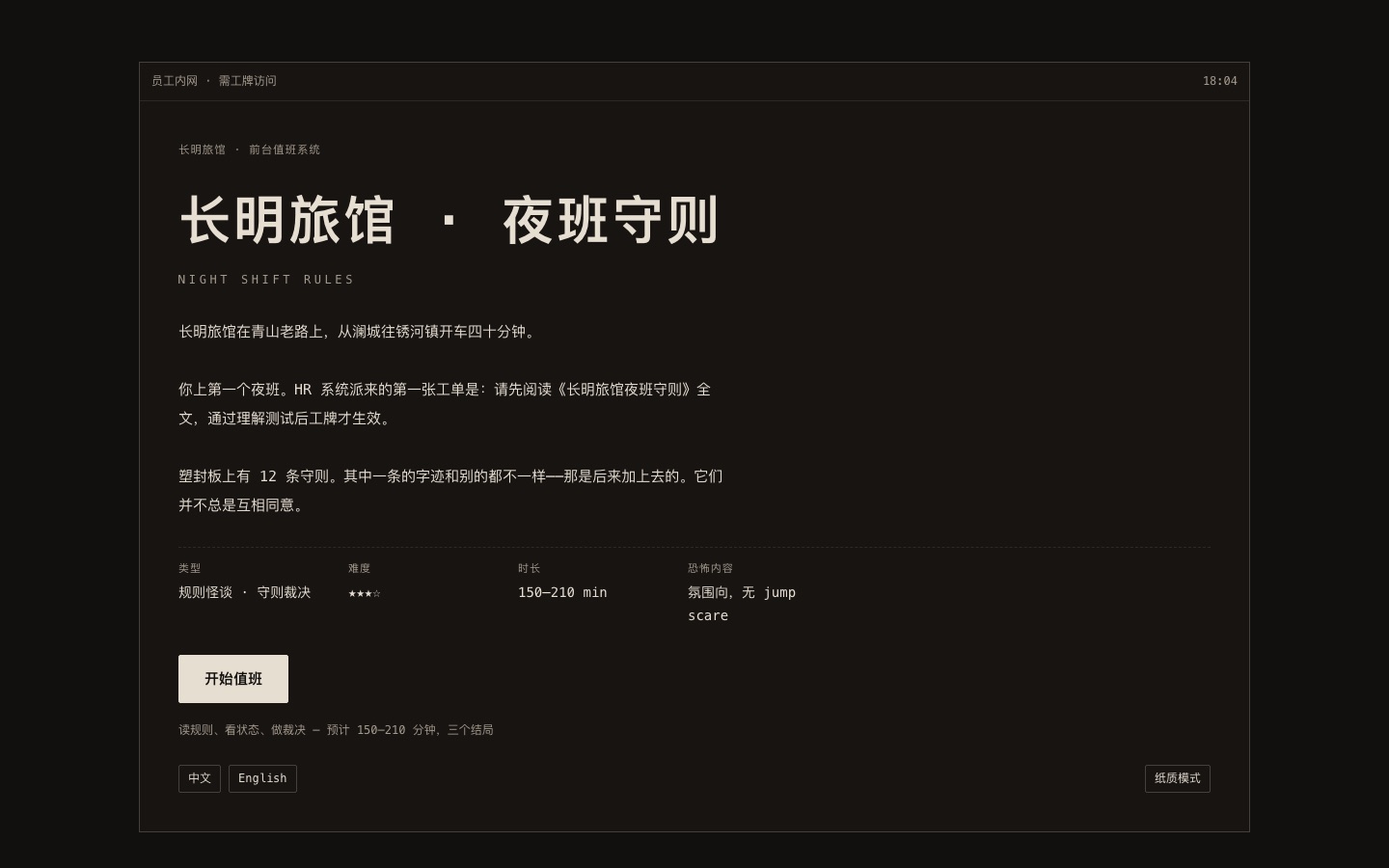
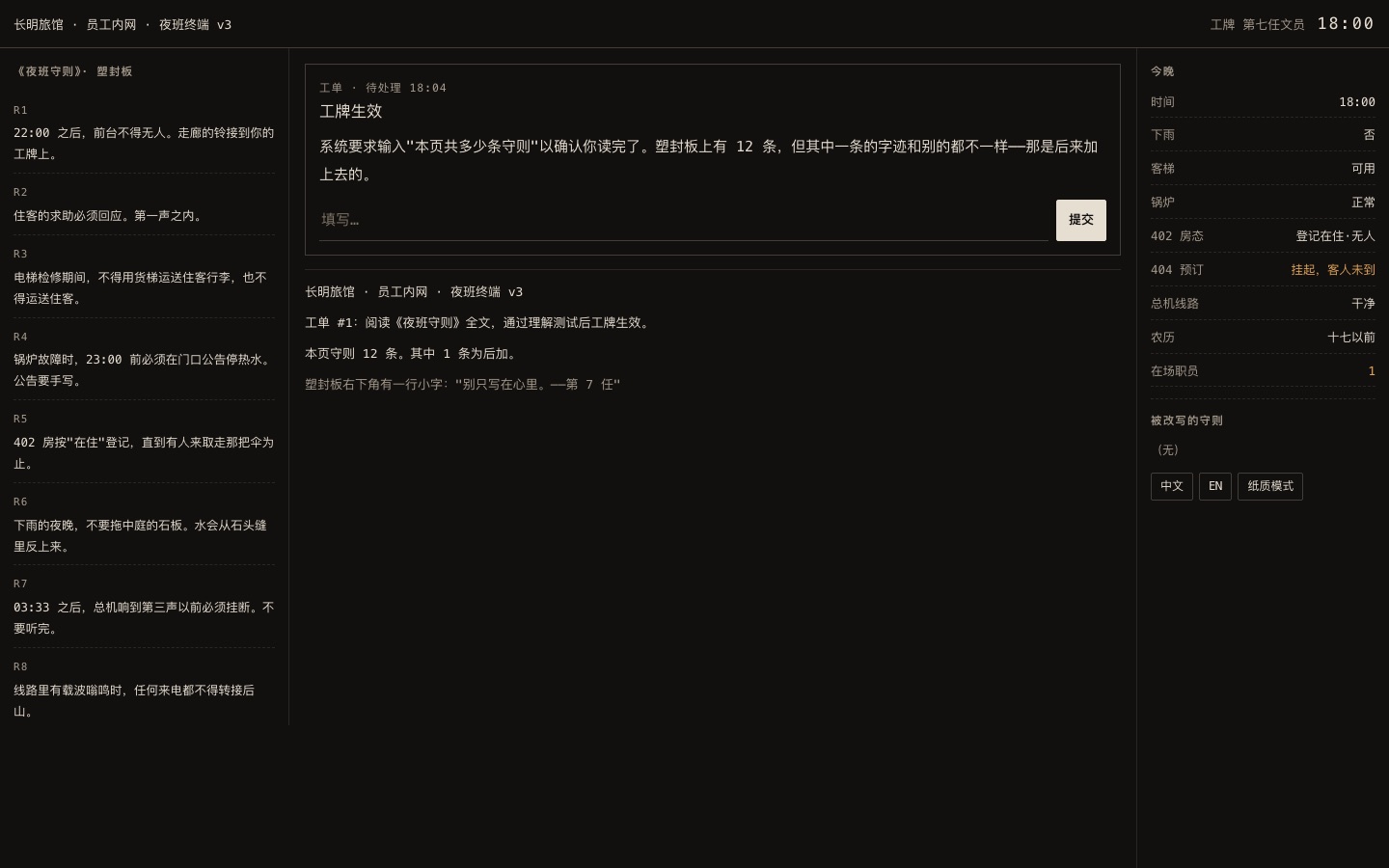
The duty terminal before entry: 12 rules, 7 acts, three endings, 150–210 minutesThe first work order, Badge activation: the laminated rules on the left, tonight's state board on the right
What it is
The Changming Inn sits on the old Qingshan road, forty minutes from Lancheng toward Rust River. It is your first night shift. The first work order from HR is not a floor check or a cash handover. It reads: read the Night Shift Rules in full; your badge activates only after the comprehension check.
There are twelve rules in the laminate. One is written in a different hand — added later. They do not always agree: one tells you to answer a guest, another tells you not to pick up at a certain hour; some hold only while the boiler is down, some only on a rainy night.
Over the next twelve hours, thirteen things happen at the desk: 402 rings three times at 22:41; the boiler trips at 22:58; an old man needs the fifth floor while the passenger lift is out; the courtyard flags are tracked with mud in the rain; Room 404 holds a booking first made in 2019; a steady carrier hum appears on the switchboard; the phone rings at 03:33 exactly; at 04:05 someone comes for an umbrella.
This is not a find-the-key puzzle. There is no inventory — only a rules board, a state board and a log that keeps growing. Each work order asks one question: which rule is in force right now?
The horror comes from procedure. The system always wants another confirmation, another signature, another handover summary. The rules are written as calmly as a staff handbook; following them to the letter is not calm at all.
How to play: read the rules, read the state, rule
The screen has three columns: the laminated rules (R1–R12) on the left, the open work order and duty log in the middle, and tonight's state board on the right;
The board always lists nine lines — clock, rain, passenger lift, boiler, Room 402, Room 404 booking, switchboard line, lunar day, clerks present; the relevant line has already changed when a work order appears;
Two kinds of decisions: pick an option, or type an answer into the terminal (for example, how many rules are on the page);
A wrong call does not restart the night. The first miss gives a hint; on a choice question, a second miss leaves a strike on the laminate — the rule you wrongly cited, or the one that was in force while you did nothing;
The twelfth work order asks you to write a rule of your own: no more than twelve characters (or words), signed, permanently on the board, and read aloud at handover;
Hints come in three tiers: direction first, then the board line, then the gist. Hints do not cost points, but they are counted in the night's record;
The back of every rules page may hold a slip from an earlier clerk: rule correctly on that rule and the “Handover book · back pages” counter on the right goes up; all eight open one more page in the ending;
Progress saves automatically in the browser. Close the tab and pick the shift back up. No account; Chinese by default, English available at any time.
Seven acts and thirteen work orders
The acts are not a chapter select; they advance with the event queue. Every work order leaves its timestamp in the log, so you can trace when each rule came into force.
Act 0 · Induction (18:04): the badge activates — read the rules, then answer how many there are;
Act 1 · Three Presses (22:41 / 22:58): an unanswered corridor bell, and a boiler fault that must be handled before 23:00;
Act 2 · Goods Lift & Courtyard (23:40 / 00:20): an old man and two cases while the passenger lift is out; mud on the courtyard flags and a mop on the housekeeping cart;
Act 3 · The Seventeenth (01:15 / 01:40): a traveller who wants Room 404, and a stale booking from 2019; then the system asks for a handover summary;
Act 4 · Carrier Hum (02:50 / 03:10): a steady hum on the switchboard and a woman asking to be routed to the back mountain; Room 402 flips from empty to occupied within ten minutes;
Act 5 · 03:33 (03:33 / 04:05 / 05:40): the first ring; a soaked man who has come for an umbrella; and the rule you write yourself;
Act 6 · Handover (06:20): the morning clerk arrives, twenty-two years old, and you read the struck-out rules to them.
The state board is the map of the night
The same door, Room 402, answers to different rules at different hours. When you take over it is registered as occupied but empty, so R5 holds: keep it occupied until somebody comes for the umbrella. At 03:10 the board reads occupied with someone inside, so R9 holds: the door opens only with two clerks present. At 04:05 the umbrella is collected, the board flips itself to checked-out, and R5 begins to fade — the only rule in the game that retires by completing its job.
The boiler, the rain, the lunar day and the carrier hum work the same way: each line on the state board is a switch for a rule. Read the rules together with the conditions under which they hold.
The state board is also where hints land. When you are stuck, the game does not print a rule number; it tells you to look at the line on the right.
R1 after 22:00 the desk may not be left unattended; R2 a guest's call must be answered within the first ring;
R3 while the lift is under maintenance the goods lift may not carry guest luggage or guests; R4 on a boiler fault a handwritten hot-water notice must be posted by 23:00;
R5 Room 402 stays occupied until somebody comes for the umbrella; R6 on rainy nights do not mop the courtyard flagstones;
R7 after 03:33 hang up before the third ring; R8 with carrier hum on the line no call may be routed to the back mountain;
R9 Room 402 opens only with two clerks present; R10 after the seventeenth of the lunar month no new 404 booking, and the old one is neither chased nor refunded;
R11 at handover read every struck-out rule aloud to the next clerk; R12 if you are certain the rule above is wrong, strike it, write yours, sign the date — do not keep it to yourself.
03:33: R2 against R7
The central ruling of the game happens at 03:33. R2 says a guest's call must be answered within the first ring. R7 says after 03:33, hang up before the third ring — do not listen to the end. The display reads 402.
The board never says which rule wins. It hangs both sentences there, asks you to choose, and makes you live with it. That is the design position: rules horror is not “you don't understand the rules”, it is “you understand them perfectly and they contradict each other”.
After the call you get a log entry explaining what happened. There is no score for the correct answer; your ruling is written into what follows — especially into what you have to read aloud to the next clerk at the final work order.
Three endings
The ending is decided by the final work order at 06:20. The right option is to read both — including R5, which was not struck by you but faded by itself.
The endings are not a morality score. In A you still withhold the second half of R7′ from the new clerk; in B he takes the call for you; in C you follow ordinary human decency and breach the rules. All three hold together, and all three cost something.
With all eight slips, a final page is added after every ending: the back of the handover book. It does not change the A/B/C fork; it adds what the first seven clerks left behind.
Ending A · Handover: you read both R7 (struck by you) and R5 (faded by itself). The new clerk asks whether to answer 402 tonight; you say yes, within the first ring. Next morning you try to add a line; the system replies that R7′ was registered by the 8th clerk, is immutable, and can be struck only by the 9th.
Ending B · Only Your Own Strike: you read R7 and say nothing about R5. The new clerk works alone and answers within the first ring at 03:33 — because R2 is still there, and you never told him R7 had ever existed.
Ending C · Do Not Keep It To Yourself: you read nothing, on the grounds that it would only frighten a twenty-two-year-old. The next day your badge is revoked and the log gains one line: handover incomplete, R11 breached.
What a wrong call leaves on the laminate
The board is both the rulebook and the save file. On a choice question there is no retry button: if you cite a rule that does not hold, it gets struck; if you cite nothing, the rule that was in force gets struck. At handover, R11 makes you read those strikes out loud.
On a choice question the strike happens on the second miss; text questions only give hints and never strike the board. The first miss only gives a hint, so the penalty accumulates slowly: the more you guess, the more gaps the board carries into the ending.
Hints point at the state board rather than the answer. Tier one says which line to look at, tier two names it, tier three gives the gist; using tier three is counted in the night's hint total.
That is also what separates it from most puzzle games: a mistake is not a failed attempt that gets erased. It is an action that happened on this shift.
Eight slips behind the handover book
Every page of the laminate is double-sided. The front is the rule; the back holds a slip left by one of the first seven clerks — eight in all: the rain the first night clerk heard in 1998, the door one of them opened alone in 1999, the cases that reached the fifth floor without their owner in 2001, the pencil on the back of a boiler notice in 2003, a child's sandal put in the lost-property cupboard after a rainy night in 2014, the night someone heard the third ring out in 2016, the 404 booking that arrived at 03:33 in 2019, and the 18.7-hertz line on the switchboard in 2022.
Each slip is tied to one rule you have to get right: R2, R4, R3, R6, R10, R8, R9 and R7. When you make the correct ruling on that rule's work order, the log gains a line — “a slip falls from the back of the handover book” — and the counter on the right moves up from 0/8.
They are not answer keys, they do not drop at random, and they need no extra clicks. Each one sits on a work order you must solve correctly to continue, so a complete night always collects all eight; what they add is what happened the night before each rule was written down.
With all eight, the ending page turns one more page after A/B/C: the slips laid out by date, each with an object photograph, closing with what the 9th clerk will see. It rewrites no ending; it is the shared coda.
The slip photographs are AI-generated illustrations used to fill in the objects, not screenshots of the game.
Where players get stuck
The first work order asks for a count, not handwriting. There are twelve rules and the highest number is the answer; the different hand means added later, not an extra rule;
The Act 3 summary includes your own call tonight. The previous clerk left eleven “answered, no request” lines on the 402 page; yours makes twelve;
At 03:33 the display says 402, but do not treat it as an ordinary guest call before checking the clock and the room state on the board;
The man at 04:05 claims he stayed in 402 three years ago. R9 still requires two clerks, and R5 is completed by somebody taking the umbrella, not by somebody claiming a room;
The final work order is not “which rule is right” but R11: rules struck out, and rules that faded, both get read;
The slips are not missable and need no extra clicks: each is tied to a work order you must solve correctly to continue, so a completed night collects all eight. If the counter stops partway, the matching order has not been ruled correctly yet;
The freeform rule at the twelfth order has a twelve-character cap (twelve words in English). It has to contradict R7, but only slightly; something off-topic is rejected.
Why it is worth a night
It does not use jump scares. The loudest sounds are the switchboard and the rain; the scariest object is a laminated sheet and a work-order system that never stops.
Thirteen work orders, thirteen rulings, each backed by a line on the state board. There are no passwords to brute-force, no jigsaws, no pixel hunting — only two pages you have to read carefully, and the difficulty is that the two pages do not fully agree.
All three endings are worth seeing because they answer the same question: did you hand on what you learned tonight? A first run takes 150–210 minutes; on a replay most text can be skipped quickly.
If you like the specific dread of rules horror — following the rules goes wrong, ignoring them also goes wrong — this game turns it into an operable adjudication system rather than a passage you can only read.
How it sits with our other first-party ARGs
It is listed with Room 404, Last Online and Midnight Frequency in the site's ARG catalogue and shares the same browser-narrative entry point; saves, language and progress are independent for each game.
You do not need to play anything first. It uses the “Linyuan Archive” label as a series tag only; the story and characters stand alone.
To see the mechanics before committing, read the complete walkthrough of all thirteen orders. It states every answer and its basis; on a first run, use it only when stuck.
Recent changes
2026-10-20: eight slips from earlier clerks added behind the handover book, one per correct ruling, with a shared back page after the ending;
2026-10-18: the rule you write by hand can no longer be claimed by mashing keys; share images standardised at 1200×630 and compressed;
2026-10-17: the trust page's last-updated date now follows the actual body revision; the sitemap no longer claims a lastmod without a source;
2026-10-16: four statements that did not match the screen were corrected (fading, signing, the length gate, ending reachability); the studio credit was unified as alphaBETA DEV.
How the numbers on this page are checked
Seven acts, thirteen work orders, twelve rules and three endings come from the game's acts.js, events.js and rules.js; 150–210 minutes is the length stated on the game's own landing page.
The eight slips, their dates and their clerks come from notes.js; each is bound to a rule that is the correct answer somewhere, and the audit walks a correct night to confirm all eight are reachable.
Both screenshots were taken from the running game on 2026-10-18: the title terminal before entry, and the night terminal after signing in (badge activation). The hero image is an AI-generated illustration, not a game screenshot, and is labelled as such at the top of the page.
If a number here disagrees with the game, the game is right; tell us in the changelog and we will fix it.
Who it is for
For players who like rules horror, textual deduction and making judgements from documents. It needs no reflexes and no code-breaking.
Not for players looking for jump scares, and not for anyone who does not want to read long text — the core content is exactly two pages of rules and a growing duty log.
FAQ
Do I need an account or payment? No. It runs in the browser, free, with no account and no in-app purchases.
Can I finish it in one night? Yes. 150–210 minutes is one full run; seeing all three endings takes a replay or branching from a save.
Where is progress saved? Locally in the browser (localStorage). Refresh or close the tab and continue; it does not sync across devices, and clearing site data restarts.
What happens if I answer wrong? Nothing restarts. The first miss gives a hint; on a choice question, a second miss leaves a strike on the rules board and changes what you must read at handover. Text questions only give hints.
Can I miss the eight slips? No. Each is tied to a work order you must solve correctly to continue, so a complete night collects all eight; there is no random drop and no extra clicking. The full set adds one page — the back of the handover book — after the ending, without changing A/B/C.
Are there jump scares? No. The horror comes from atmosphere, the telephone and the contradictions in the rules; the landing page also states “atmospheric; no jump scares”.
Can I switch to English? Yes, on the title screen and in the terminal. The freeform rule is capped by characters in Chinese and by words in English.
What if it will not open? Try a current Chrome, Edge or Firefox. If it still fails, email contact@gamestrategists.com with your device and browser version.
Begin the shift — Runs on its own subdomain · progress saved locally · Chinese and English