Gravity Courier
A gravity-slingshot puzzle: three shots a level, no fuel, and a one-second trajectory forecast. Planets, moons, black holes and wormholes in the way.
A gravity-slingshot puzzle: three shots a level, no fuel, and a one-second trajectory forecast. Planets, moons, black holes and wormholes in the way.
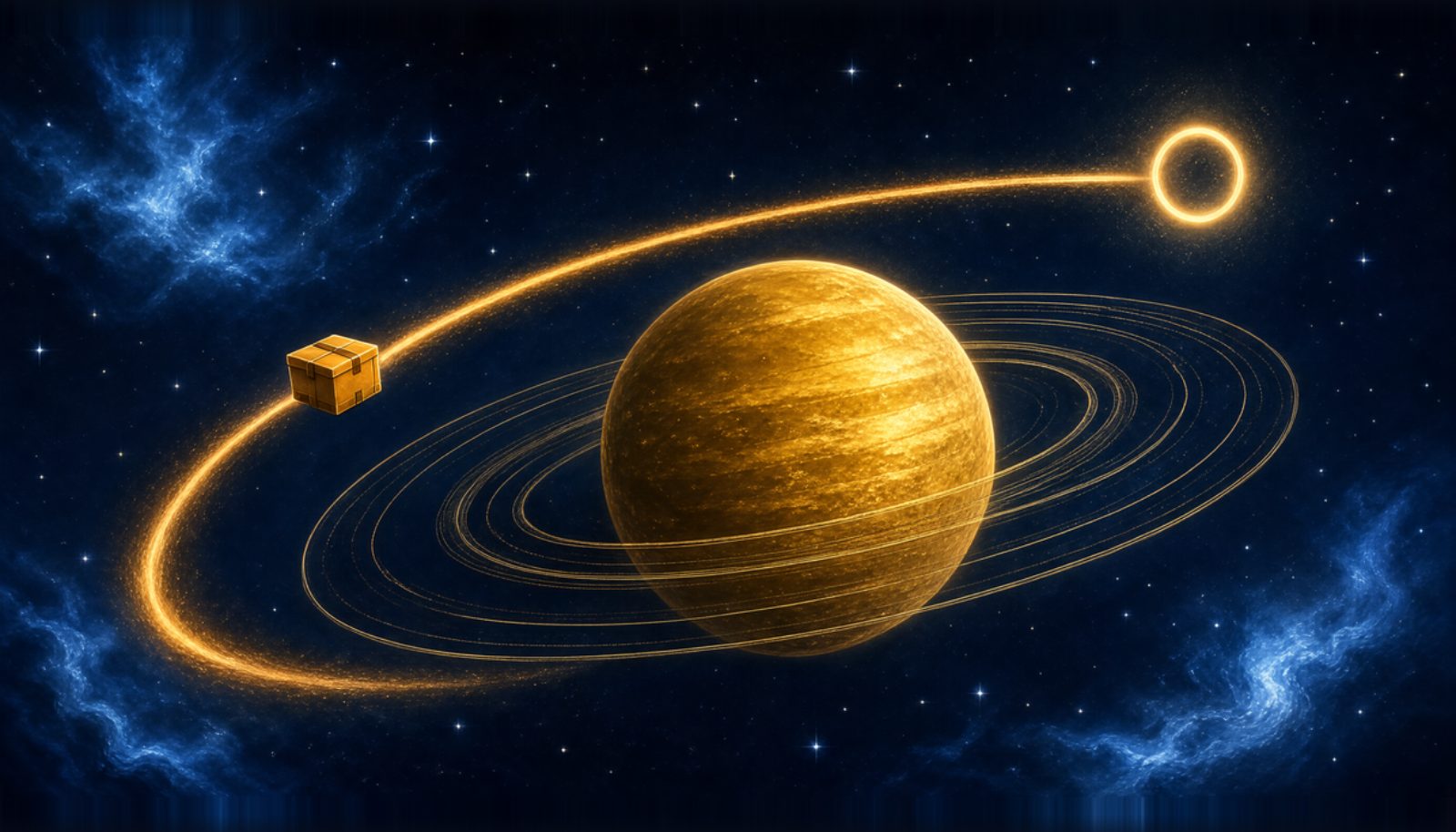
You have to put a parcel inside a delivery ring, with moving planets, moons, black holes and an asteroid belt in the way. No fuel, no thruster, three shots: set an angle and a power, and let gravity do the rest. Twenty-four levels across four chapters, each graded by how many shots you spent.
Released 2026-11-07 · Version 1.0.0 · Updated 2026-11-07

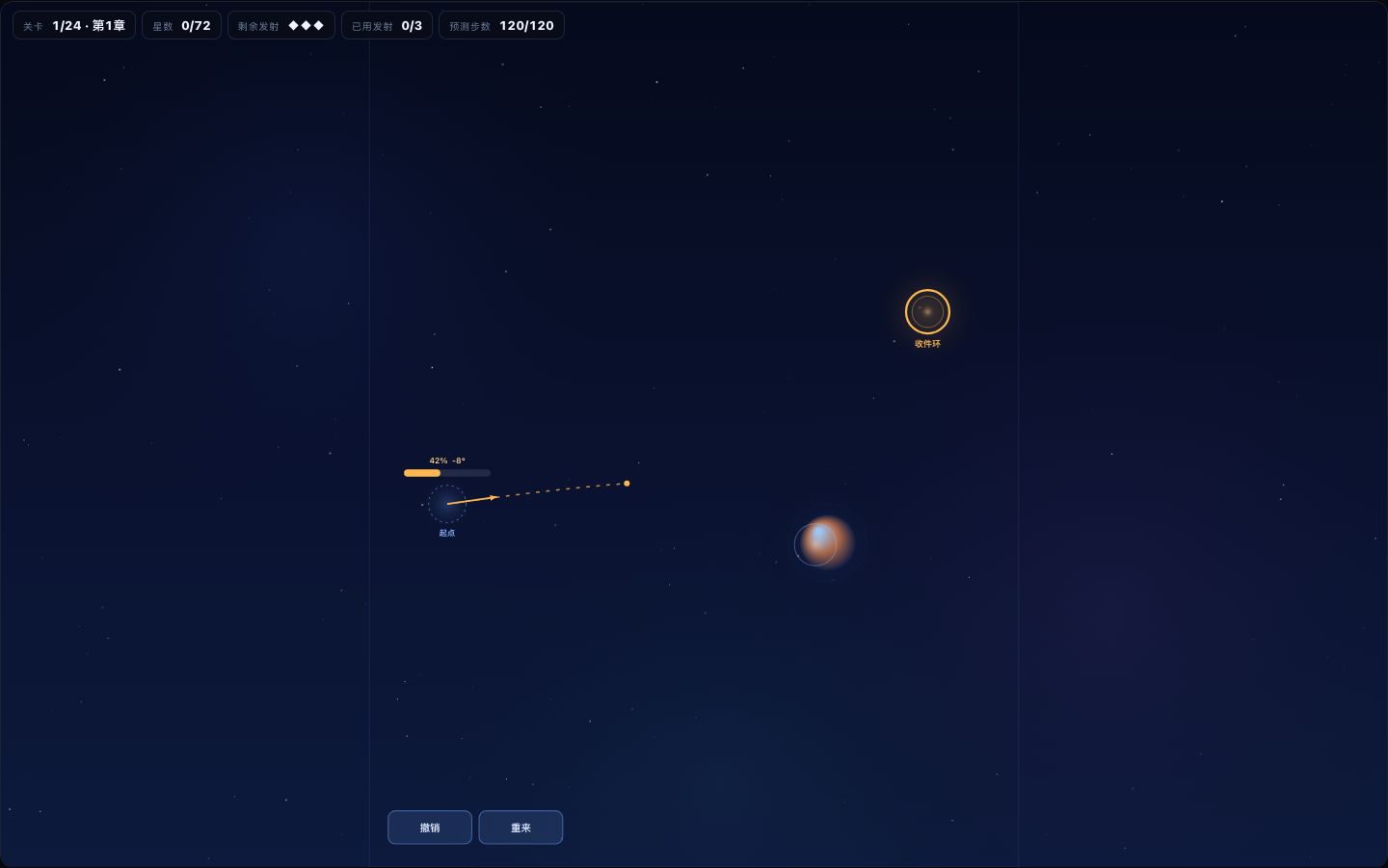
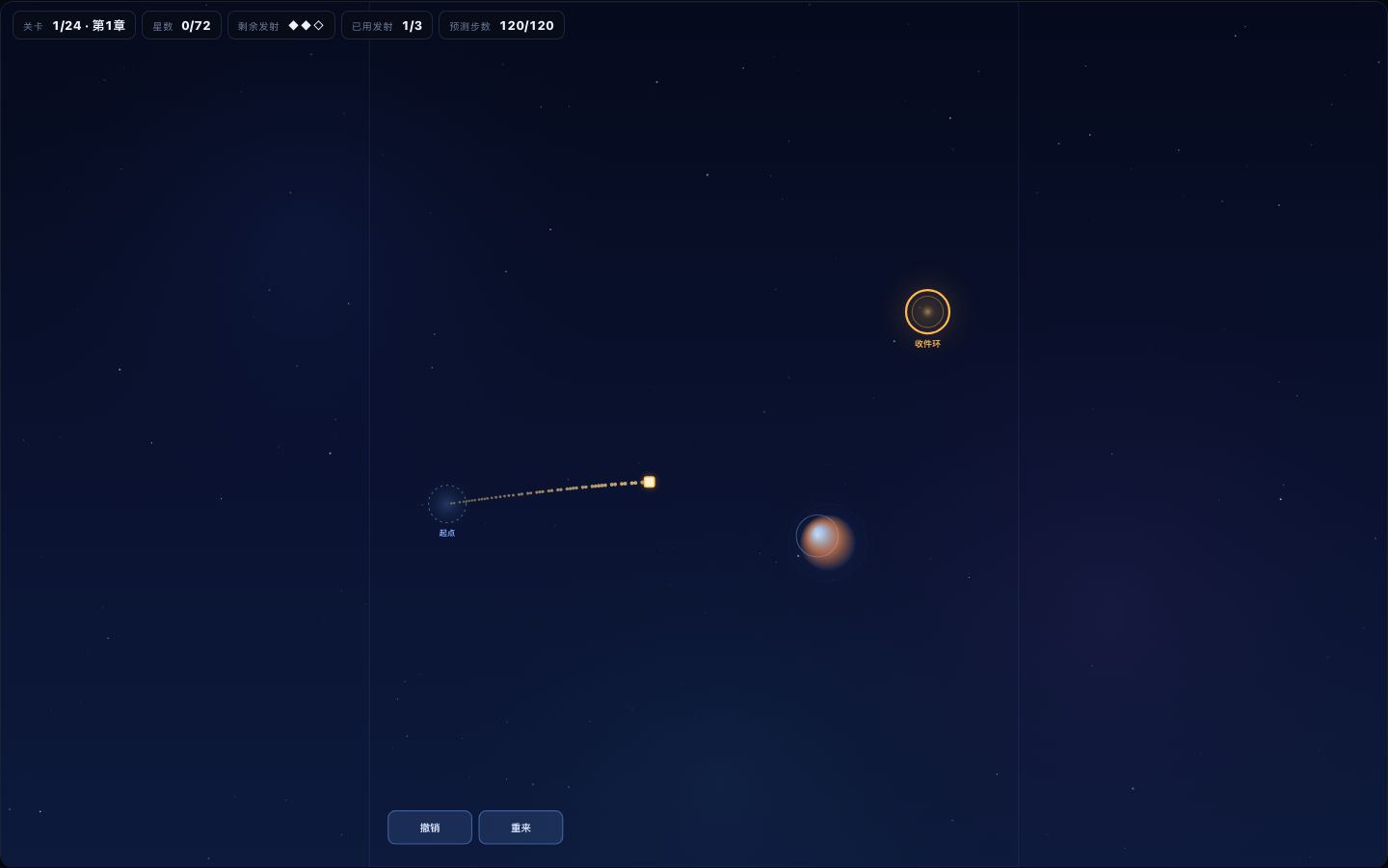
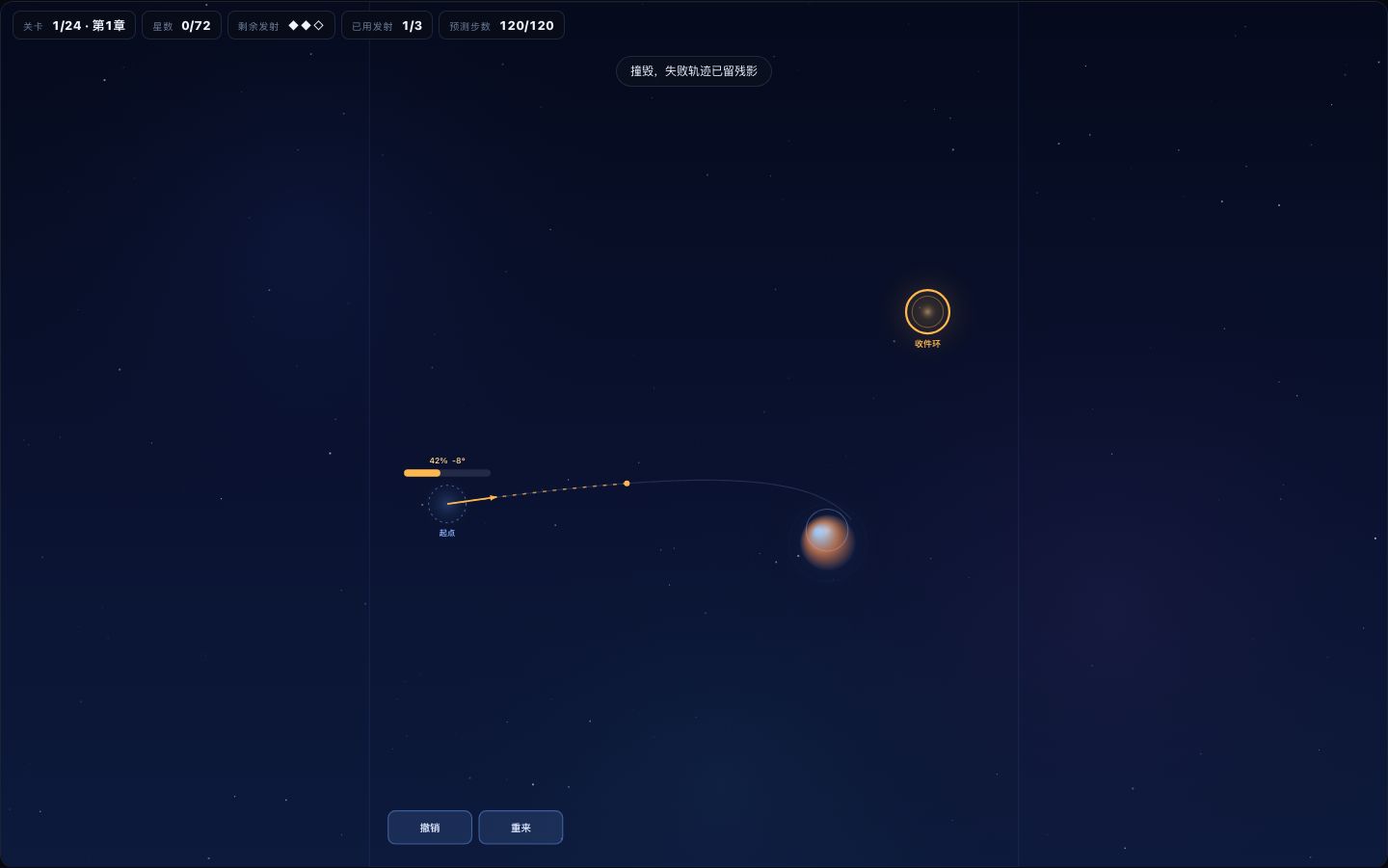
Chapter one, Low Orbit, has planets only, and teaches one thing: the path curves. Chapter two, Binary Dance, adds moons — and a moon does not sit still, it runs a steady circle around its own small orbit, so the same angle fired at a different moment gives a different result. Chapter three, Abyss, brings in black holes and an asteroid belt. A black hole carries one and a half to five times a planet's mass in roughly half its radius: get close and you are either slung out very fast or swallowed. The belt is a rotating ring of obstacles — cutting through the inner edge is a dead end, so you go around the outside.
Chapter four, Wormhole Express, adds portals and wind bands. Portals come in pairs; a parcel entering one leaves the other along the same velocity direction, with a 0.22 s cooldown so it cannot ping-pong. A wind band is a rectangle that adds a constant sideways force while you are inside it. Targets in this chapter often sit on the far side of a portal, so the order matters: portal first, gravity second.
The parabola from school physics assumes a constant force in a constant direction. Here neither holds: every body pulls with a = G·M / r², always toward its centre, growing sharply as you approach. G is 2400 and planet masses are in the thousands, so skimming a planet can produce thousands of pixels per second squared while far away the pull is almost nothing.
The consequence is that one trajectory can begin as a near-straight glide and then whip through a hard turn next to a planet. That is what a gravity slingshot means — you are not captured, you are thrown. Every elegant line in the game happens in that short stretch beside a body.
The dashed line while aiming is not decoration: it runs the same integrator as real flight. The physics step is a fixed 1/120 s, semi-implicit Euler — velocity first, then position using the new velocity — and the prediction runs 120 steps, exactly one second.
A fixed step rather than a per-frame interval matters because frame pacing wobbles: with real deltas, the same shot would land differently on a 120 Hz and a 60 Hz screen, and the preview would drift with it. A fixed step keeps prediction and reality on the same time grid, so the two can only diverge after that first second — and they diverge because you cannot see the gravity changes ahead, not because of numerical error.
Each level gives three shots. Arriving on the first earns three stars, on the second two, on the third one — so clearing and clearing well are separate things. Seventy-two stars across 24 levels, and the level select shows total stars, not levels cleared.
A failed shot is not wasted: the trajectory that crashed or left the screen stays on the canvas as a ghost trail, fading slowly enough that you can see which stretch over-curved. The next shot starts from the previous angle and power, so you only adjust one value.
A shot ends when the parcel hits a body, leaves the frame, or slows to almost nothing — under 14 px/s for 0.55 s. A single flight also caps at 13 seconds, so you never sit watching it orbit forever.
All of those tests measure the distance from a segment to a circle rather than checking whether the endpoint is inside it. A parcel covers real distance per frame, and point tests let it tunnel straight through; segment tests do not. The belt uses an annulus test: inside the outer radius but not inside the inner one counts as a hit, which is why the middle of the ring is empty but you still have to come at it from outside.
Is there fuel or a thruster?
No. After launch the parcel is affected only by gravity, wind bands and portals; you cannot steer mid-flight. Three shots means three re-aims.
Why does the real path differ from the prediction?
The prediction covers one second. Beyond that the gravity field changes — bodies rotate, moons orbit — so the later half must diverge. The line tells you whether the launch direction is right, not the whole route.
Can I lose stars?
No. Records only improve: replaying for fewer stars never overwrites a better result, and the fewest-shots record keeps the best attempt.
Does it work on a phone?
Yes. Aiming is press-and-drag from the launch point and release to fire; touch and mouse share one input path.
Send the first parcel — Runs on its own subdomain · 24 levels, 72 stars · records stay on this device
Since the first version on 2026-11-07, this page records what changed in each version of this game.