MrQiWinWinWin is our first-party candlestick arcade game: your altitude is the price, every flap becomes a candle, and you can only go long. 10,000 capital, open at 20.00, 150 candles in about 2 minutes 15 seconds, titled on the close. Free in the browser or installable as a Windows app.
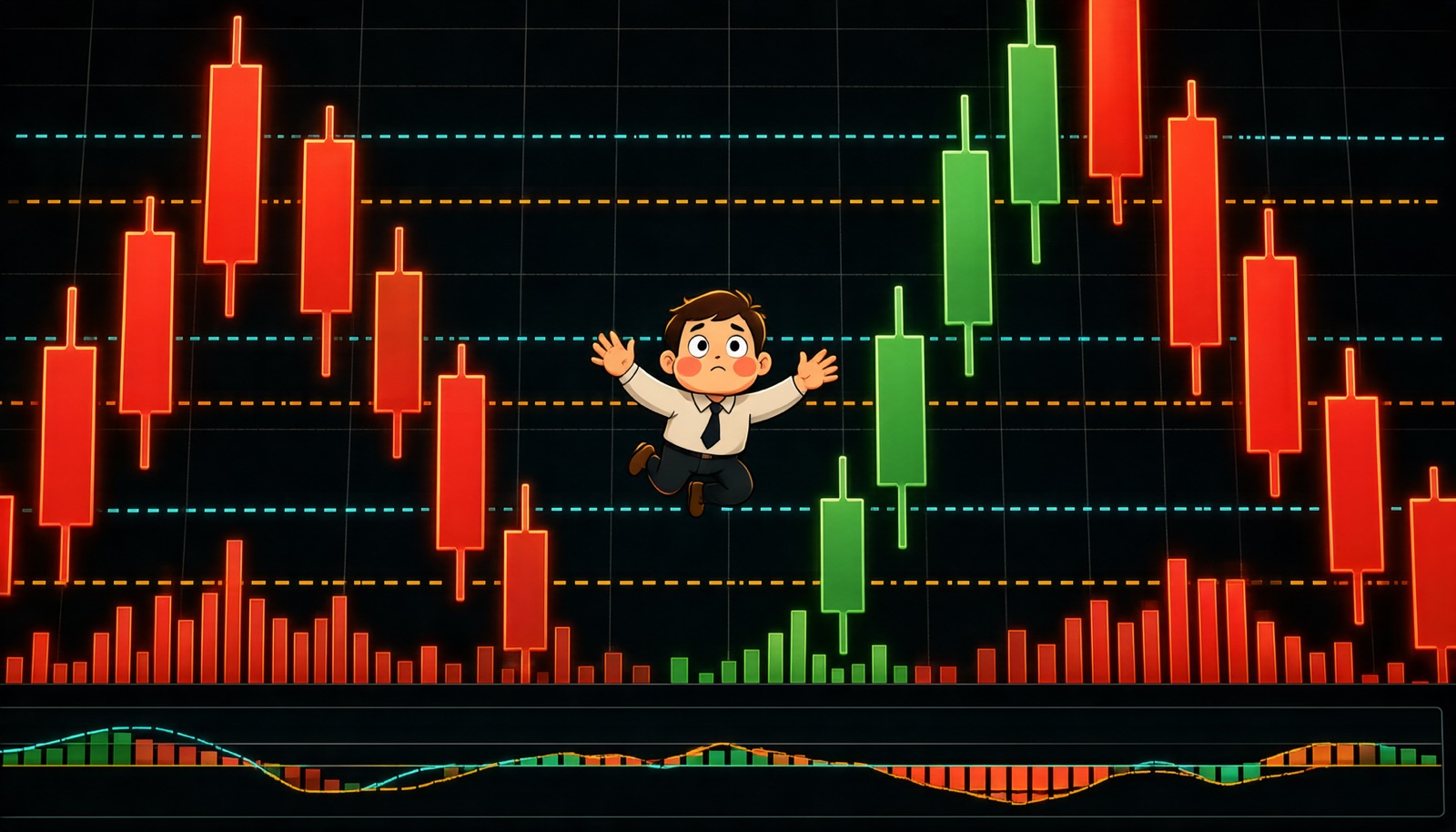
Illustration (AI-generated), not a game screenshot
Xiao Qi is a retail trader who believes that if he just tries hard enough the chart will go up — and he is right. Your altitude is the price, every flap is drawn as a candle, long only. 10,000 in cash, open at 20.00, 150 candles in about 2 minutes 15 seconds, eight market events drifting in, and a title awarded on the close — with the ones you have met logged in a local market-events book.
Capital:10,000
Open:20.00
Lot:100 shares · grid 5.5
Candle:0.9 s / 150 per session
Direction:Long only
News:8 (4 good / 3 bad / 1 halt)
Market book:8 events
Session:about 2 min 15 s
Platform:Browser / installable Windows app
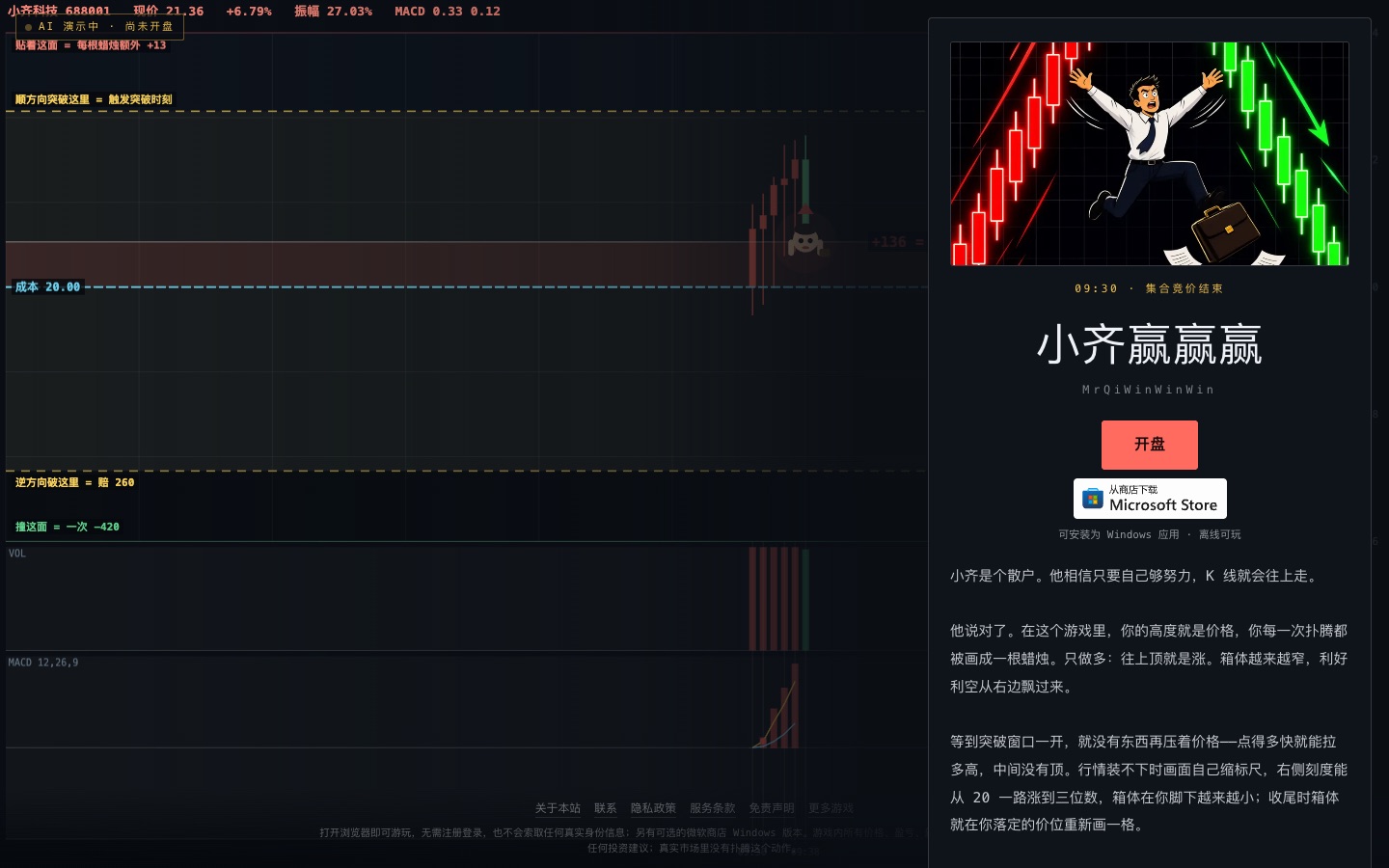
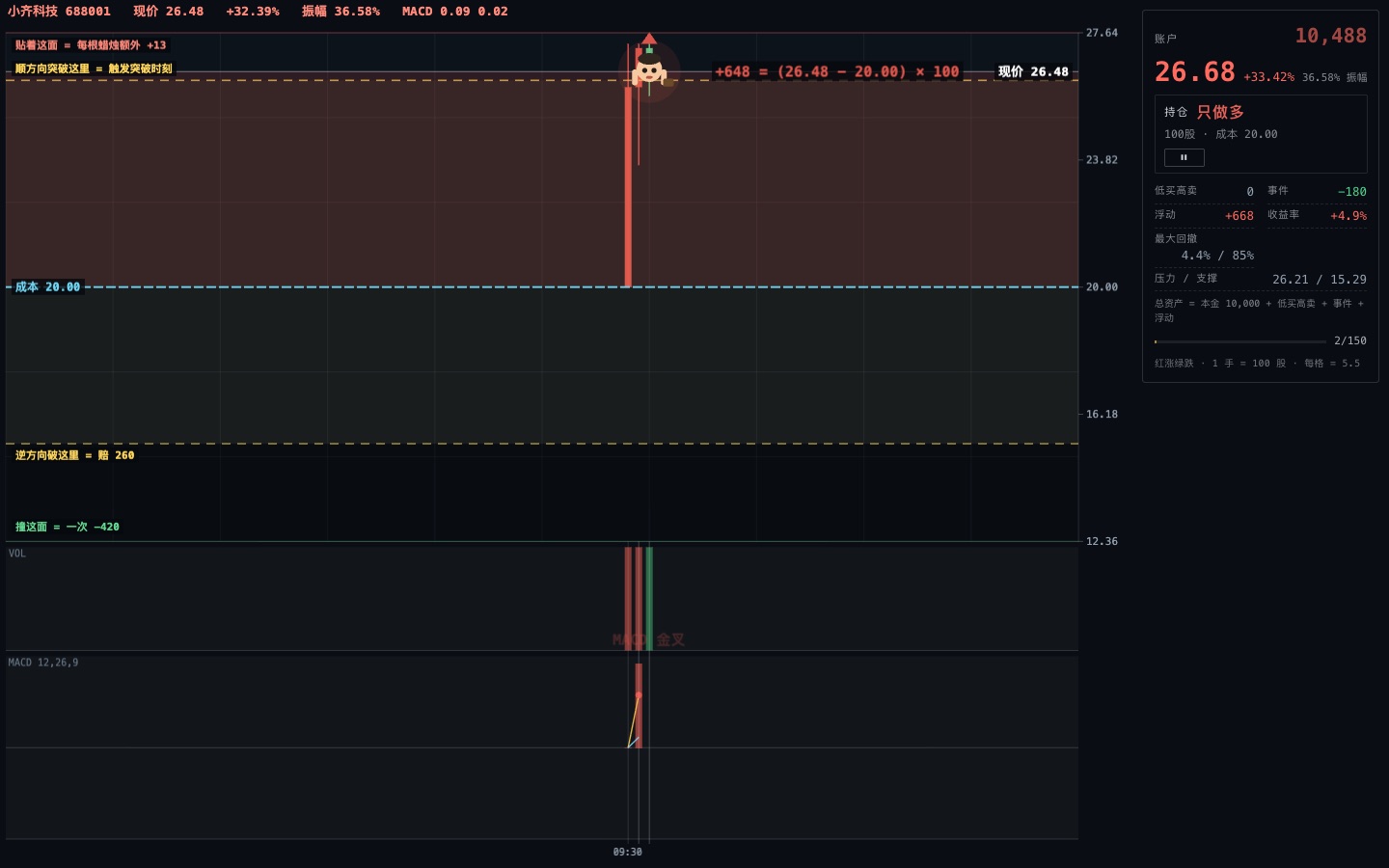
The landing page: before the open the backdrop is an AI demo, with the rules, controls and store entry on the rightIn-game: main chart, volume, MACD and the account panel on the right, with the +13, −260 and −420 rules written on the walls
What it is
Flappy Bird wired to a market terminal: Xiao Qi flaps inside the chart, his altitude is the stock’s last price, and every 0.9 seconds that stretch of trajectory settles into one candlestick — 150 of them a session.
Long only. Pushing up is going up; there is no short button. That is deliberate: a retail trader who mashes does not short either.
Four lines on screen keep teaching you the rules: hug the upper wall for +13 per candle, break in the right direction to trigger the breakout moment, break the wrong way through the lower line for −260, hit the bottom wall for −420. The text is written on the walls; there is no manual.
The box keeps narrowing and headlines drift in from the right. When the breakout window opens nothing above is holding the price: mash as fast as your fingers, and when the run no longer fits the chart rescales itself, the axis climbing from 20 into three digits.
How the account is computed
The formula in the HUD is real: total = capital + realised (buy low, sell high) + events + unrealised. Capital is 10,000, one lot is 100 shares at a 20.00 cost, and the right-hand panel lists all four parts with return, maximum drawdown and an 85% pressure line.
“Realised” is money from your own entries and exits; “events” is news and wall penalties; “unrealised” is (last − cost) × shares — the +648 = (26.48 − 20.00) × 100 line in the screenshot.
The close grades you on return across six bands: above 35% is “Hot-money legend” (someone in the other chat is asking whether you take clients); 18% is “Limit-up squad”; 5% is “Enough for a bubble tea”; below that “Wasted a day”, “Standing guard”, and at the bottom “Buried”.
The box, the walls and the breakout window
The box starts at half-width 100 and narrows to 70, drifting with the tape by up to 40 per candle;
Hugging the upper wall pays +13 a candle; breaking down through the lower line costs 260; hitting the bottom wall is −420;
A window arrives every 13–21 seconds: 2.8 seconds of warning, then 4.6 seconds open;
Only a real break inside the window becomes a surge; bumping the top wall outside it is a false breakout — judged at 0.35, and it costs;
The surge lasts 3.6 seconds: gravity ×0.34, flap ×1.5, up to +18 per tap counted for at most 22 taps, a 260 base reward, then a 5-second cooldown with at least 12 seconds between surges;
Limit up and down are handled too: −420 per hit with a 1.5-second cooldown.
What actually happens in the window
These are the only seconds that pay real money: there is no ceiling above, so your fingers drag the price up. Nothing caps it on screen — when the run outgrows the chart the axis rescales, running from 20 into three digits while the box shrinks away beneath you.
The cost is risk: each tap in the surge converts 0.75 of its gain into exposure, and the pullback lands straight on your maximum drawdown. Mashing is not a free option; it is the account traded for a single slope.
At the end the box is redrawn around wherever you landed, and the next stretch of tape starts there.
Eight headlines, three temperaments
Headlines drift in from the right and settle into the events column. They never forecast direction; you only learn what one was after it hits you, which is the point.
Good news “Guidance raised”: +320 cash for 6 seconds, gravity cut to 0.72;
Good news “Stake disclosed”: +240 cash for 5 seconds, gravity 0.8;
Good news “Dragon-Tiger list”: +180 cash for 5 seconds, gravity 0.86;
Good news “Reserve cut”: +260 cash for 6 seconds, gravity 0.78;
Bad news “Major shareholder sells”: −260 cash, gravity 1.3;
Bad news “Regulator opens a case”: −340 cash, gravity 1.42;
Bad news “Late-session dump”: −300 cash for 5 seconds, gravity 1.38;
Neutral “One-hour halt”: 0 cash, but the tape stops — it changes rhythm, not the account.
The events you have met are kept in a book
Eight market events each have a slot on this device: met one and it lights up, never met and it stays grey. The title screen reads “Market events seen X/8”, and the close card lays all eight out at once, good, bad and neutral in three colours.
Three were added on 2026-10-20: Dragon-Tiger list (+180, 5 s), reserve cut (+260, 6 s) and late-session dump (−300, 5 s). They join the existing spawn pool straight away — nothing has to be unlocked first.
The book lives only in this browser. It does not sync across devices, and clearing site data starts it over. There is no reward and it changes no odds — it only answers “how many of these eight have I actually seen”.
Red is up, and the portrait layout
The palette follows the Chinese market convention: red rises, green falls. That is not decoration — for anyone trained on the opposite scheme it needs saying, so the HUD footer reads “red up · 1 lot = 100 shares · grid = 5.5”.
Portrait is not a squashed landscape view: on a phone it is a vertical terminal with the main chart, volume, MACD and the account panel stacked 0.6 / 0.13 / 0.27, and candles re-sized to 5×3.
The indicators are real too: MA 5/10/20 and a 12,26,9 MACD whose crosses are labelled. They are not set dressing — the breakout and false-breakout calls run off the same kernel as these lines.
Controls, devices and that AI demo
Space / ↑ / tap to flap, P to pause;
Every sound is synthesised live with Web Audio — flap, breakout, headlines, the close and a margin call each have their own voice; the lower-right toggle mutes it and remembers that choice on this device;
The physics lives in data: gravity 1250, flap 400, fall capped at 780, rise capped at 560;
Before the open the backdrop plays an AI demo and the top-left badge says so;
After a blow-up it restarts on its own: 1.1 seconds in the demo, 1.7 in play, back to 09:30;
Results save in this browser; if WebGL is unavailable the page says so instead of showing a black rectangle.
How long a session is
0.9 seconds per candle times 150 candles is about 135 seconds — roughly two minutes and fifteen seconds. It is sized like watching one tape: long enough for a few windows and headlines, short enough that you never forget you are playing a joke about retail traders.
The difficulty was measured, not felt
The gameplay was extracted into a kernel that runs in node, and the acceptance gate asserts on the median of several fixed-seed runs rather than one session’s feel. Among the things it pins down: blowing up must remain reachable for an ordinary player (otherwise “risk” is theatre), the top grade must not be provably decorative, and the news economy must move the account rather than just the picture.
Why the median: the same tuning can swing tens of places across seeds. After the 2026-10-18 extraction the gate measured the news economy for the first time — the greens before that were greens that had not looked at it.
The store build
The game is also on Microsoft Store as an installable Windows app that plays offline. Both builds share the same gameplay; results stay on each device.
Store screenshots were re-shot against the current build; if they ever disagree with this page, trust this page and the game.
This is not investment advice
The game says it in its own footer: it plays straight in the browser with no account and never asks for personal details; every price, P&L figure, headline and title is invented, and nothing here is investment advice — real markets do not have a flap button.
That deserves its own section in a game that wears an account panel as its interface.
Recent changes
2026-10-20: a full procedural sound layer and a mute toggle; headlines expanded from five to eight with a local market-events book; the kernel’s news event now carries an id, and both the title screen and the close card show the book’s progress;
2026-10-18: rules extracted into one kernel so the gate finally measures the news economy, and blowing up is reachable for a normal player; share images standardised at 1200×630;
2026-10-17: stale jump-era copy removed and the landing notes rewritten, together with Dajin’s, to state only rules that are actually true; trust-page dates follow real body revisions;
2026-10-16: trust pages gained a content-rating note and a unified credit.
How the numbers on this page are checked
The 10,000 capital, 20.00 open, 0.9-second candles, 150 per session, box values 100/70/40, the +13 / −260 / −420 wall rules, the 0.35 false-breakout judgement, the 13–21 and 4.6-second windows, the 3.6-second surge with +18 per tap capped at 22 taps, and the −420 limit hit with 1.5-second cooldown all live in MARKET and LABELS in market.js; gravity 1250, flap 400 and the 780/560 caps are in PHYS; the six grades and thresholds are in GRADES.
The eight headlines live in NEWS: four good (guidance +320, stake +240, Dragon-Tiger +180, reserve cut +260), three bad (insider selling −260, probe −340, late dump −300) and one neutral (halt). The book’s eight slots are exactly the length of NEWS, and the three new payouts and gravity multipliers are read straight from market.js.
Session length follows from 150 × 0.9 seconds (about 135). Both screenshots were captured from the running game on 2026-10-19. The hero image is an AI-generated illustration, not a game screenshot, labelled at the top of the page. If a number here disagrees with the game, the game is right; tell us in the changelog.
Who it is for
For players with two minutes who want an instantly legible arcade joke, and for anyone who reads charts and wonders what a platformer made of one would play like.
Not for players wanting long progression or leaderboards: each session settles on the close, hands you a title, and starts from zero again.
FAQ
Do I need an account or payment? No. It plays free in the browser and never asks for personal details.
Can I short? No. Long only — pushing up is going up, because a retail trader who mashes does not short either.
How long is a session? About 2 minutes 15 seconds (150 candles × 0.9 s).
Why is red up? It follows the Chinese market convention, and the HUD footer states it plainly.
Where are results saved? The best equity and the market-events book live in this browser. The store build keeps its own local data; the two do not sync.
Is there a reward for completing the book? No. It only records which events you have met — it changes no odds and pays nothing, and a new device or cleared site data starts it over.
Does it work on phones? Yes, and it is laid out for it: a vertical terminal with chart, volume, MACD and account stacked top to bottom.
Is this investment advice? No. Every price, P&L figure, headline and title is invented, and real markets have no flap button.
Open the market — Runs on its own subdomain · a session takes about 2 min 15 s · long only, red is up