The Sunken City is our first-party ocean-horror ARG: an anonymous email about counting lights off Lan City leads journalist Shen Yu to a thirty-century fishing port, and to a city fifty metres under the sea. 8 acts, 15 puzzles, 20 simulated websites, 36 collectible clues, 4 endings, 5–8 hours.
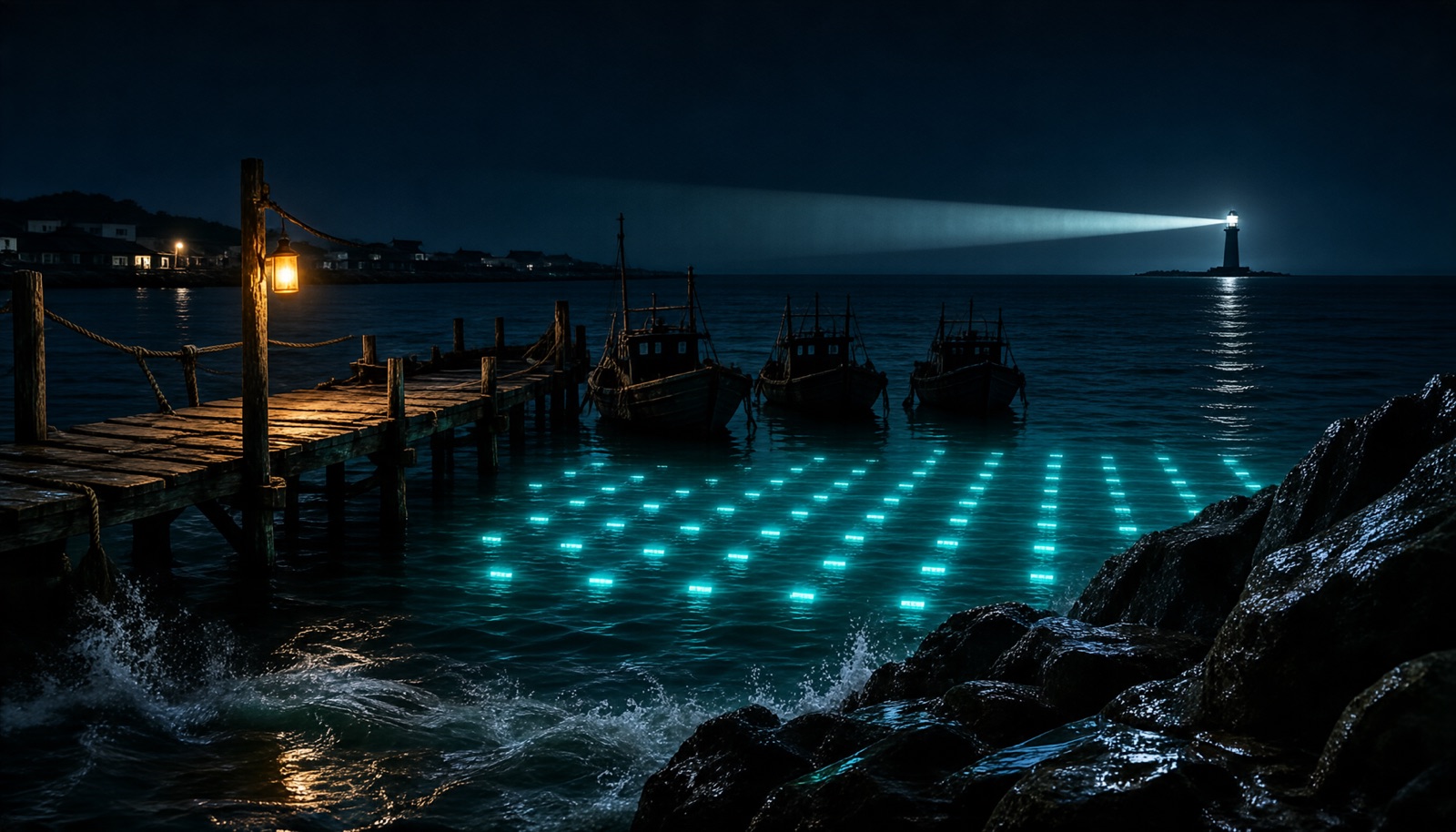
Illustration (AI-generated), not a game screenshot
July 2026. Freelance investigative journalist Shen Yu gets an anonymous email: strange lights off Lan City — not boats, not buoys; they have patterns, they are counting. Fifty metres down there is a city that does not belong to humanity. 8 acts, 15 puzzles, 20 simulated websites, 36 collectible clues, 22 emails, 4 endings, an 8-page lighthouse log, about 5–8 hours.
Acts:8
Puzzles:15
Simulated sites:20
Lighthouse log:8 pages, one per act
Collectible clues:36
Emails:22
Endings:4 + 1 epilogue
Length:5–8 hours
Platform:Browser, nothing to install
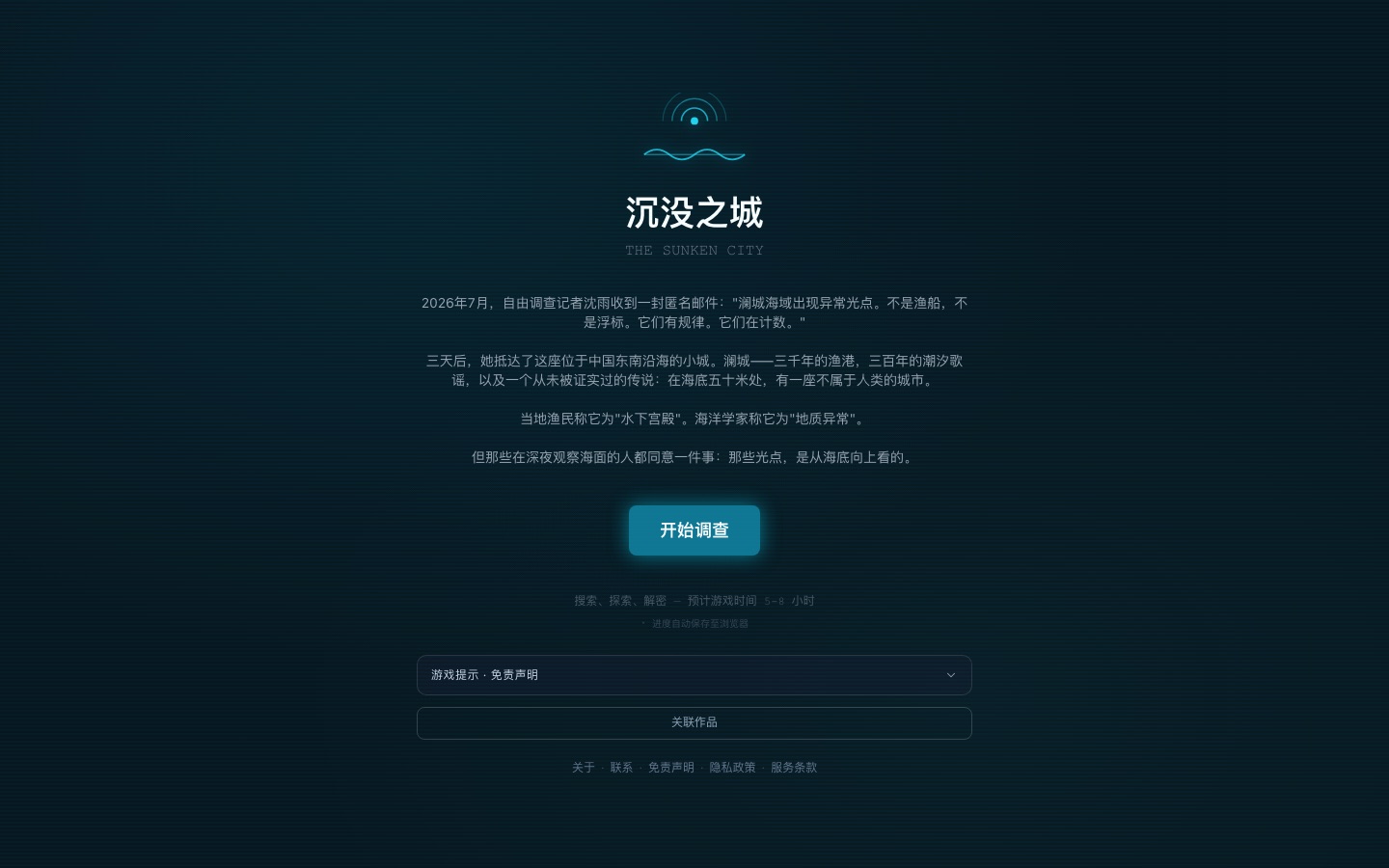
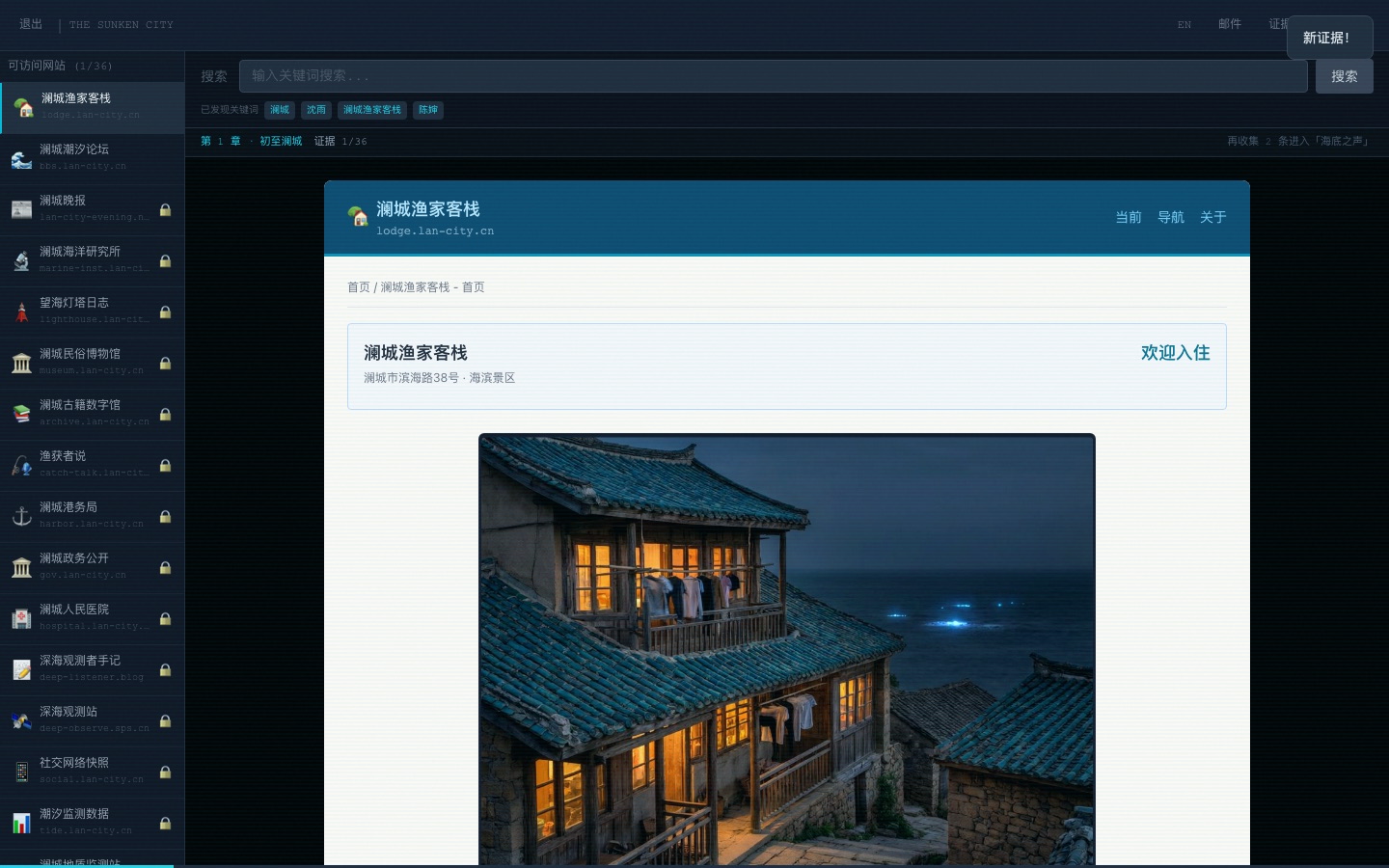
The opening before entry: July 2026, an anonymous email about strange lights off Lan CityThe first site inside the fake browser: unlocked and locked sites on the left, keyword search and the evidence bar on top
What it is
July 2026. Freelance investigative journalist Shen Yu receives an anonymous email: “Strange lights have appeared in the waters off Lan City. Not fishing boats. Not buoys. They have patterns. They are counting.” Three days later she reaches this small town on the south-eastern coast.
Lan City has three thousand years of fishing history, three hundred years of tidal songs, and one legend nobody has ever confirmed: fifty metres under the sea there is a city that does not belong to humanity. Fishermen call it the Underwater Palace; marine scientists call it a geological anomaly. But everyone who watches the water at midnight agrees: those lights are looking up from below.
It is played as a pseudo-interface investigation: the whole game is a browser, and you hop between twenty simulated websites — the fishing lodge, the tide forum, the evening news, the marine institute, lighthouse logs, the folk museum, the digital rare-book archive, catch reports, the harbour bureau, government releases, the hospital, deep-observer field notes, social snapshots, tide telemetry, geological survey, police notices, the Dark Water archive, church records.
The dread is not jump scares. It comes from assembling unrelated public records into one conclusion: a 222-year cycle, and a door that is being opened.
How to play: one browser, twenty sites
The left rail lists the sites: reachable ones are lit, locked ones carry a padlock; they open as acts advance, no keys to find;
The top bar is a keyword search: one term, results aggregated across sites; discovered keywords stay as chips under the bar so you can click back;
The evidence bar reads “evidence n/36”: every collectible clue advances it, and the left rail uses the same denominator;
At the top of the evidence panel is the Wanghai Lighthouse log: one page per act, each recording what the keeper heard that night and the line he left at the bottom;
Emails and notes are separate panels: emails push the story in date order, notes keep the intermediate conclusions you derived;
Puzzles are input boxes: a frequency, hydrophone parameters, manuscript numbers, an access code, date gaps, tide percentages, a dark-web captcha, a deciphered word, cycle years, relief ordering, Morse, a four-digit figure on a spectrogram;
Puzzle 12 is a choice: each option leads to a different ending;
Progress saves locally in the browser; Chinese by default with English available.
Eight acts
Act 0 · Arrival: check into the fishing lodge; the first forum post about lights that count;
Act 1 · Sound from the deep: frequency, duration and interval in a hydrophone recording point at a rhythm that is not natural;
Act 2 · The tidal song: numbers in a three-hundred-year song match the manuscript, and the cycle first shows itself;
Act 3 · The institute's secret: an access code and a redacted report turn “geological anomaly” into a signed programme;
Act 4 · Eye of the abyss: a contact event, the Dark Water archive, and one sentence deciphered from seabed carvings;
Act 5 · The cage: cycle verification and the door's cipher show this door has opened twice before;
Act 6 · Before the awakening: the lighthouse's Morse signal and a static tuning hand you the warning;
Act 7 · The final choice: the full-moon night, torches on three reefs, and whether you speak or sing.
Fifteen puzzles, and what each one tests
FM decryption: the same number sits in different bands — fix the band first;
Sound tracing: frequency, duration and interval from the hydrophone combine into one location;
Manuscript cipher: three groups mean an era, a cycle and a day; they nest rather than stand side by side;
Project access code: the seabed structure's number is the key; enter it as written, no extra symbols;
Redacted report: what is blacked out is not only text but a radiocarbon date;
Contact-event cipher: how many days between three dates; use the first gap to reach the third;
Tide singularity: the percentage doubles — 4% → 8% → 16% → 32%; what happens when the interval shortens by 100%;
Dark Water entry: the captcha is not fixed; count your clues, then let that number multiply itself;
Ancient seal script: the memo copies one incantation deciphered from the seabed carving — say it;
Cycle verification: the cycle turns every 222 years; count three windows from the first recorded year;
The door's cipher: six reliefs, six eras; order them by what is in the image, not by converting to AD dates;
The final choice: options lead to different endings; only a listener with enough clues is said to see all of them;
Tongue of the deep: it has many names, one in the files and one in the song, and they mean the same one;
Lighthouse signal: the keeper already counted the shorts and longs; three short, three long, three short, letter by letter;
Static tuning: a four-digit figure sits on the spectrogram; mind the frequency and duration pairing.
Four endings and an epilogue
The four are decided by the choice in puzzle 12, and two of them also depend on how many clues you collected; exact triggers are listed in the walkthrough.
With all eight lighthouse pages, every ending gains a page headed “tonight’s keeper.” It changes no branch; it is their shared coda.
Ending · Eternal Seal: at the slack tide of the full-moon night you light torches on three reefs and speak the nine characters from the old book — tide to tide, night to night, the door to silence;
Hidden ending · Voice of the Abyss: no torch. You open your mouth at the black water and say “I am here”; what rises from the crack is not water but sound, frequency, a four-thousand-year-old whisper;
Secret ending · Child of the Tide: you walk into the glowing water of your own will; the lights gather and turn around you and the sea steps aside, and you reach a door twenty metres tall;
True ending · The Sunken City: neither fire nor door — you sing the tidal song three hundred years of fishermen have carried;
Epilogue · Return: one year later Shen Yu stands on the same beach; Aunt Chen waits at the lodge door.
The Wanghai Lighthouse log: eight pages of the sea
Chen Shoudeng kept the Wanghai light for forty years. Beyond the official log he kept his own copy: from the page his father handed him in 1960 to the last page he wrote on 18 June 2026.
The log unseals with the acts, one page per act. Each page records the date, the sound he heard that night, what happened, and one line he left at the bottom — not a conclusion, but a sentence still waiting for an answer.
The entrance is at the top of the evidence panel: “Wanghai Lighthouse log n/8.” All eight are guaranteed before the final chapter; with the full set, every ending gains a page called “tonight’s keeper,” reading from 1960 to tonight, with the last line left for Shen Yu.
The log gives no puzzle answers. It fills in what this town heard, on the lit side of the water, across seventy years.
The eight object photographs are AI-generated illustrations used to fill in the objects, not screenshots of the game.
Where players get stuck
The search takes one keyword; typing a whole sentence usually returns nothing;
A padlocked site is not a secret, it is an act you have not reached; fill the current act's evidence first;
The frequency trap is the band, not the number; the same figure from the institute and the lighthouse may not be the same band;
The dark-web captcha depends on how many clues you hold now, so retry it after the evidence bar moves;
For the door cipher do not convert to AD years; the reliefs follow their own internal order;
For the true ending, read all three sources of the tidal song first — they are split across the museum, the rare-book archive and the catch reports.
Why it is worth several evenings
It is the longest game here: 5–8 hours, twenty sites, thirty-six clues. It does not try to frighten you in one sitting; it lets you finish a fictional city's public record the way an investigation actually ends.
The puzzle types are the most varied on the site: text input, redaction recovery, Morse, spectrogram tuning, sequence verification and date arithmetic each take a stretch, so no single trick repeats fifteen times.
All four endings are fully written, not one scene recoloured: sealing, answering, entering and singing are four postures towards the same door.
If you play only one of our ARGs, this is the biggest one. If you prefer to start short, begin with Unclaimed or Last Online.
How it sits in the shared universe
Lan City is shared geography: the sonic experiments of Tide Sound Archives, the abandoned asylum of Eye of the Abyss and the polluted town of Rust River all sit on the same map.
This is the game that takes the sea all the way down: the tidal cycle, the seabed structure and the song-memory are the settings the others keep citing.
No required order. Play this first and the others fill in details; play the others first and several coordinates here will look familiar.
Recent changes
2026-10-20: the Wanghai Lighthouse log adds eight keeper pages, one per act, plus a “tonight’s keeper” page after every ending;
2026-10-18: search no longer spoils unreleased acts, three half-finished first-screen elements closed; related-game cards dropped retired sites; share images standardised at 1200×630;
2026-10-17: og:image switched to the WebP already served by this repo instead of a 3.7 MB PNG; trust-page dates now follow real body revisions;
2026-10-16: trust pages gained a content-rating note and a unified credit.
How the numbers on this page are checked
Eight acts come from the entries in acts.js, fifteen puzzles from puzzles.js, twenty simulated sites from locations.js, twenty-two emails from emails.js, and four endings plus one epilogue from endings.js.
Thirty-six is the denominator the evidence bar itself uses (the size of the collectible clue set in App.vue), not the row count of the clue data file — that file holds entries that are not collectible. The 5–8 hours is the game's own stated playtime.
The eight lighthouse pages, their dates, keepers and sounds come from lighthouse.js; the build gate checks one page per act, all eight images, and has negative controls (a duplicate act or a missing image turns it red).
Both screenshots were taken from the running game on 2026-10-19. The hero image is an AI-generated illustration, not a game screenshot, labelled at the top of the page. If a number here disagrees with the game, the game is right; tell us in the changelog.
Who it is for
For players happy to spend several evenings reading a fictional coastal city's public record and matching dates against frequencies.
Not for players wanting something short and sharp — reading twenty sites takes time — and not for anyone who cannot take ocean horror at all.
FAQ
Do I need an account or payment? No. It runs in the browser, free, with no account or in-app purchases.
Must I play the other universe entries first? No. What is shared is geography and underlying settings; each game's main line closes on its own.
How long is it? About 5–8 hours; seeing all four endings takes longer, and two of them depend on clue count.
Where is progress saved? Locally in the browser. Refresh or close and continue; it does not sync across devices, and clearing site data restarts.
What if I am stuck? Check the evidence bar and the keyword chips, then search again; every answer is in the body text of an unlocked site — no outside sources needed.
Can I switch to English? Yes; both the interface and the site content have English versions.
Can I miss the lighthouse log? No. It unseals one page per act and is complete before the final chapter; the full set adds a “tonight’s keeper” page after every ending.
What if it will not open? Try a current Chrome, Edge or Firefox. If it still fails, email contact@gamestrategists.com with your device and browser version.
Start investigation — Runs on its own subdomain · progress saved locally · Chinese and English