The Light We Kept is our first-party keyword-retrieval mystery: you mind a forty-one-year-old photo studio while its owner is away, and the ten starred cases in the ledger have to reach their people before the lane comes down. 45 files, 12 rolls, 10 cases, 4 endings, plays in the browser, no horror content.
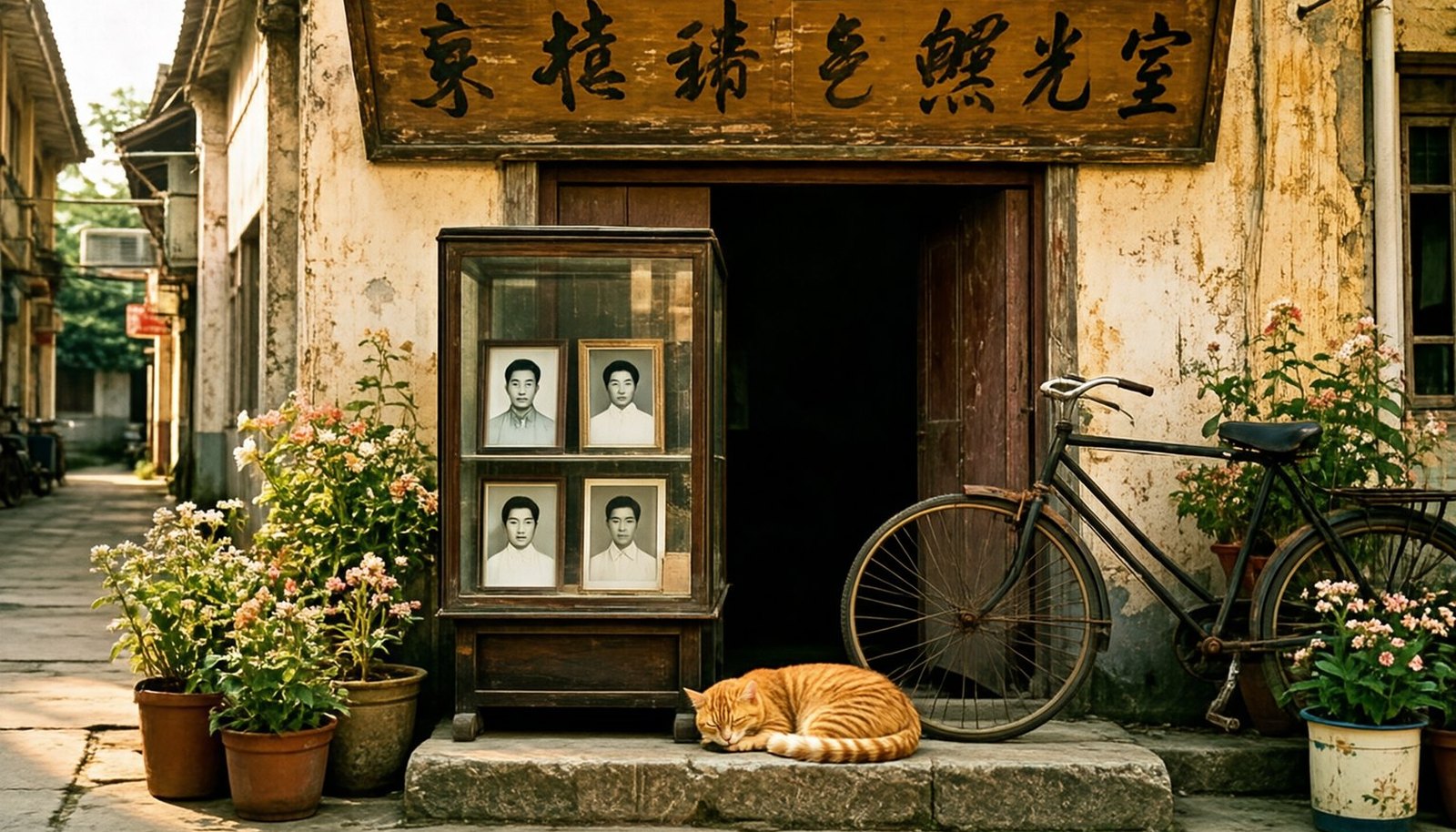
Illustration (AI-generated), not a game screenshot
You are minding the studio while its owner is away. In the cabinet are photographs nobody came back for since 1985, and ten of them are starred in the ledger: find them, understand them, and get them to their people before the lane is demolished. Read a name, put it into the search box, develop the roll, then decide which stamp the case deserves. No timer, no horror, no fail state — it only waits for the last photograph to reach a hand.
Files:45 (43 searchable + 2 granted by developing)
Darkroom:12 rolls (ten cases + biscuit tin + No. 000)
Endings:4, one of them hidden
Platform:Browser · Chinese and English · saves on this device
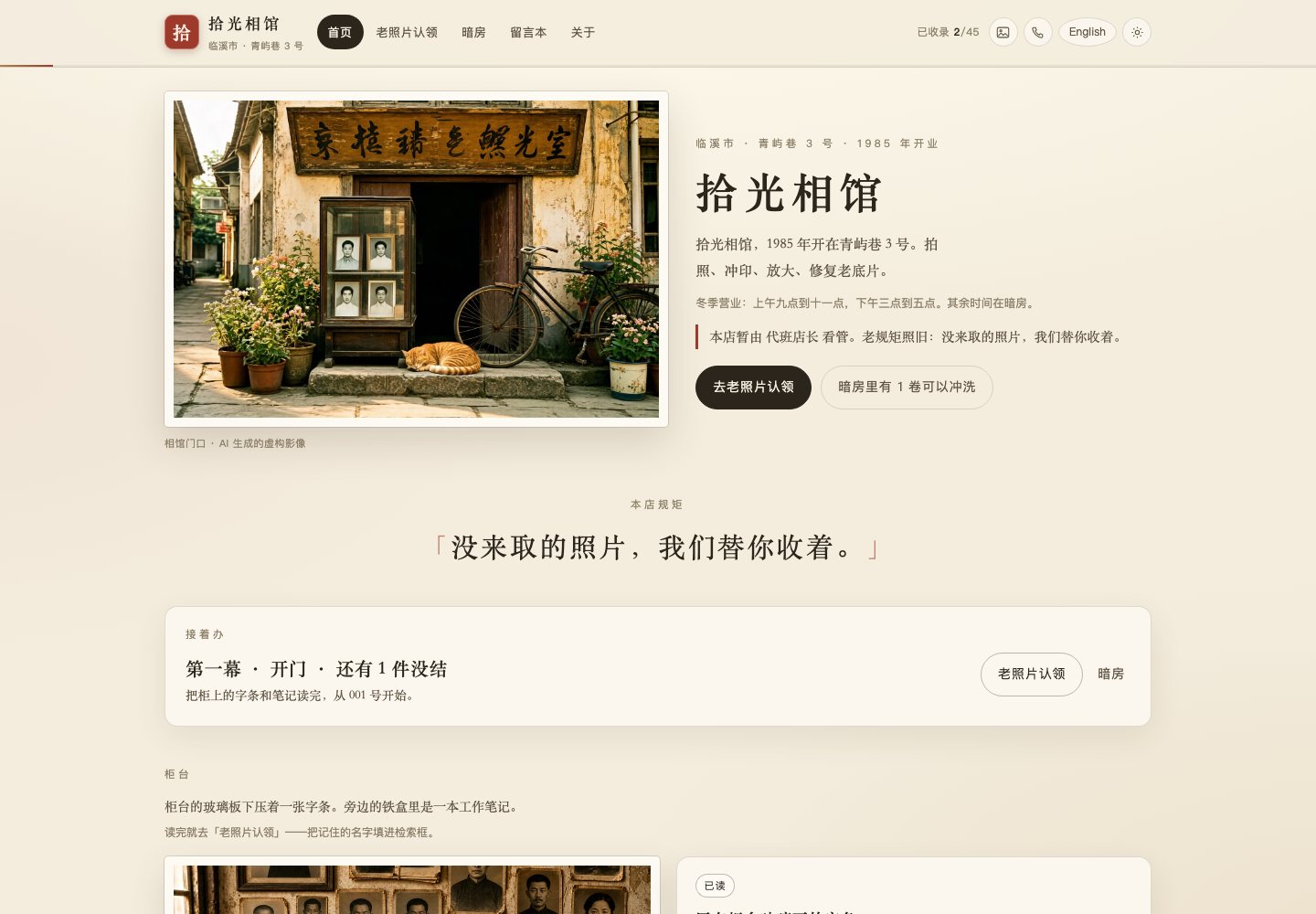
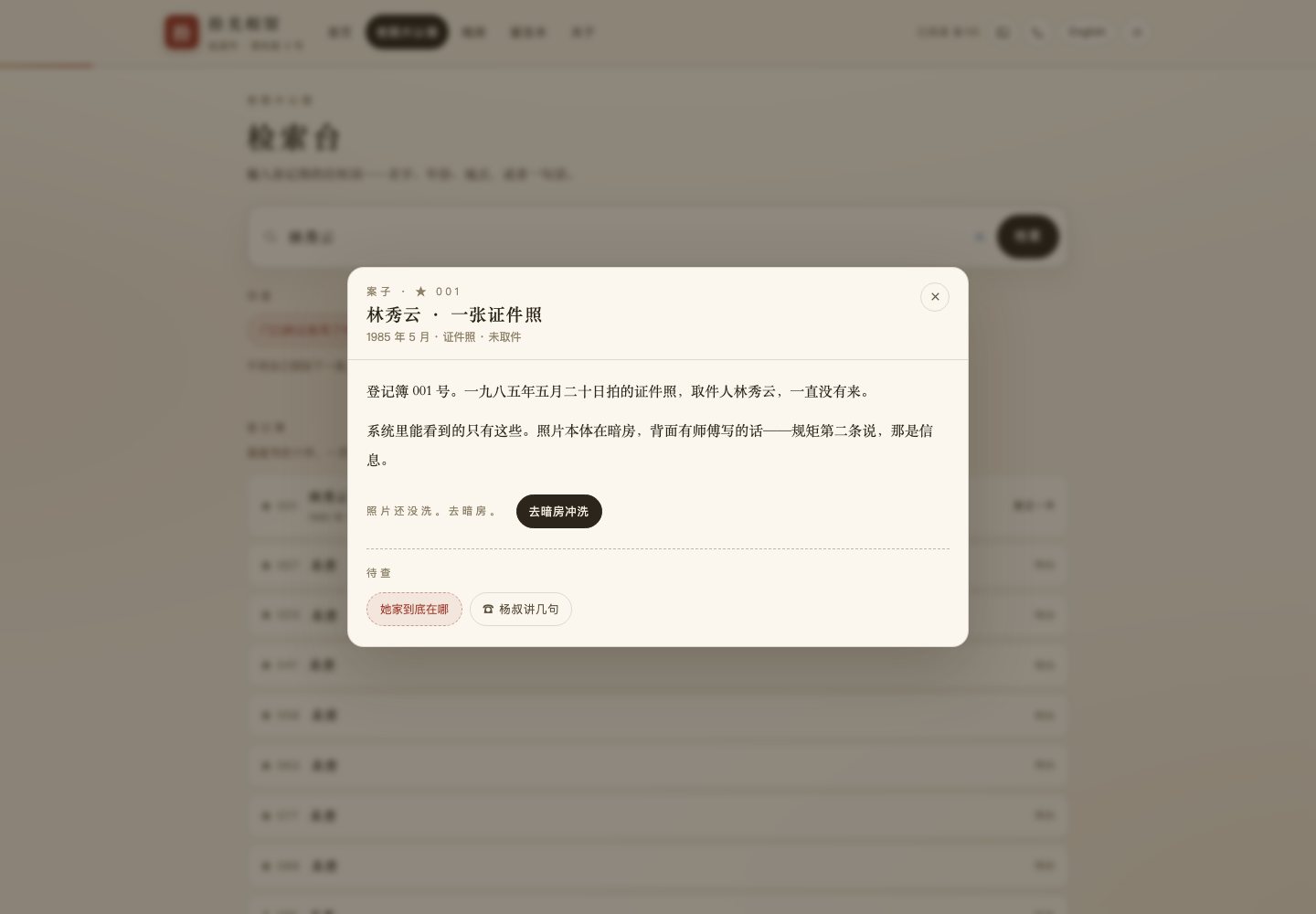
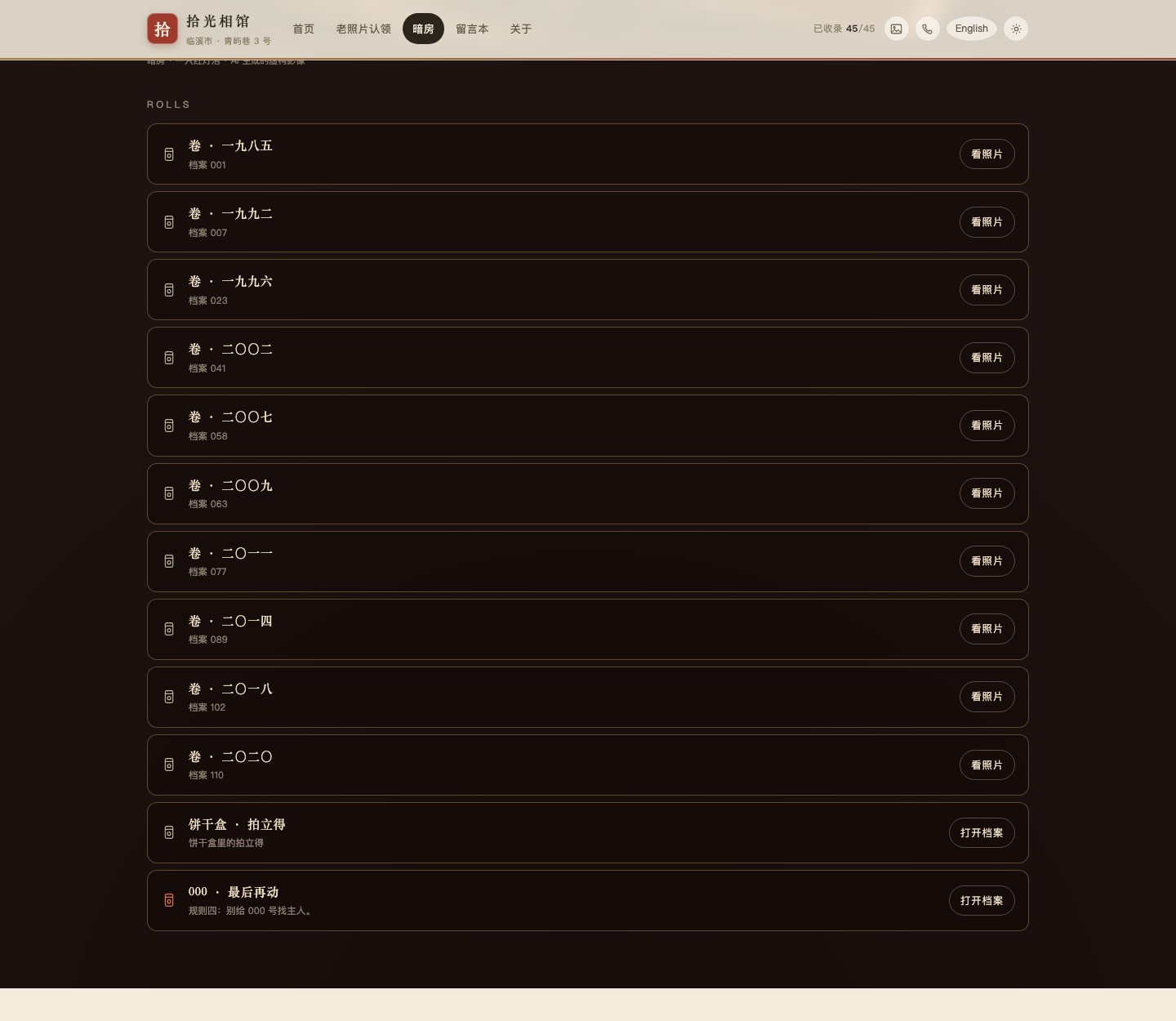
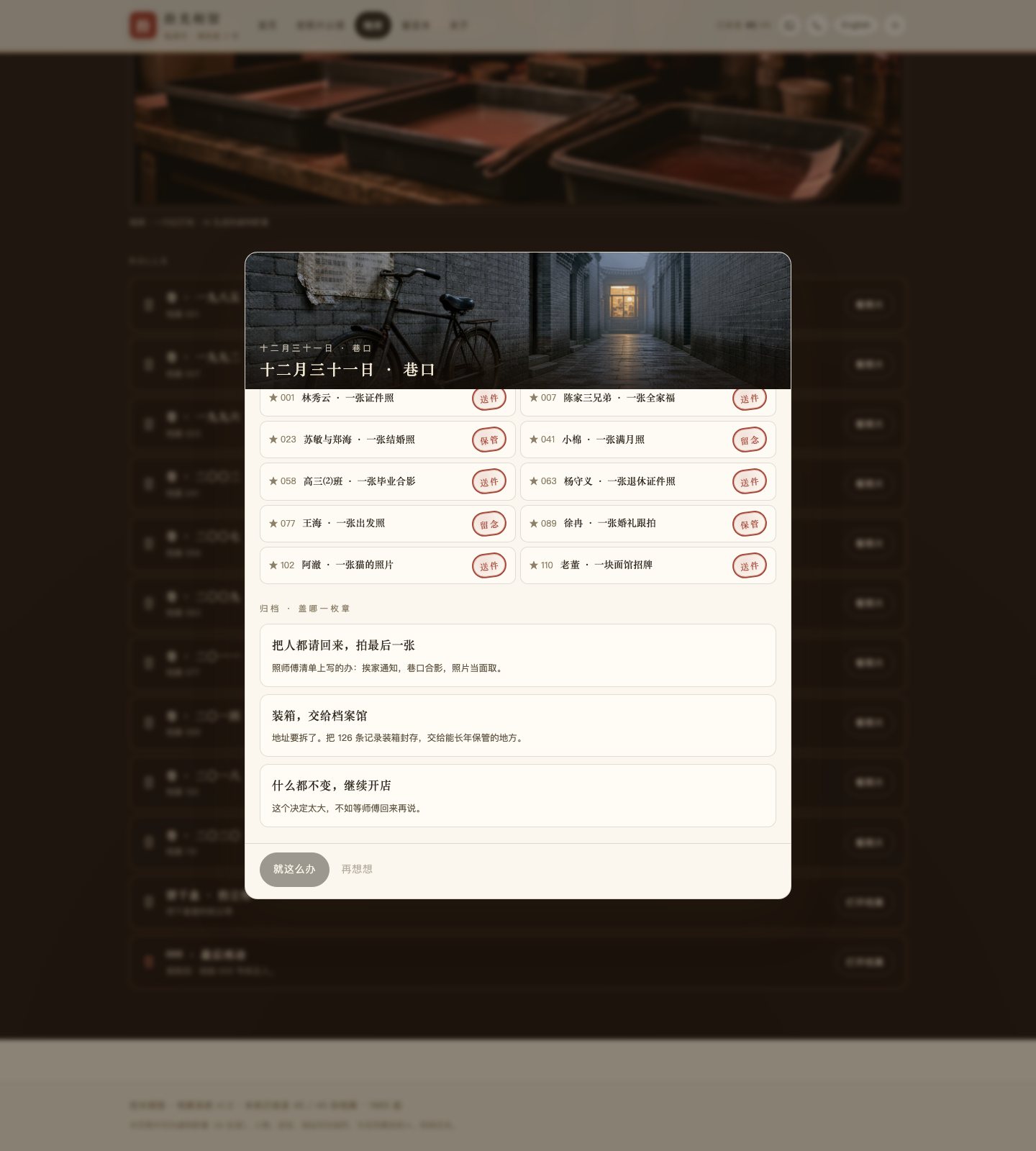
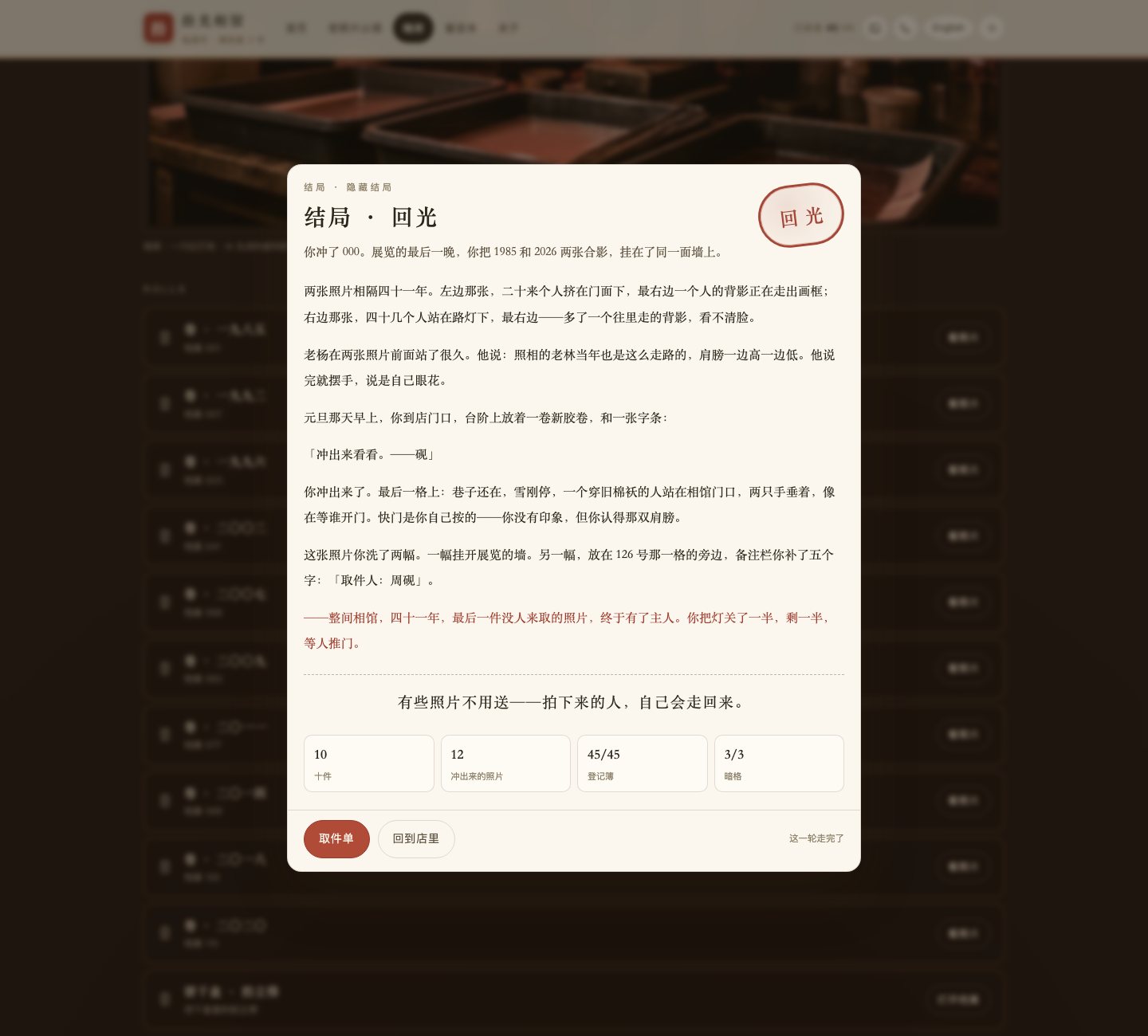
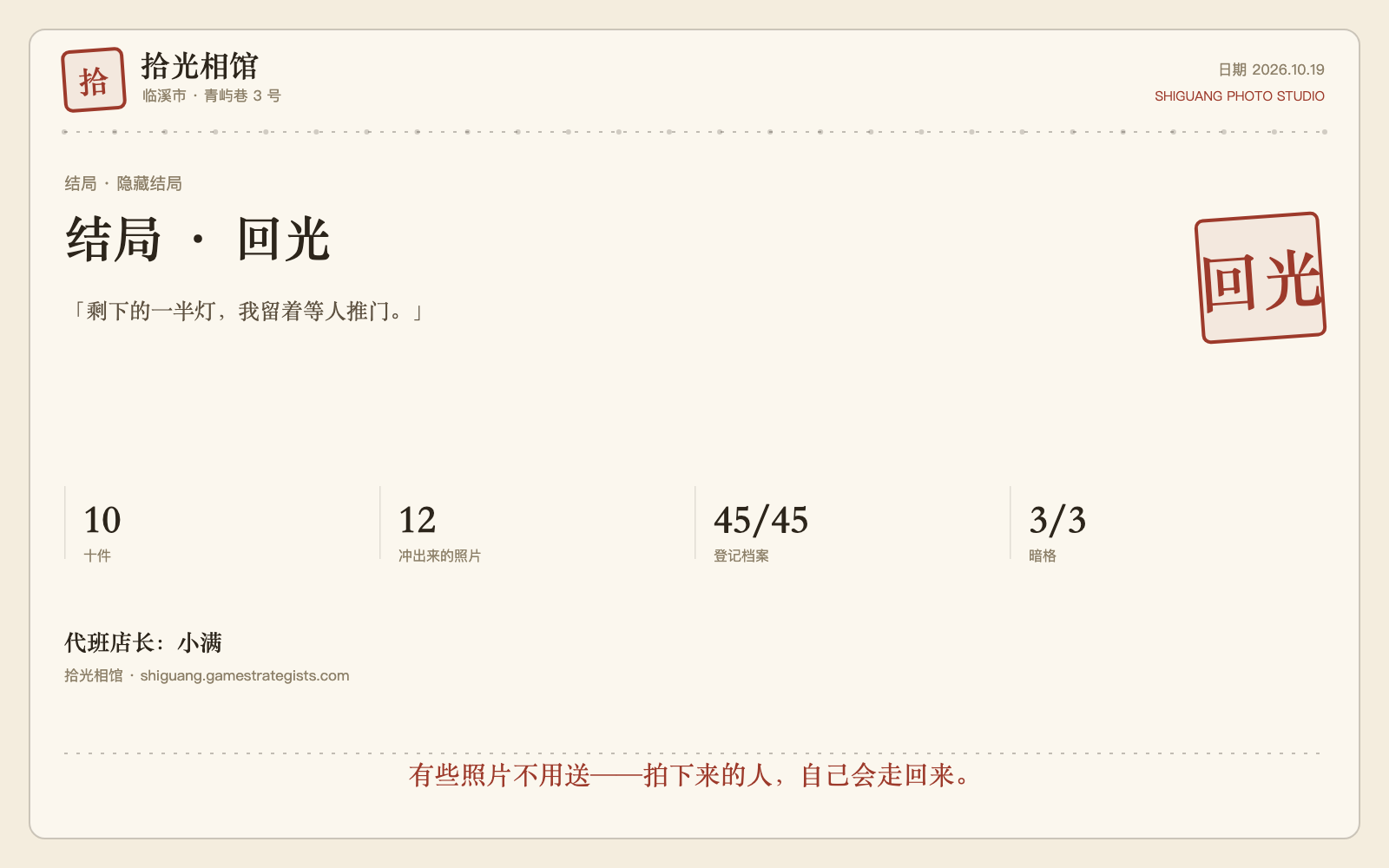
The front page: the shopfront, the note under the counter glass, and the first act's to-do. Top right reads "2/45 found" — the note and the work notebook are the only two records read at the start.Search: typing "Lin Xiuyun" opens record No. 001 straight away. The photo has not been developed yet, so the card offers the darkroom and two "to look up" leads.The darkroom, on a save with all ten cases finished: all 12 rolls developed. Ten are sorted by year (1985–2020); the last two are the biscuit tin and No. 000. Every row now reads "see the photo" or "open the file".The finale at the lane mouth on 31 December: ten files with the stamp each one earned, and three ways to close the shop — bring everyone back, box everything for the archive, or change nothing.The hidden ending, "Afterglow". The four counters read ten cases, 12 photographs, 45/45 records and 3/3 hidden files; the closing line is "Some photographs need no delivery — the person who took them walks back on their own."The 1600×1000 PNG the ending draws when you press "collection slip" (rendered on canvas in-game, not a screenshot): the keeper's name, the date, ten cases, photographs, the ledger, hidden files and the ending seal.
What it is
The Light We Kept is a keyword-retrieval mystery set in a neighbourhood photo studio that has stood for forty-one years. In July 2026 the owner, Zhou Yan, says he is going out to deliver something and does not come back. You mind the shop. A note waits under the counter glass; a work notebook waits in a tin box.
The game has four verbs: read a file, put a word from it into the search box, develop the roll in the darkroom, and stamp the case once it is settled. After the ten starred cases are done, the last frame — No. 126 — is yours to finish.
In the fiction the ledger runs to 126 entries, numbered 001 to 126 without a gap; what this game actually writes and lets you open is 45 files, ten of them starred. The two numbers do not compete: 126 is the shop's account, 45 is the paper you can read. Every figure on this page is checked against the 45 side.
No timer, no horror, no fail state; free, no sign-up, and it never asks for real personal details.
One shop, forty-one years
The studio opened at No. 3 Qingyu Lane, Linxi, on 1 May 1985. A larger backdrop arrived in 1992, along with the first school graduation photographs; the old guestbook was damaged by damp in 2003 and replaced; the last customer to ask for black-and-white came in 2015; no new commissions after 2021.
In the winter of 2023 Zhou Yan began delivering things on his own, telling no one. In 2026 the lane enters the renewal programme and must be vacated by 31 December; on 6 January 2027 the house plate comes down.
Those dates are not decoration. Every case sits in a particular year, and the writing on the back of a photo, the ledger number and the roll in the darkroom all have to agree. By the end you understand that "delivering" was never postage: it was handing photographs back, one at a time.
The first line of the game and the last are the same: "Photos nobody came back for, we keep for you."
The verb is search
The search box lives on the Lost Photos page. Every keyword comes out of something you have just read — a name, a year, a place, a shop, an object — 82 of them in all. The game never asks you to guess a password, and it never hides an answer in the pixels; the clues are words, and searching is how you follow them.
Search tries an exact match first, ignoring case, full-width forms, spaces and common punctuation. Then come eight special replies (for "photo", "thank you", "Qingyu Lane", "000" and so on), then fuzzy containment, minimum two characters. A single hit opens the file; several hits are listed for you to choose.
Files have prerequisites. If you hit one too early, you get a sealed notice with no spoiler: you know something is there, but it is not time to open it.
Every one of the ten cases has its answer written in the file and on the back of the photograph. No moral guesswork, no reading the owner's mind. You only have to finish reading the facts.
Treating the player as a beginner: three safety nets
First, the "to look up" chips. Each file you read offers the next lead; one tap puts the word into the search box, and you still press Enter yourself. There are 22 of them, so there is always a direction forward.
Second, the ledger. The right-hand column lists all 45 numbers; unread ones say "not yet". Tapping a number fills the search box. That is also how an English player can finish: the keywords are Chinese, the numbers are not.
Third, the telephone on the counter. Call Old Yang, the retired postman, and each case gives three tiers of hints — 30 in all. Miss three searches in a row and the phone rings on its own. A hint nudges; it never searches for you.
A wrong stamp cannot lock you out: the game answers with a line written for that mistake, the stamp does not land, and you may try again. There is no "wrong choice, start over".
The content gate runs a deliberately dumb player: it may only tap chips, tap ledger numbers and follow hints, and may not improvise. That player finishes 45/45, settles all ten cases and opens all four acts.
Three stamps: deliver, keep, memorial
Once a case is read and its photograph developed, you stamp it. Deliver means the address still exists and someone can still receive it; keep means someone will come back, so hold it for them; memorial means there is no address left, but someone has to remember. Across the ten: six deliver, two keep, two memorial.
The answer comes from facts rather than preference: is the recipient alive and reachable, does the address still stand, does the photograph belong to one person or two? Stamp No. 023 — a wedding portrait — as deliver, and the game asks whom you would deliver it to: one of the couple is in another province, the other is at the end of the lane, so either delivery is half a photograph.
Cases open by act: one in Act One, three in Act Two, four in Act Three, two in Act Four. The next act opens only when every case in the previous one is stamped. No. 126 is not an eleventh case; it is the last page to be stamped, and the finale appears only when the ten are done and 126 has been read.
The darkroom: twelve rolls
Ten rolls are sorted by year — 1985, 1992, 1996, 2002, 2007, 2009, 2011, 2014, 2018, 2020 — one for each case. A roll can only be developed after you have read its file; once developed, the photograph appears in the file, and the back of the photograph has writing on it.
The eleventh roll is a biscuit tin at the back of the shelf, holding instant photographs. You have to read the torn-out ledger page first before the darkroom admits it exists. The twelfth is No. 000; rule four of the work notebook exists for it alone — "do not look for the owner of No. 000" — and it stays locked until the ten cases are finished.
Twelve photographs = ten case photographs + the instant photo + No. 000. No. 000 adds no case and does not change the ten-case count; it changes only which ending you can reach.
Developing is an animation with water and timer sounds drawn by WebAudio. There is no real photographic paper and not one audio file in the build.
Four endings, one inside the last roll
The finale offers three choices: bring everyone back for one last photograph (Collection Day); box everything for the archive (Sealed); or change nothing and keep the shop open (Open House). All three are complete endings, none is a "bad end"; they differ in where the photographs end up and how far the door is closed.
If you have developed No. 000 and then choose to bring everyone back, you reach a fourth ending, "Afterglow". It is a hidden ending, not the true one: a player who never touches 000 does not feel a chapter short, while a player who does learns who is in the last frame.
The ending screen shows four counters — ten cases, photographs developed, ledger records, hidden files — and draws a 1600×1000 collection slip with the keeper's name, the date, those counters and the ending seal. It can be downloaded as a PNG or copied to the clipboard.
The name is the one you entered at the start (up to 24 characters); the date is the day you played. Neither is baked into a promo image.
Pictures and sound
The game contains 17 AI images: four scenes (shopfront, counter, darkroom, lane), ten case photographs, two developed photographs and one social card. In-game every scene and photograph is labelled as an AI-generated fictional image; the people, the shop and the address are invented.
The interface is built like paper: cream ground, serif body text, red seals, white borders and drop shadows on the prints. There is no simulated browser and no terminal window — the site is simply the studio's own website. You are reading its pages, not cracking a machine.
Photographs are not decoration. Each has to be developed in the darkroom before it appears in its file, and each has writing on the back — usually the next lead.
All sound is synthesised live with WebAudio: shutter, stamp, doorbell, telephone. No audio files. It runs on desktop and phone; at 390×844 the layout was measured with no horizontal overflow.
The gates: how we know it can be finished
The rules are a pure-data kernel that touches neither DOM nor canvas, so the whole game can be walked in node. The content gate has 21 checks plus four negative controls, all green on 2026-10-19: 45/45 reachable, ten cases settleable, four acts openable, 12 rolls developable, no dead "to look up" chip, every chip term actually finds something, and every Chinese search term quoted in the English hints matches the Chinese side one for one.
The four negative controls deliberately break the game: delete the keyword for 041 and the playthrough must fail; remove the 1996 roll and 023 must be impossible to stamp; cut 023's telephone line and some file must become unfindable; delete one English key and the bilingual check must go red. An assertion that cannot turn red is not an assertion.
The render gate drives a real browser through the whole path: enter a name, search 001, develop the roll, stamp the wrong way once, stamp correctly, push to the finale, choose an ending and draw the collection slip. It runs at 1280×900 and 390×844 and checks script errors, 4xx/5xx, horizontal overflow and whether the photographs actually load. Its negative control empties the interface and must fire four checks.
Saves live under shiguang.save.v1 with a 32-bit FNV-1a checksum: a hand-edited save returns to the start, junk does not throw, and missing fields fall back one by one. Progress stays on this device and does not sync.
How the numbers on this page are checked
The 45 files, 43 searchable, 2 granted by developing (the instant photo and No. 000), ten starred cases, eleven case records including 126, 12 photographs, 12 rolls, four acts (1/3/4/2), four endings and eight special replies all come from shiguang/src/data/records.js and src/data/endings.js. The 82 keywords, 22 chips and 30 telephone hints come from src/data/records-act1..4.js and records-secrets.js.
The exact / special / containment order, the two-character minimum, sealed notices, the rule that only the correct stamp lands, the conditions for the ten cases and No. 126, and the Afterglow test (choose the exhibition and have developed No. 000) are in src/game/engine.js; the save key and checksum are in src/game/save.js.
The 21 checks and four negative controls, the render gate's 0 problems and its four negative controls, were produced on 2026-10-19 by `node scripts/audit-game.mjs --selftest` and `node scripts/check-render.mjs --selftest` in the shiguang repository. They are measured, not estimated.
The five screenshots were taken from the running game on 2026-10-19: one save with 45/45 read, 11 stamps landed and 12 rolls developed. The collection slip is a PNG drawn by the game's canvas, not a screenshot. The hero is an AI illustration, not gameplay, and is labelled at the top; the photographs inside the game are labelled as AI-generated fiction on screen. If a figure here disagrees with the game, the game is right.
Who it is for
For people who like reading, opening files and reconnecting a name to a life; and for anyone looking for a mystery that does not scare, rush or punish, and can be read across several sittings. Its pace is the pace of reading, not of input.
Not for anyone looking for jump scares, action, leaderboards or PvP: there is no enemy here, no clock, only a cabinet of photographs and a lane due for demolition.
The story touches demolition, parting, bereavement and off-screen death (one case is a baby's first-month portrait; another is someone who did not come back). There is no horror imagery, no jump scare and no gore.
The interface is Chinese and English. Search terms are Chinese; English players can finish using the chips and ledger numbers, and the gate has proved 45/45 reachable with exactly that dumb-player model.
FAQ
Do I need an account, payment or real personal details? No. It runs free in the browser, has no purchases, and never asks for a phone number, ID number or other real details.
Is there horror? No jump scares, no horror imagery and no gore. The story does touch demolition, parting, bereavement and off-screen death; case No. 041 is a baby's first-month portrait.
What if I get stuck? Tap a "to look up" chip in the text, or an unread number in the ledger, or call Old Yang from the counter: three tiers of hints per case. Miss three searches in a row and the phone rings by itself.
What happens if I stamp wrongly? Nothing locks and nothing reloads. The game answers with a line written for that stamp; the stamp does not land; you try again.
Can I play in English? Yes. The interface and hints are English; search terms are Chinese, but the chips fill them in for you and ledger numbers can be typed directly. Every Chinese term quoted in an English hint matches the Chinese side.
How long does it take? There is no timer and it is not designed by the minute. Ten cases across four acts; the length depends on how closely you read, and it can be finished in one sitting or several.
Where is progress saved? In this browser under shiguang.save.v1, with a checksum against tampering. It does not travel between devices.
What is No. 000? The last frame, and the key to the hidden ending. Rule four of the work notebook says not to look for its owner, and the darkroom will not let you touch it until the ten cases are done.
Are there ads? No. This title has no ad slots and does not load any ad script.
What if it will not open? Try a current Chrome, Edge or Firefox. If it still fails, email contact@gamestrategists.com with your device and browser version.
Mind the shop — Runs on its own subdomain · no timer · progress saved on this device