Rust River is our first-party industrial-horror ARG: a lab report showing groundwater 127 times the national standard leads journalist Ye Shen into a south-western smelter town with 47 disappearances over twenty years. 9 acts, 18 puzzles, 20 simulated websites, 24 collectible clues, 4 endings, 8–12 hours. Contains horror content and sudden audio.
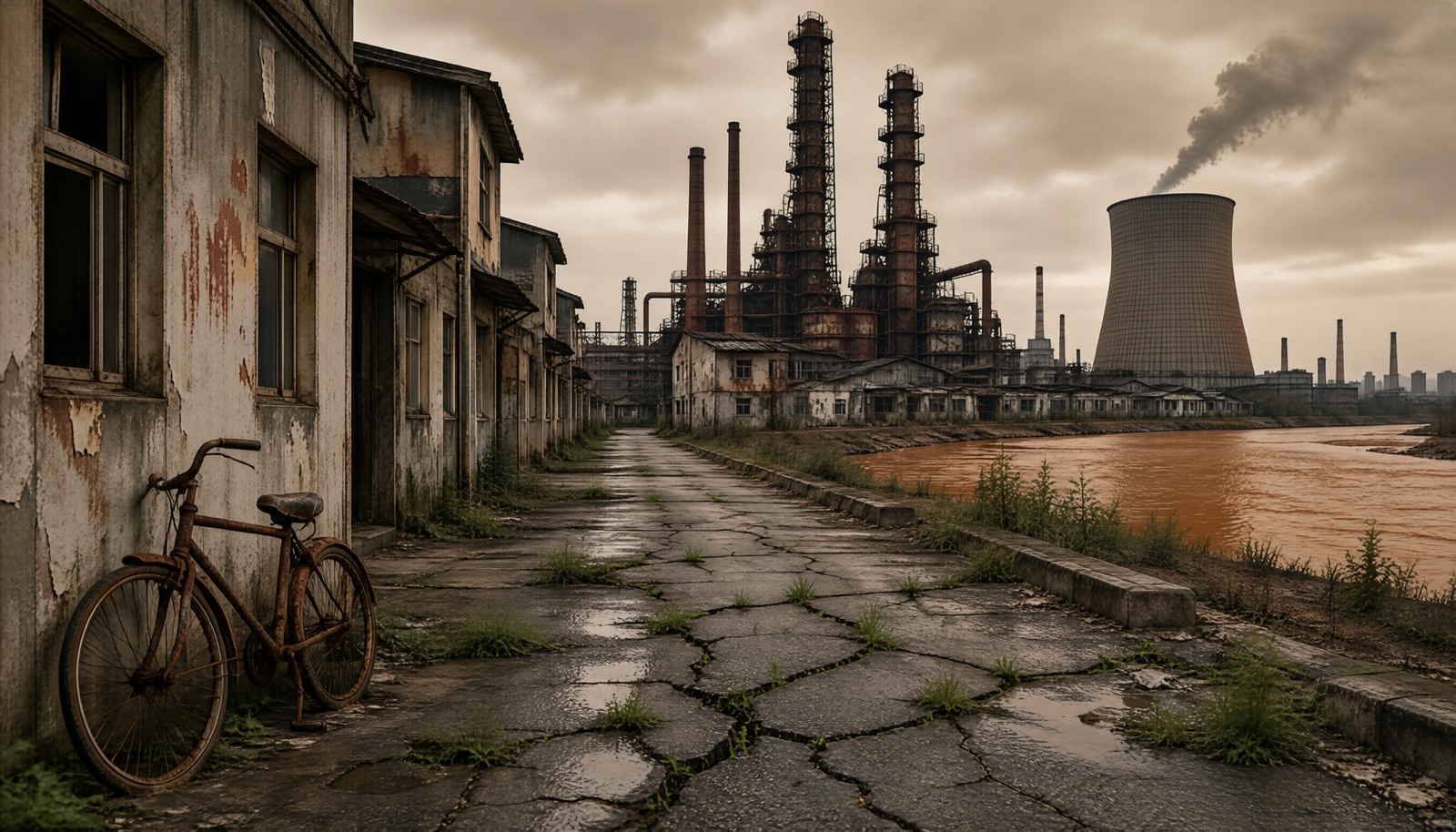
Illustration (AI-generated), not a game screenshot
April 2026. Investigative journalist Ye Shen receives an anonymous email with one attachment: a lab report showing groundwater heavy metals 127 times the national standard in a small town in south-west China. She arrives with a recorder and a 1960s survey map. 9 acts, 18 puzzles, 20 simulated websites (48 pages), 24 collectible clues, 44 emails, 4 endings, an 8-page missing-workers ledger (47 people), 8–12 hours.
Acts:9
Puzzles:18
Simulated sites:20 / 48 pages
Missing-workers ledger:8 pages / 47 people, one per act
Collectible clues:24
Emails:44
Endings:4
Length:8–12 hours
Platform:Browser, nothing to install
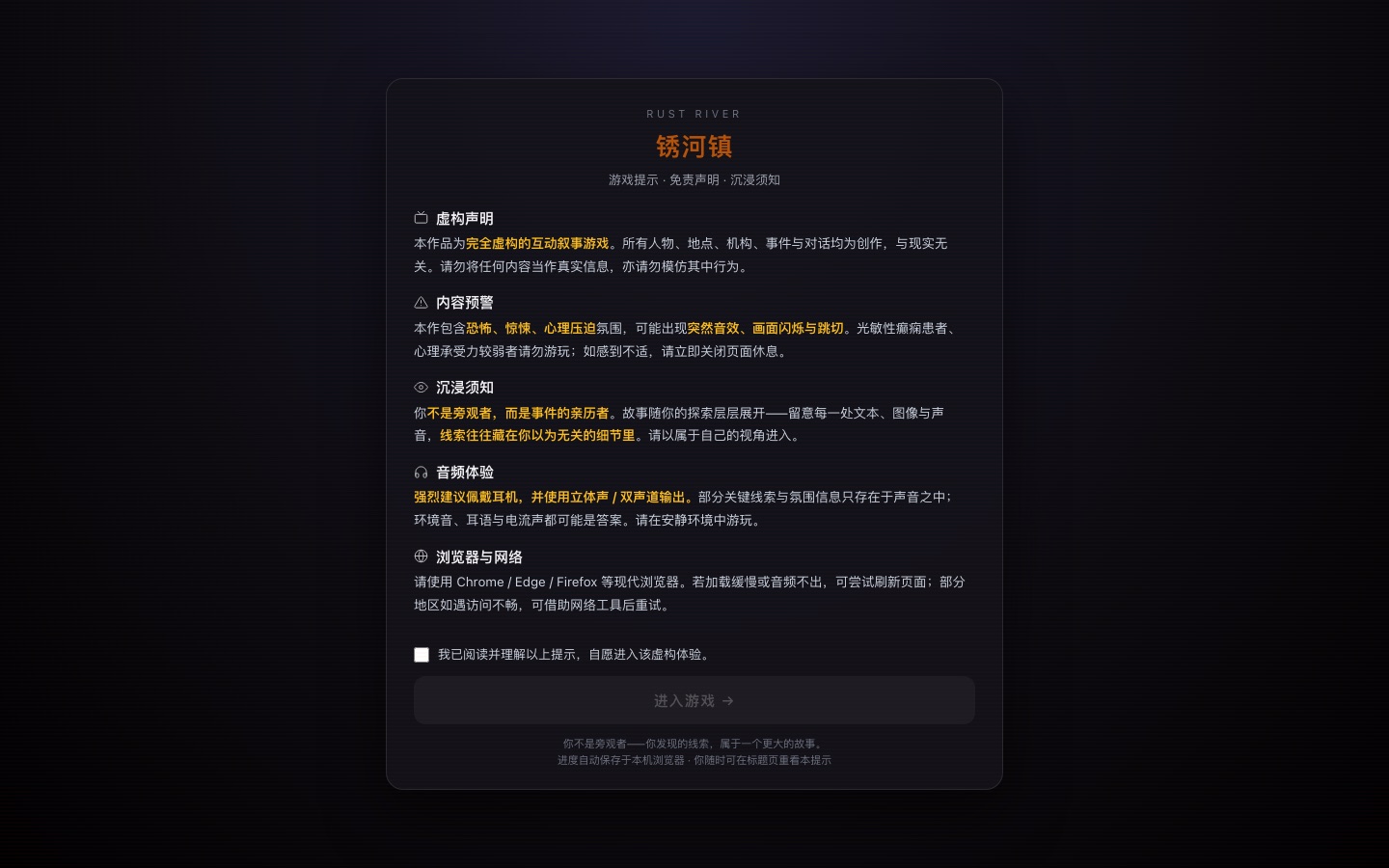
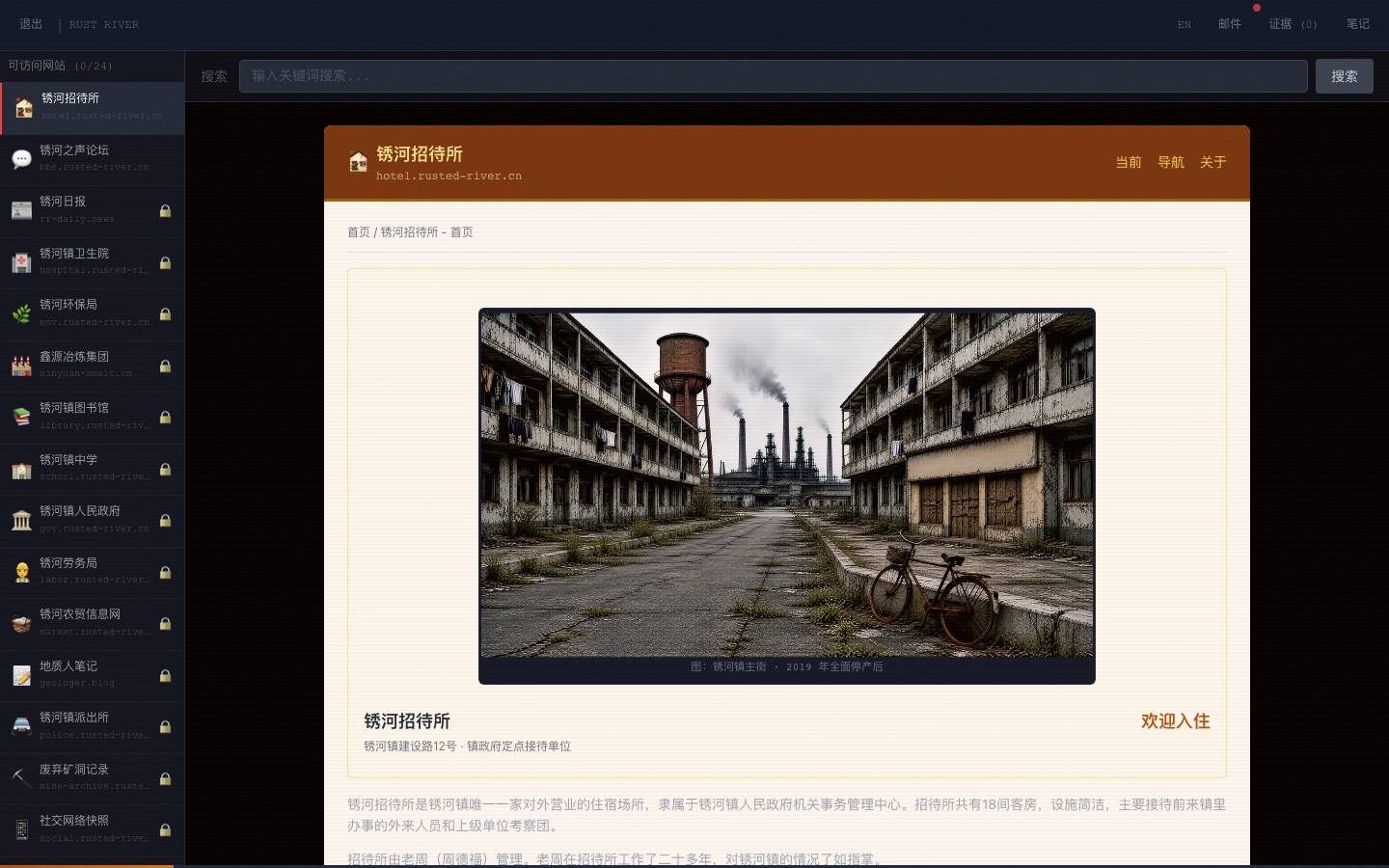
The fiction notice and content warning before entry; the box must be ticked to continueThe Rust River guesthouse site inside the fake browser: 20 sites on the left (padlocks open per act), keyword search and the evidence bar on top
What it is
April 2026. Journalist Ye Shen receives an anonymous email: no signature, one attachment — a PDF test report showing groundwater heavy metal levels 127 times the national standard in a small south-western town. At the bottom, a handwritten scan: “The water in Rust River is tainted. So are the people. Coming?”
Four days later she boards the long-distance bus with the email, a voice recorder and a 1960s geological survey map photocopied from the provincial library. What she does not know: she is not the first investigator here. The ones who came before never left.
It is played as a pseudo-interface investigation: the game is a browser and you hop between twenty simulated websites — the guesthouse, the Rust River forum, the daily paper, the township clinic, the environmental bureau, Xinyuan Smelting, the library, the middle school, the town government, the labour office, the agricultural market board, a geologist's notes, the police post, abandoned mine records, social snapshots, a lab, geological archives, a dark-web entry, deep files and the final site — 48 pages in all.
The horror works on two levels. One is a straight pollution investigation: exceedance factors, deleted case files, forty-seven people who “disappeared” rather than left over twenty years. The other is what those records point at once assembled: a cavity breached by drilling in 1999 that releases a pulse every seven years on a 222-year cycle.
Let us be plain: the content warning
Before you enter the town there is a checkbox you must tick, and the warning is the game's own: it contains horror, thriller and psychological pressure, with sudden sounds, flicker and jump cuts; it advises against play for people with photosensitive epilepsy or lower tolerance, and says to close the page immediately if you feel unwell.
This page will not soften that sentence. It is a different game from Unclaimed or Last Online: those are warm and quietly tense; this one has jump cuts and sudden audio, and its subject matter includes pollution illness and disappearance.
It is also entirely fictional. The landing and trust pages state that all people, places, institutions and events are invented — nothing here should be read as real information, and none of it should be imitated.
How to play: one browser, twenty sites
The left rail lists the sites: reachable ones lit, locked ones padlocked; they open as acts advance;
The top bar is a keyword search: one term, results aggregated across sites, with discovered keywords kept as chips below;
The evidence bar reads “evidence n/24”: each collectible clue advances it, and the rail uses the same denominator;
At the top of the evidence panel is the Missing Workers ledger: one page per act, eight pages covering 47 people, each with a roster and one person’s last line;
Emails and notes are separate panels: 44 emails carry the chronology and relationships, notes keep the conclusions you derived;
Puzzles are inputs: a frequency, water-report figures, a hidden clinic number, a book-page cipher, a borrower sequence, an access code, a hidden budget line, an encrypted spreadsheet, an underground headcount, deep coordinates, a constant temperature difference, a thermal shape, a cycle series, a rising frequency, and the resonance word;
Two puzzles are special: underground Morse (count shorts and longs) and an image in the noise (read the shape off the spectrogram);
Puzzle 15 is a choice leading to different endings; progress saves locally, Chinese by default with English available.
Nine acts
Act 0 · Arrival: the guesthouse; the water tastes of metal and people watch the door;
Act 1 · Tainted Water: your samples exceed the standard by orders of magnitude, and the clinic's “metal deposition” case files have been edited;
Act 2 · Echo Below: a self-described former Xinyuan engineer writes — the secret is not the pollution but a shallow cavity 400 metres down;
Act 3 · The Xinyuan Curtain: inside the company systems: a deep bore twenty years ago punched through a crustal cavity, and the cavity is not empty;
Act 4 · The Missing: forty-seven disappearances in twenty years, all of them underground workers at Xinyuan; the newest was three days ago;
Act 5 · Eye of Geology: provincial deep-survey data shows a near-perfect sphere about 800 metres across at roughly a kilometre down, with wall ages that do not belong to that stratum;
Act 6 · Window of Sound: the cavity releases a pulse every seven years; during it electronics fail and residents share one dream;
Act 7 · The Final Choice: at the mouth of Shaft Three the low vibration keeps rising — publish, go down, or something else;
Act 8 · The Resonant Year: 2026 is the peak of the 222-year cycle, and what lies under Rust River resonates in step with other sites in this universe.
Eighteen puzzles, and what each one tests
Mystery frequency: fix the unit and band before using the number in the email;
Water report cipher: the exceedance factor and the sampling point sit in different parts of one document;
The hidden number: a deleted clinic page still leaves one figure behind;
Book-page code: shelf marks and page numbers are read through the loan record;
Borrower sequence: order the borrowers in time; the names carry the answer;
Access code: the internal system's format matches the mine district numbering;
Hidden budget: an expenditure absent from the official sheet — the amount is the clue;
Encrypted spreadsheet: the trap is a hidden column, not the formula;
Underground headcount: the gap between shaft rosters and the surface list;
Deep coordinates: match the projection used by the 1960s map and the provincial survey;
Constant temperature difference: a value that barely moves across a year implies a heat source;
Thermal node shape: connect the nodes and it is a shape, not a scatter;
Cycle series: how the seven-year pulse nests inside the 222-year cycle;
Rising frequency: the progression between 47.8 Hz and 52.9 Hz;
The final choice: options lead to different endings; only those with enough clues see all of them;
Word of resonance: it is called several things, once each in the files, the recording and the forum;
Underground Morse: the shaft keeper already counted the signals; translate letter by letter;
Image in the noise: the answer is the figure drawn on the spectrogram, not a number.
Four endings
The four are decided by the choice in puzzle 15, and two also depend on how many clues you collected; exact triggers are in the walkthrough.
With all eight ledger pages, every ending gains a final page headed “the last page of the ledger.” It changes no branch; it is their shared coda.
Ending · Buried Secret: you publish everything. Xinyuan halts, Shaft Three is sealed, residents are relocated for “environmental works”; He Yongchang and Zhou Huaimin become entries 48 and 49 on the missing list; you leave with a low hum between 47.8 and 52.9 Hz that doctors call tinnitus;
Hidden ending · Voice Below: you go in alone. Forty minutes later you stand at the edge of the cavity and hear a sound inside your skull — a being whose existence is wave-form, trapped in the crust for 450 million years: “Take me out. Not open the prison. Let me go home.”;
Secret ending · Abyssal Echo: you descend with a 52.9 Hz generator like a navigation beacon. The shell opens and you see the people preserved in the medium — He, Zhou, Chen Xiaoyan and the miners on the list. They do not want to leave;
True ending · Aftermath of Rust River: you neither descend nor go to the press. You post He Yongchang's recording to the town forum: “The sound you have been hearing — what is it saying?” Within three days miners reply that it says “go home”, “sorry”, “I don't want to hurt anyone”. On the seventh day the answer comes from above: the cavity's output climbs 52 → 104 → 208 Hz, then stops, and the survey shows a perfect sphere where the anomaly was.
The missing-workers ledger: forty-seven people, eight pages
The labour bureau’s directed-training contracts gave only forty-seven numbers, start dates and the word “missing.” These eight pages turn them back into people: names, jobs, last days, and what eight of them left behind.
The ledger unseals with the acts, one page per act. The fourth row on the first page is Ye Changlin — Ye Shen’s father. The game does not say so; it only leaves his line at the bottom: “Tell Shenshen I’m working late tonight.”
The entrance is at the top of the evidence panel. All eight pages are guaranteed before the final chapter; with the full set, every ending gains a page called “the last page of the ledger”: forty-seven names in number order, and one blank line at the end.
The ledger gives no puzzle answers. It fills in what these forty-seven people did, loved and promised before they became “missing persons.”
The eight object photographs are AI-generated illustrations used to fill in the objects, not screenshots of the game.
Where players get stuck
The search takes one keyword; whole sentences return nothing;
A padlocked site means an act you have not reached, not a secret;
The clinic puzzle needs the deleted page number from the library first;
The spreadsheet trap is the hidden column;
Deep coordinates differ between the 1960s map and provincial data because of projection;
The Morse puzzle's shorts and longs are already counted for you;
For the true ending, read all three sources of 52.9 Hz — they are split across the lab, the forum and the geological archive.
Why it is worth several evenings
It is the longest game here: 8–12 hours, twenty sites, 48 pages, 24 collectible clues, 44 emails. It is not built to frighten you in one sitting but to let you finish a fictional town's records the way real reporting ends.
It turns investigative-journalism form into mechanics: exceedance factors, edited case files, a budget line that is not in the budget, the difference between shaft rosters and the surface list. Those are the reporter's tools and the puzzle material at once.
The four endings are genuinely different postures: publish, go alone, go with a beacon, or hand the question back to the town. The true ending is not a victory — it is a whole town listening once.
If you play one of our ARGs, this is the biggest. If sudden audio and jump cuts are a line you do not cross, read the content warning section first.
How it sits in the shared universe
Rust River is inland and south-western, on the same map as the coastal Lan City (The Sunken City, Tide Sound Archives) and the hillside asylum of Eye of the Abyss.
Act 8 ties the 222-year cycle to several locations at once; that shared mechanism, not a cameo, is how the games connect.
No required order. Play this first and the others show the same cycle behaving differently elsewhere.
Recent changes
2026-10-20: the missing-workers ledger adds eight pages covering 47 people, one per act, plus a “last page” after every ending;
2026-10-18: the evidence counter no longer shows self-contradictory values such as 31/24, chapter buttons are no longer dead, and missing pieces now say what is missing; the title screen uses an in-repo town photo as a low-contrast backdrop, subtitle contrast raised from 2.38:1 to 6.22:1 with bilingual captions and alt text; share images standardised at 1200×630;
2026-10-17: og:image switched to the WebP already served by this repo instead of a 3.4 MB PNG; trust-page dates follow real body revisions;
2026-10-16: trust pages gained a content-rating note and a unified credit.
How the numbers on this page are checked
Nine acts come from acts.js, eighteen puzzles from puzzles.js, twenty sites from locations.js and 48 pages from the summed entries of the pages-*.js files; 44 emails from emails.js and four endings from endings.js.
Twenty-four is the denominator the evidence bar itself uses (the size of the collectible clue set in App.vue), not the row count of the clue data file, which holds 76 entries of which some are not collectible. The 8–12 hours is the game's own stated playtime.
The ledger’s eight pages, forty-seven names and start dates come from ledger.js; the build gate checks the numbers run 01–47 without gaps, that each page’s focus person is in that page’s roster, that all eight images exist, and runs negative controls.
Both screenshots were taken from the running game on 2026-10-19. The hero image is an AI-generated illustration, not a game screenshot, labelled at the top of the page. If a number here disagrees with the game, the game is right; tell us in the changelog.
Who it is for
For players happy to spend several evenings through a fictional industrial town's public record and to accept horror atmosphere and sudden audio; also for anyone interested in investigation-shaped puzzles.
Not for players wanting something short and sharp, nor for those who will not tolerate jump cuts and psychological pressure; people with photosensitive epilepsy should not play.
FAQ
Do I need an account or payment? No. It runs in the browser, free, with no account or in-app purchases.
Is there horror content? Yes. The landing warning states horror, thriller and psychological pressure with sudden sounds, flicker and jump cuts; you must tick it to enter.
How long is it? About 8–12 hours; seeing all four endings takes longer, and two depend on clue count.
Where is progress saved? Locally in the browser. Refresh or close and continue; it does not sync across devices, and clearing site data restarts.
What if I am stuck? Check the evidence bar and keyword chips, then search again; every answer is in the body text of an unlocked site — no outside sources needed.
Can I switch to English? Yes; the interface and the site content have English versions.
Can I miss the missing-workers ledger? No. It unseals one page per act and is complete before the final chapter; the full set adds a “last page” after every ending.
Is this a true story? No. It is an entirely fictional interactive game; the people, places, institutions and events are invented and should not be read as real information.
Start investigation — Runs on its own subdomain · progress saved locally · contains horror content and sudden audio