The Last Bus to Lingjiao
On 17 November 2009 the 17:40 bus to Lingjiao never came back, and the record says conductor Zhou Hui was not on board.
On 17 November 2009 the 17:40 bus to Lingjiao never came back, and the record says conductor Zhou Hui was not on board.
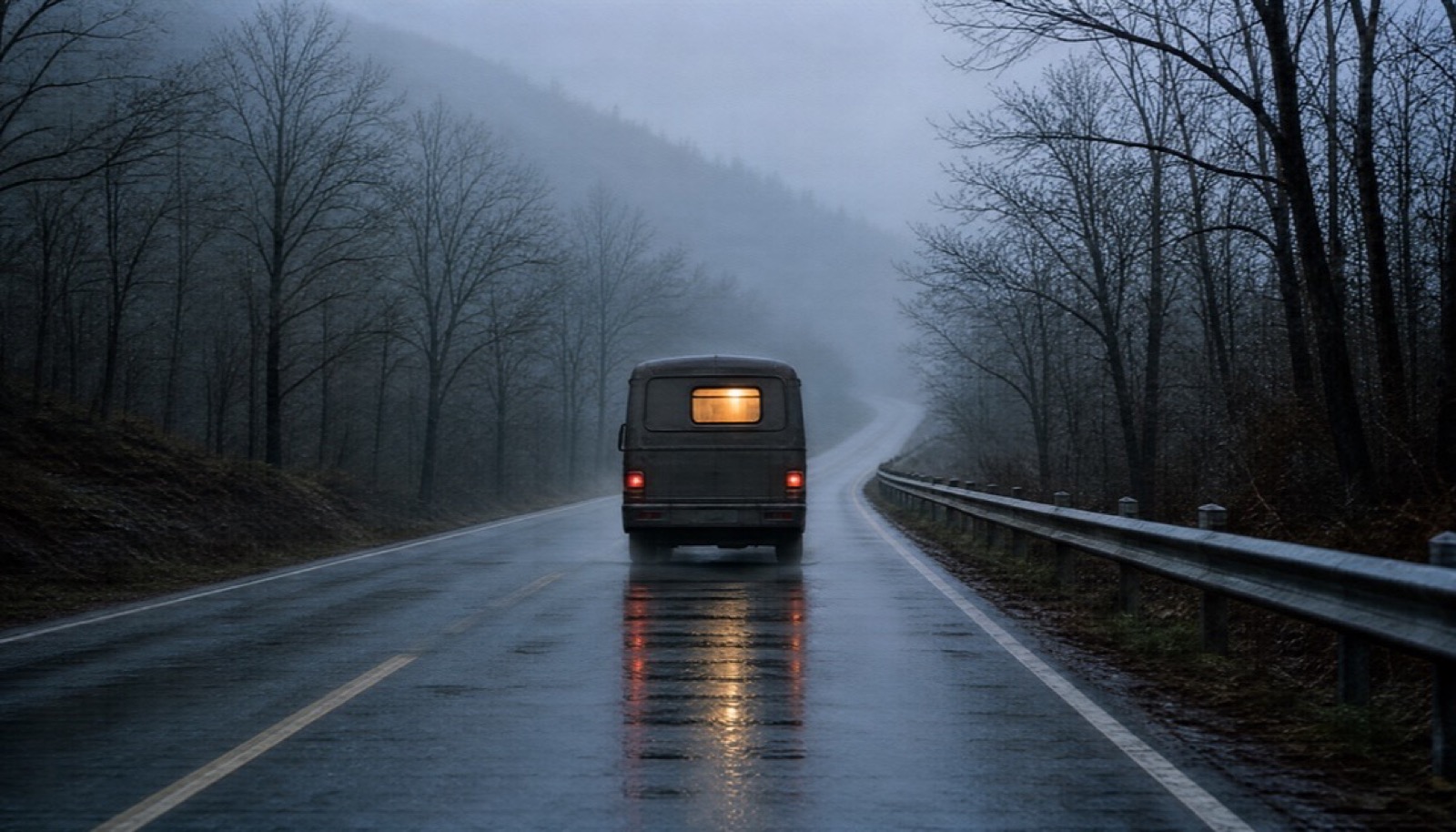
On 17 November 2009 the 17:40 bus from Anping to Lingjiao never came back. The official record says conductor Zhou Hui was not on duty and not on board. Seventeen years later her son, Zhou Ye, receives a text from an unknown number: “Your mother was on that bus. The site is still up.”
Released 2026-10-25 · Version 1.0.0 · Updated 2026-10-25
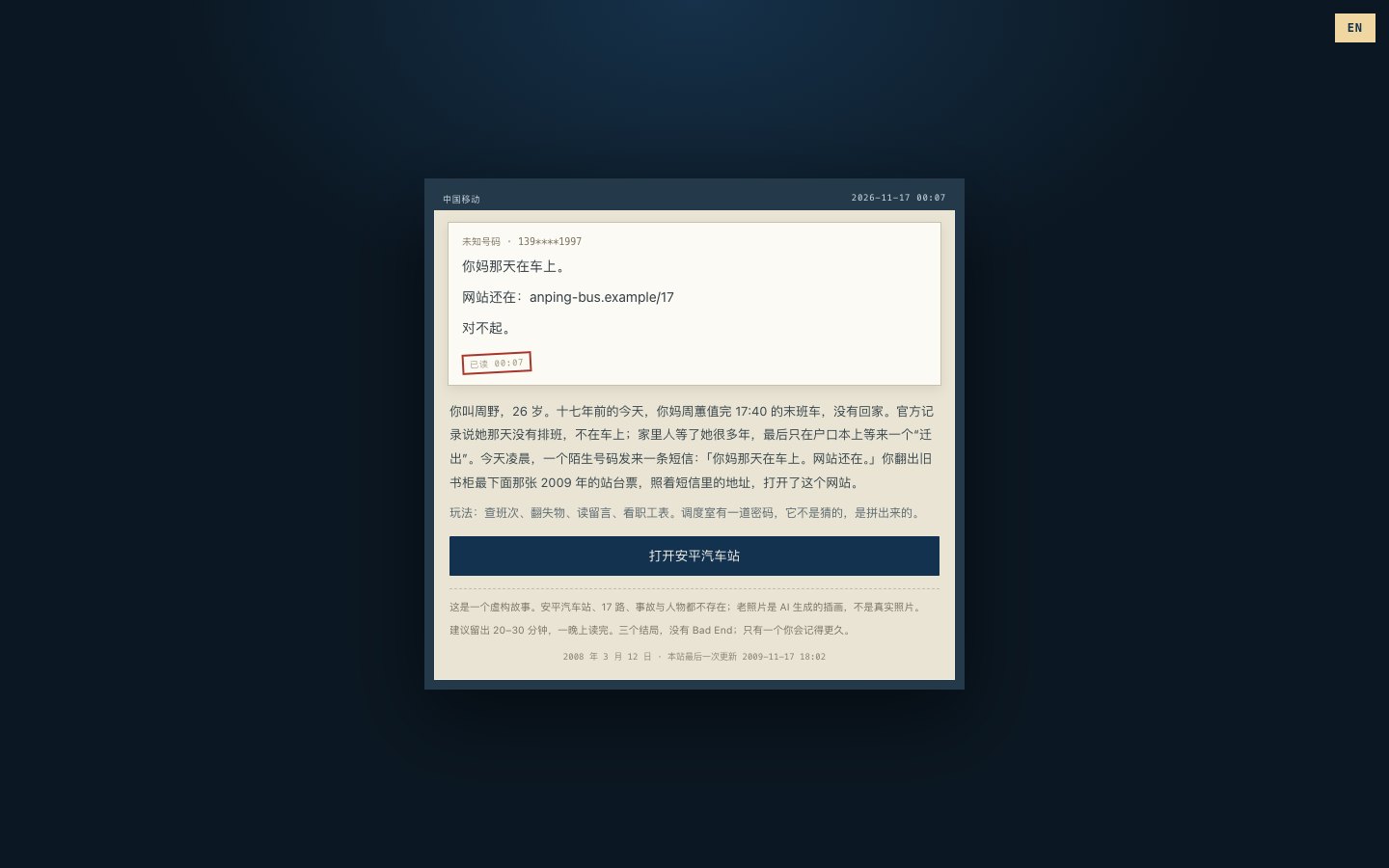
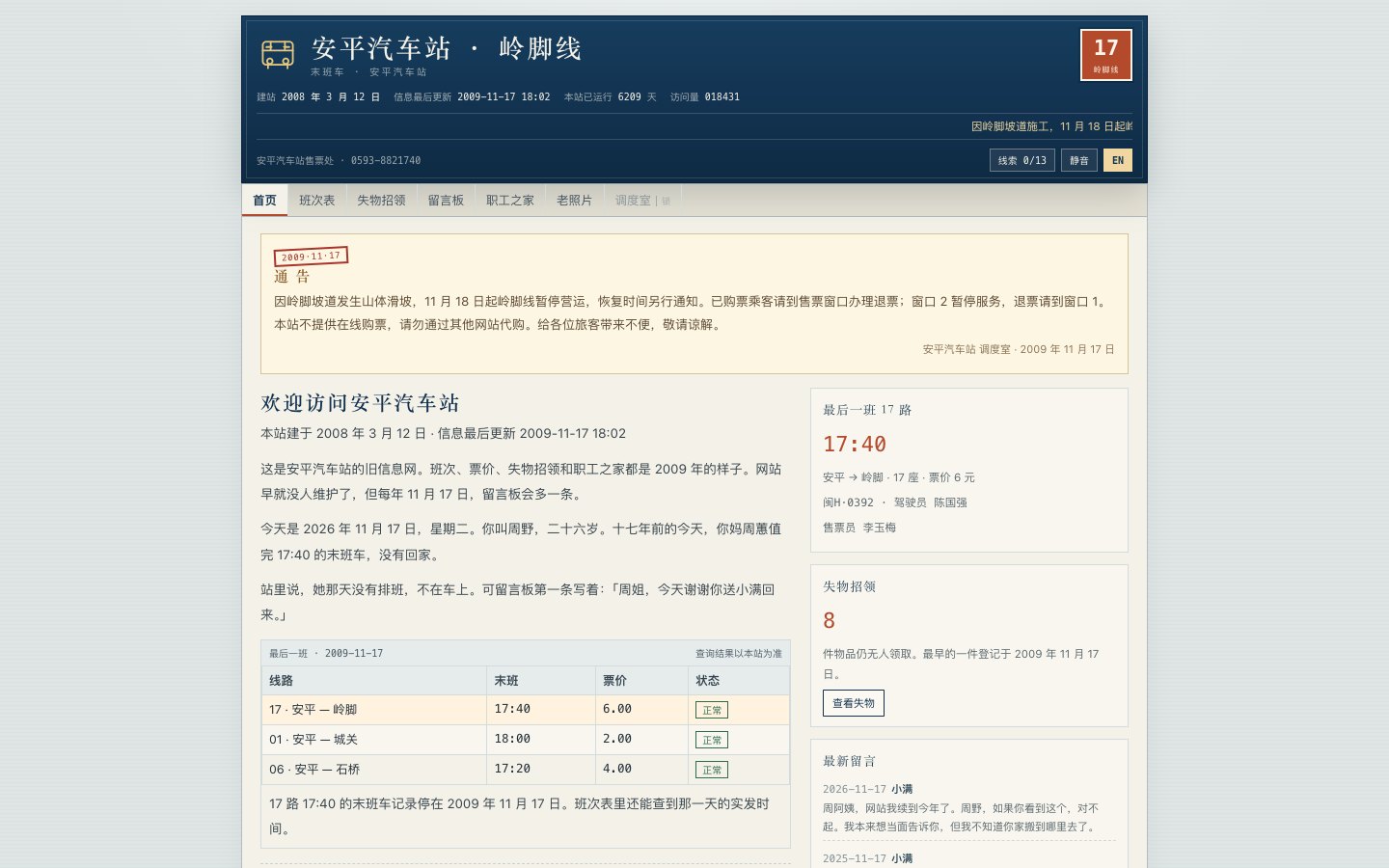
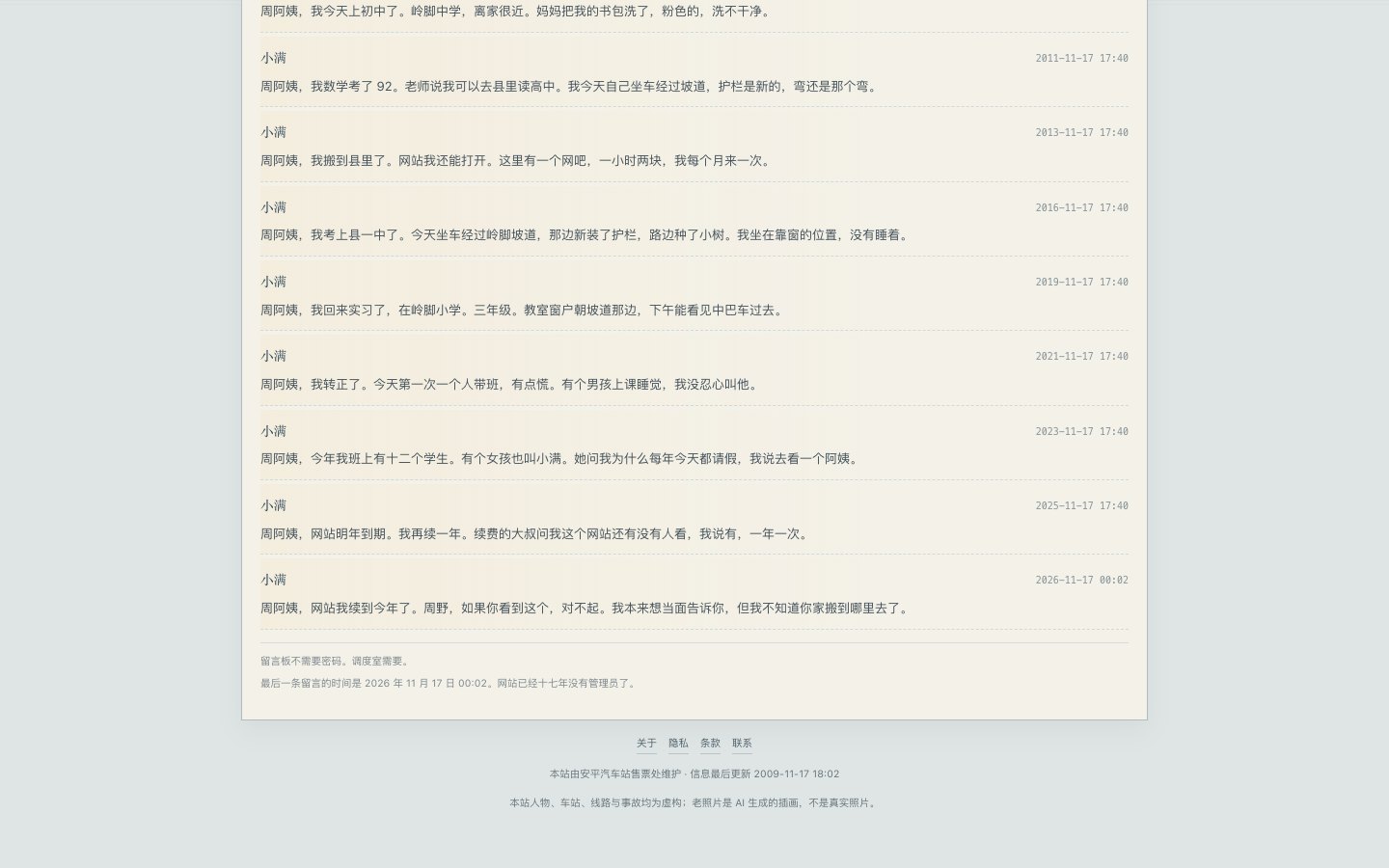
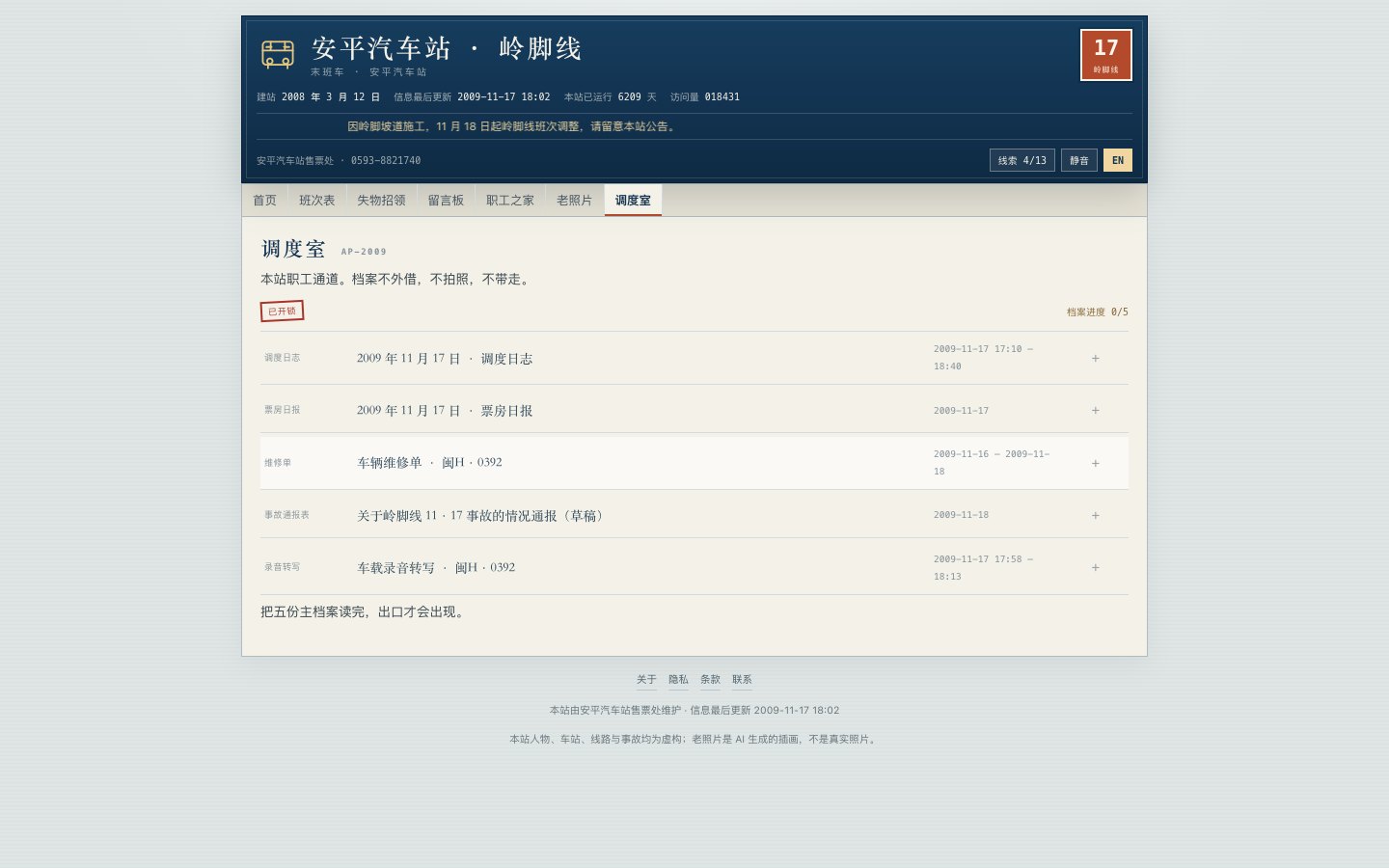
The Last Bus to Lingjiao is a 2009 county bus-station website and an investigation seventeen years late. You are Zhou Ye, twenty-six. Your mother, Zhou Hui, worked ticket window 2 and never came home after the 17:40 last bus.
The station’s account is clean: she was not on duty that day and not on the bus; there were no passengers in the wreck. But the first guestbook message is dated 17 November 2009, 19:12 — “Sister Zhou, thank you for walking Xiaoman home today. She is home. Her schoolbag is missing; I will come to the station and ask tomorrow.”
One run takes 20–30 minutes. No timer, no fail state; you read seven old pages and set the official version against the physical record.
Five routes, including 17 Anping–Lingjiao; eight lost items, from a red thermos with 周 scratched into its base and Xiaoman’s pink schoolbag to a child ticket for seat 7 and a cake nobody collected.
Sixteen guestbook messages, 2009 to 2026; six staff files and a winter roster; five old photographs, including the 17-seat Mudan minibus with plate 闽H·0392.
The dispatch office holds five main records: the dispatch log, the box-office daily, a repair order, a draft accident notice and the vehicle-recording transcript. A birthday card with no number is wedged at the back of the drawer.
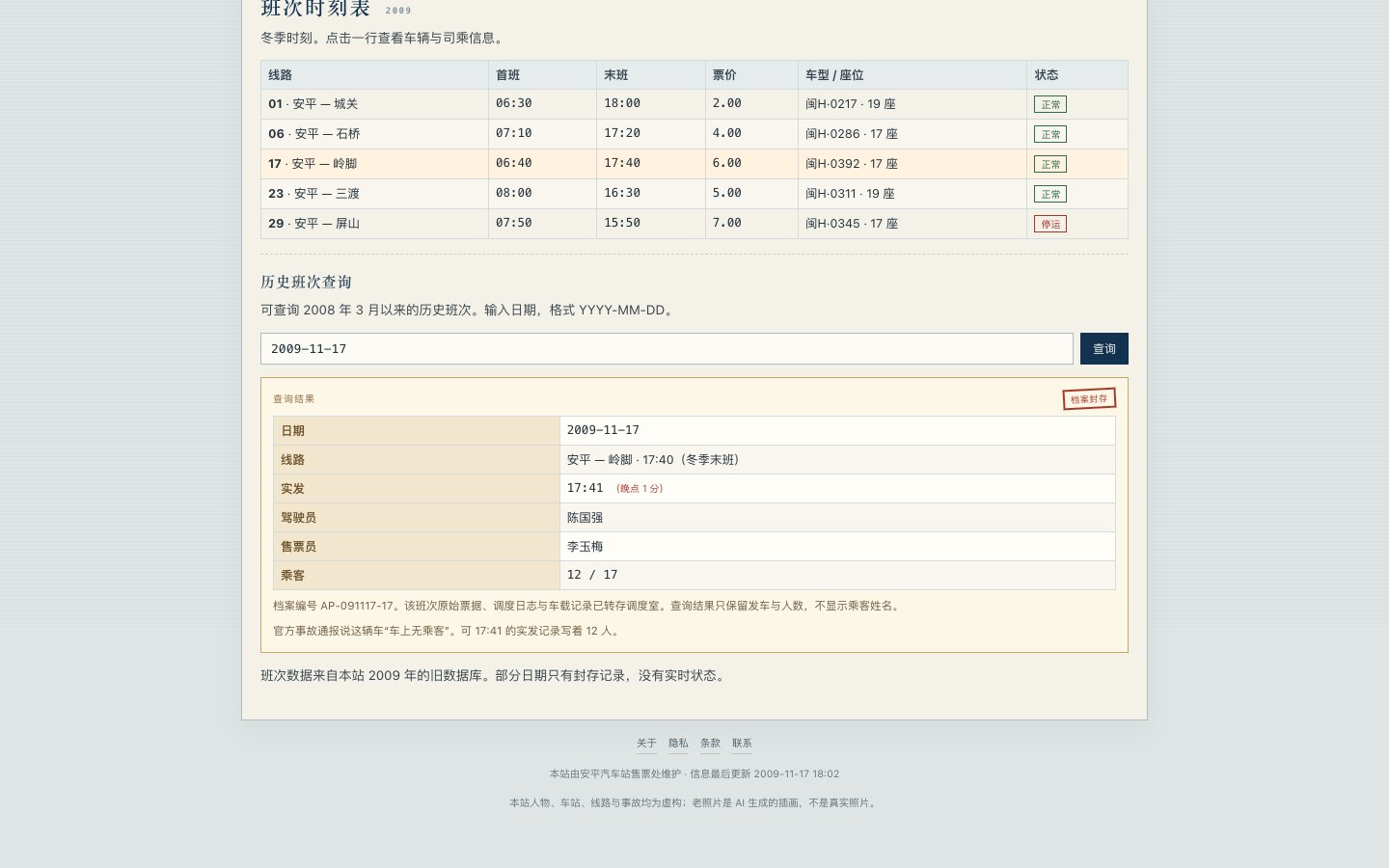
The dispatch-office lock takes six digits: route 17 plus the last four plate digits 0392, which makes 170392. The route number is in the timetable, the plate is in the timetable and the bus photograph, and the lock itself states the rule.
The other door is the historical lookup. The header says the site was last updated at 18:02 on 17 November 2009. Enter 2009-11-17 and the sealed record appears: actual departure 17:41, twelve passengers, conductor Li Yumei on the record.
What does not fit is a handwritten note at the end of the dispatch log: “Zhou Hui covered the 17:40 shift, not reported.” Read it, and the voice on the vehicle recording makes sense.
Assembling the code is part of the game. Wrong tries never lock you out or ask you to brute-force anything; the timetable, lost property, guestbook and staff pages each hold a piece.
Read all five main records and the exit appears. You can post the whole file on the guestbook and put Zhou Hui’s name back on the roster, or post nothing and leave Xiaoman one line.
The third ending is hidden: return to the drawer of ticket window 2, turn over the 2009 birthday card and finish what is written on the back. The card has to be pulled out first.
There is no bad ending. The three differ not in victory or failure, but in how far you are willing to take this tonight; the choice cannot be undone.
The five “photographs” on the site and the hero image are AI-generated illustrations, not real photographs; the game’s entry screen, About page and footer say so, and so does this page.
Anping Bus Station, route 17, the Lingjiao line, the 2009 accident, Zhou Hui, Zhou Ye, Lin Xiaoman, Chen Guoqiang, Li Yumei, Wei Dehai and every record, message and photograph are fictional, and unrelated to any real station, route, accident or person.
The game asks for no real name or contact details; you are only reading the archive of a fictional station.
The 5 routes, 8 lost items, 16 messages, 6 staff files, 5 photographs, 6 records, 13 clues and 3 endings all live in lastbus/src/data/site.js; the date lookup, code, locks and ending rules are in src/game/engine.js; saving is in src/game/save.js.
Each of those was walked on 25 October 2026: the 2009-11-17 lookup, the 170392 code, rejected wrong codes, the reading order of the five records, all three endings and corrupt-save handling; the visuals were driven from the 00:07 text to the hidden ending at desktop and 390 wide, and the information pages were checked page by page.
The five screenshots were taken from the live game on 25 October 2026; the hero is cropped from the game’s AI cover and labelled as an illustration.
Do I need an account or payment?
No. It runs free in the browser and asks for no personal information.
How long does it take?
20–30 minutes. One run covers most of it; seeing all three endings means starting again.
Can I get stuck?
Two doors: enter 2009-11-17 in the historical lookup, and assemble the dispatch-office code from the route number and plate. The lock and the site both state the rule; no brute force.
Is it scary?
No. There are no jump scares or horror imagery; it is about a disappearance and the people left behind, told quietly.
Does it work on phones?
Yes, portrait-first; the timetable and records drop secondary columns on narrow screens.
Where is progress saved?
On this device. Reload and continue; it does not travel between devices.
How is it different from the other ARGs here?
It is one institution and one old website: no network of external sites and no chat logs. The verbs are entering one date, reading a file, and setting the official account against the physical record.
Open the old station site — Runs on its own subdomain · progress saved on this device
Since the first version on 2026-10-25, this page records what changed in each version of this game.