Dajin: Go Go Go is our first-party arcade game: 1400 metres, 16 items, 4 obstacles and 5 road segments, where weight is simultaneously your speed, your width and your margin. A run takes 1.5–3 minutes, free in the browser or installable as a Windows app.
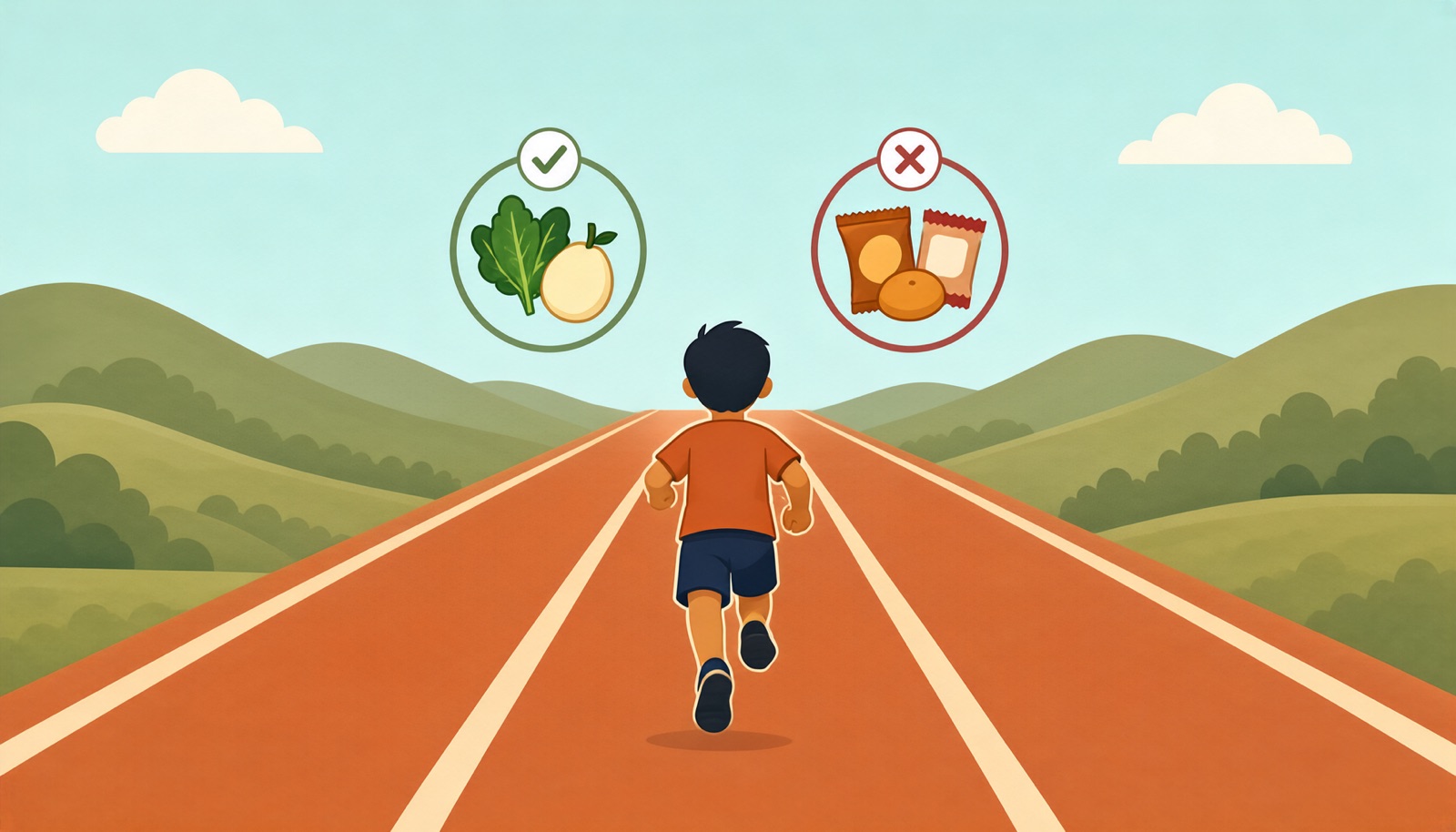
Illustration (AI-generated), not a game screenshot
Sixty days of summer. Grandmother says: finish the run and the popsicle is on her. Food is handed to you from both sides of the track — tick in a green ring means eat, cross in a red ring means don’t. Right picks shed weight, wrong ones add it, and being too thin or too heavy both hurt. 1400 metres, 22 items, 4 obstacles, 6 road segments, two lanes as your only verb — and the 18 foods you eat are logged in a local food book.
Track:1400 m
Lanes:2
Items:22 (9 junk / 9 healthy / 4 power)
Food log:18 foods
Obstacles:4
Segments:6
Lives:3
Run length:about 1.5–3 minutes
Platform:Browser / installable Windows app
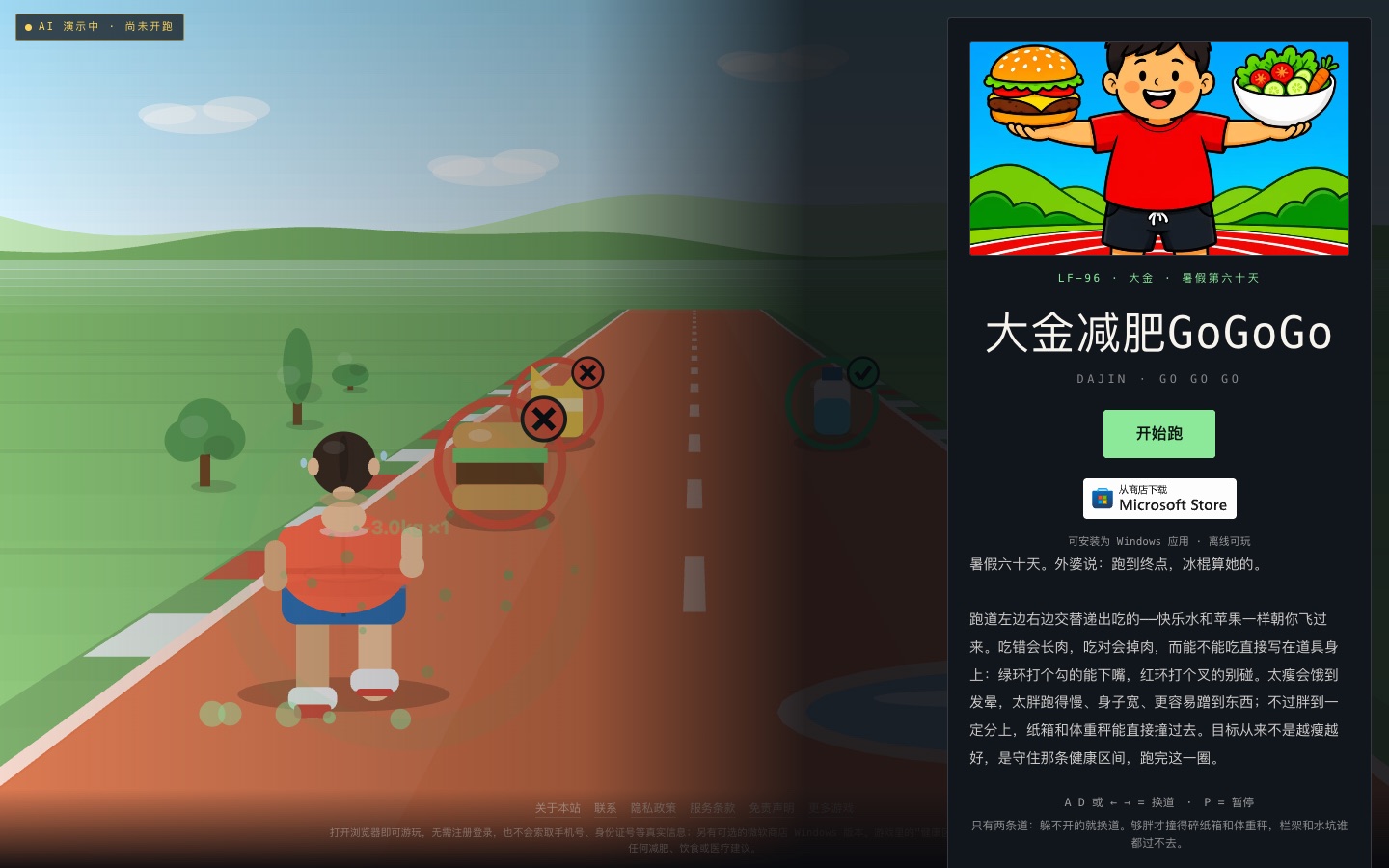
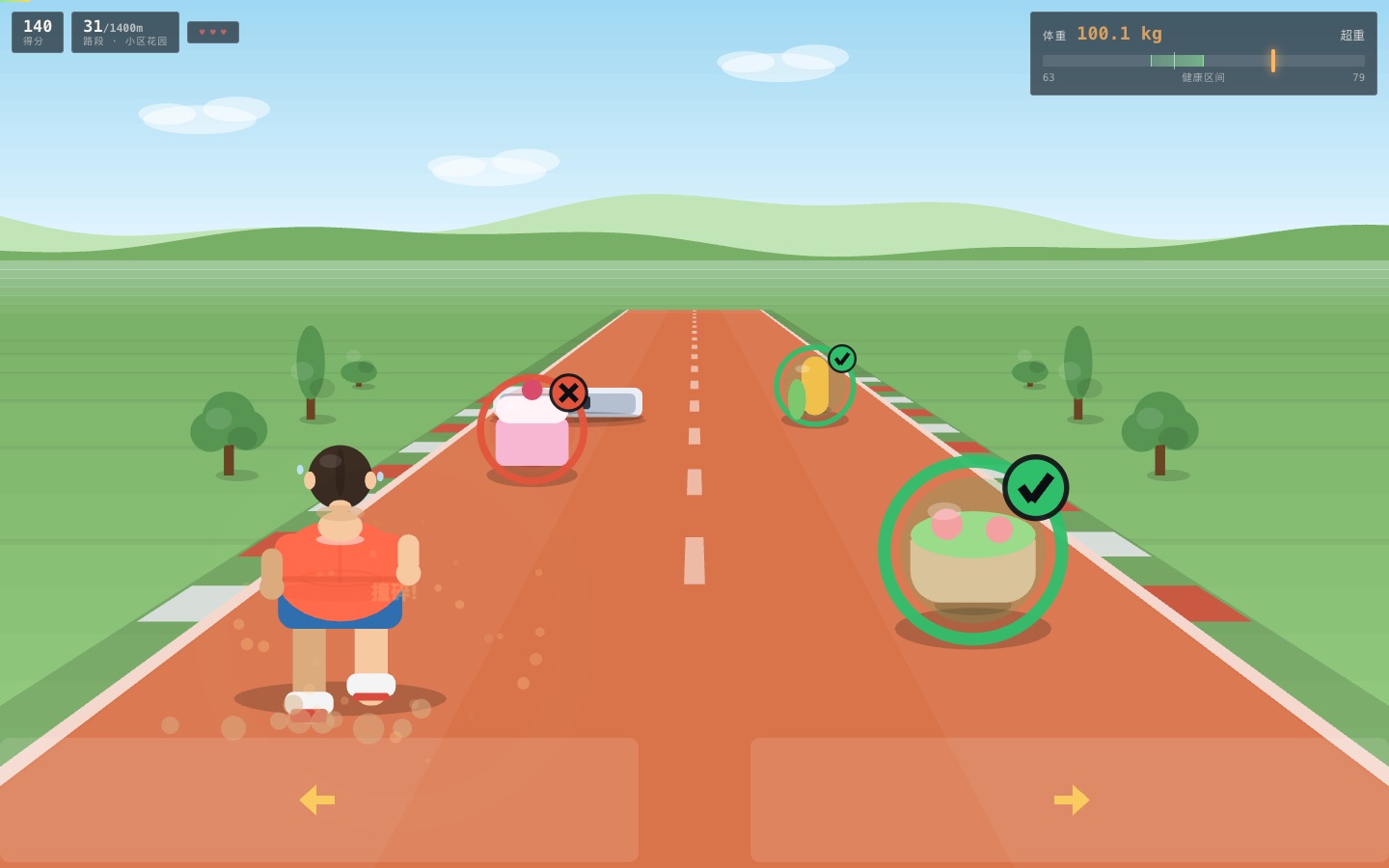
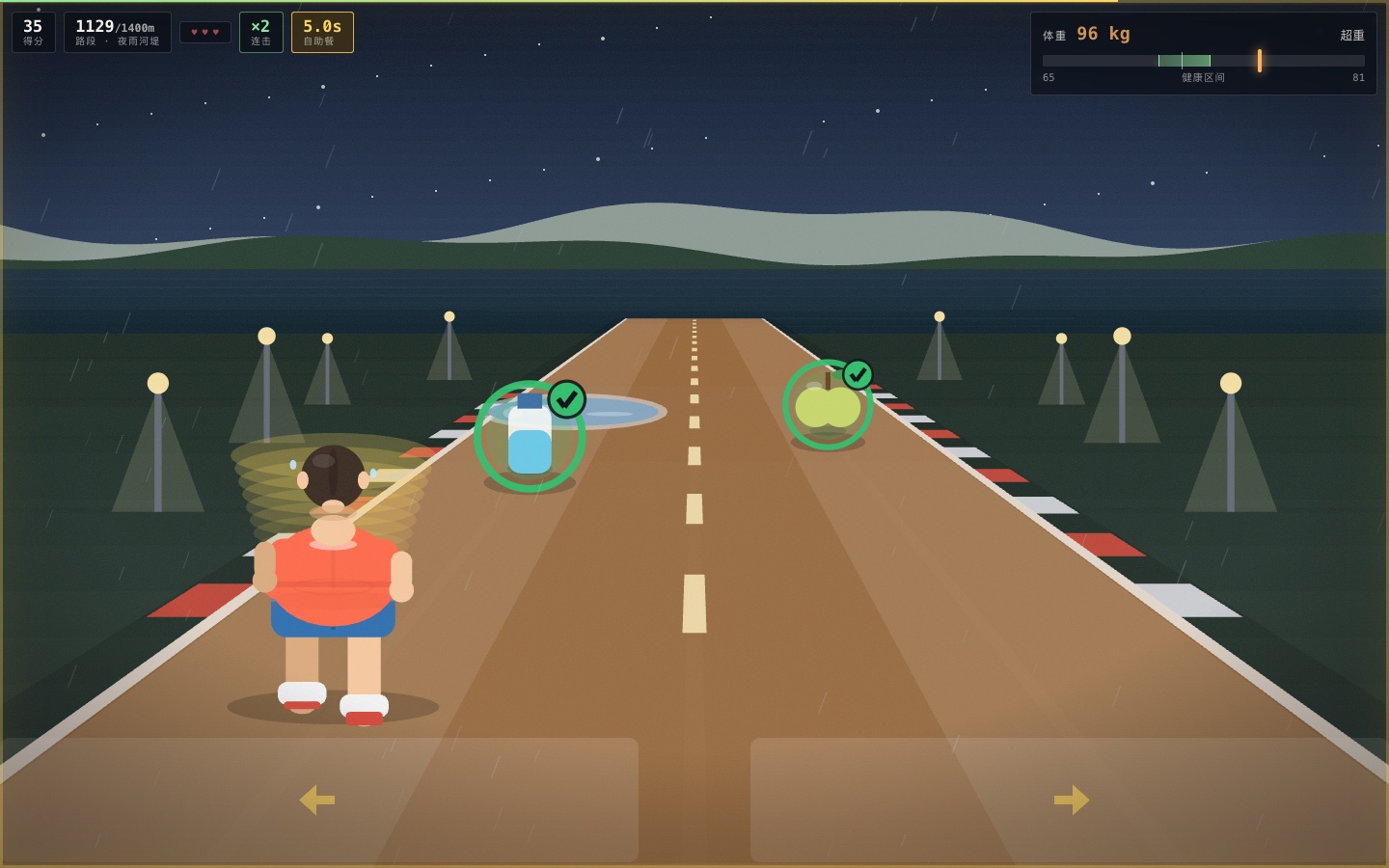
The landing page: before you start the backdrop is an AI demo, with the rules, controls and store entry on the rightIn-game: score and 31/1400 m with three lives top left, weight 100.1 kg against a 63–79 healthy band top rightThe sixth segment, the rainy embankment: rain, wet-road reflections and the river below the horizon; this stretch changes the picture only, not speed, collision or spawning
What it is
Dajin is a kid on summer break: 142 cm tall, 96 kg when the run starts. One sentence from his grandmother gets him onto the track — finish it and the popsicle is on her.
Food comes at you alternately from the left and right lanes; soda and apple fly at you the same way. Whether it is edible is written on the item itself: a tick inside a green ring means go, a cross inside a red ring means don’t. Good picks burn weight, bad ones add it.
But this is not a “thinner is better” game: too thin and you get dizzy from hunger, too heavy and you run slower, wider, and clip things more often. The goal all the way through is holding the healthy band computed from height, and finishing the lap.
The controls are two lanes. What you cannot dodge, you switch for. Only a heavy enough body smashes crates and bathroom scales — hurdles and puddles stop everyone.
Weight is the difficulty bar
The healthy band comes from height: ideal weight = height × 0.52 − 4, and the band is ±7 kg around it. At 142 cm that is 63–79 kg, ideal 69.8. The slider at the top right shows which side you are on right now: underweight / healthy / overweight.
Weight changes three things at once: speed (each extra kilo slows you; lighter runs faster), body width (wider clips more), and whether you can smash through things.
Once you are 14 kg above the band’s upper edge, crates and scales can be smashed — the scale gets its own gag when it flies. Hurdles and puddles never break; they exist to force a lane change.
Weight is clamped between 40 and 128 kg, so eating into a ball or starving to a wire does not make the game easier — only differently hard.
Twenty-two items, readable at a glance
Every item is redrawn as vector art with no pre-baked textures; the pickup glow was tightened on 2026-10-18 because it previously looked like a spilled sauce puddle.
Junk (red ring with a cross, nine): cola, double burger, chips, cream cake, ice-cream cone, fried-chicken bucket, bubble tea, donut, instant noodles — they add weight;
Healthy (green ring with a tick, nine): apple, water, salad, banana, boiled corn, oat bowl, tomato, yogurt, pear — they burn weight;
Power (four): dumbbell, kettle, magnet, commemorative medal — they leave weight alone and change the rules of that stretch.
What he has eaten is kept in a food log
All 18 foods have a slot on this device: eaten once and it lights up, never eaten and it stays grey. The title screen reads “Food log X/18”, and the finish card lays all 18 out at once, junk and healthy in two different colours.
Six were added on 2026-10-20: bubble tea 3.8, donut 4.4 and instant noodles 4.0 on the junk side; tomato −2.2, yogurt −2.6 and pear −2.1 on the healthy side, in the same weight units the game uses. They join the existing spawn pool straight away — nothing has to be unlocked first.
The log lives only in this browser. It does not sync across devices, and clearing site data starts it over. It is not a collection quest: no reward, no effect on the numbers — just a record of which of these things you have actually eaten.
Four obstacles and five road segments
Four obstacles: puddles and hurdles stop everyone, so switch lanes; crates and scales only give way to a heavy enough body.
Six segments switch by distance, each with its own sky, ground and wind: estate loop (0 m), riverside (250 m), hill road (550 m, uphill with wind), night lights (900 m, after dark), the rainy embankment (1080 m, rain and wet-road reflections) and the final straight (1300 m). The rain stretch changes the picture only, not speed, collision or spawning.
Segment changes alter the view and the rhythm, not the verbs: switching lanes is still the only action from start to finish.
Where the score comes from
Four sources only: 1.6 points per metre at the current speed; +45 for skimming an obstacle (a 0.9-second window); +90 for smashing a crate or a scale; +260 for a power item. On the other side, a junk bite is −80 and an obstacle hit −120, and the total never goes negative.
All four run through two multipliers. The combo has four tiers: 3 bites “Warming up” ×1.5, 6 “Rolling” ×2, 10 “Airborne” ×3, 16 “Unstoppable” ×4; every 180 metres opens a 6.5-second frenzy that doubles again and counts food at half the calories.
The second multiplier is the healthy band, and it does not ask whether you are in it right now: it ramps with accumulated time in band and only pays the full 1.6 bonus after 90 seconds, so a fifteen-second pass earns scraps. That changed on 2026-10-18 — while it was a flat +12 per healthy bite, a 25-run same-seed sweep showed the median score of careful players only 9% above those ignoring weight entirely, which made the whole premise worthless in points.
The verdict reads your dwell share (time in band ÷ total time): S “Grandma pays for the popsicle” at 100%, A “The trousers buttoned up” at 86%, B “Finished, not bad” at 70%, C “Bought a sausage en route” at 52%, and below that D “The bench was very comfortable”.
The difficulty was measured, not felt
The gameplay runs on a kernel that can be simulated in node. The acceptance gate plays several runs with fixed seeds and asserts on the median, not on one session’s feel: the demo AI must finish all 1400 m every run (otherwise density has bricked it), the top ×4 combo tier must be reachable with normal play, the healthy band must be holdable for real, and both failure walls — smashable and not — must exist.
Why the median: judging run by run is rolling dice, and the same tuning can swing tens of places across seeds. One genuine defect was once mis-judged exactly that way, so every assertion now takes a multi-run median.
The spawner is numbers too: a 240-pixel minimum gap between lanes, obstacle spacing tightening from 2.6 to 0.95 seconds, double-item rows rising from 14% to 26%, and junk share moving between 36% and 50% with progress. Together they decide whether “what you cannot dodge, switch for” is actually true.
Controls, devices and that AI demo
Keyboard: A / D or ← / → to change lane, P to pause;
Touch: the left and right halves of the screen are arrows; tap a side to move that way;
A sound toggle sits at the top right; effect pitch is computed straight from the combo tier, so audio can never drift from gameplay;
Before you start, the backdrop plays an AI demo (attract mode) and the top-left badge says so;
Only the finish gets the full-screen result; after the third life goes, a small card reports that run’s distance, score, weight and band time and the next run starts on its own after 3.6 seconds — no click required;
If WebGL is unavailable the page tells you instead of showing a black rectangle.
How long a run is
The track is 1400 metres. At the code’s base speed of 268 px/s with 1 px ≈ 0.0294 m, a run without any speed bonus takes about 3 minutes; being lighter raises the ceiling to 470 px/s, which is about a minute and a half.
So it is built for “one more run” rather than “one more hour”: score, metres and weight sit in the corners, and finishing just hands you the next attempt.
The store build
The game is also on Microsoft Store as an installable Windows app that plays offline. The browser and store builds share the same gameplay; saves stay on each device.
The store screenshots still show the older build and are being re-shot against the current game; if they disagree with this page, trust this page and the game.
This is not diet advice
The game says it in its own footer: it runs in the browser with no sign-up and never asks for a phone number or ID number, and the in-game “healthy band” is a gameplay value, not diet, nutrition or medical advice.
That line is not decoration. The band formula (height × 0.52 − 4, ±7 kg) exists to give the difficulty slider meaning; it is not a medical standard.
Recent changes
2026-10-20: a sixth segment, the rainy embankment, joins the track — rain, wet-road reflections and the river change the picture only; food expanded from 12 to 18 with a local food log; a light result card now appears after a crash and the next run starts automatically; band dwell became a multiplier that ramps with accumulated time, and late obstacle spacing tightened to 0.95 s;
2026-10-18: fixed a broken restart (the group never called removeAll and the scene never emitted), tightened item glows, moved rendering back to Phaser with all items redrawn as vectors; share images standardised at 1200×630;
2026-10-17: removed jumping and split the gameplay into a kernel that runs in node, with a Three.js track experiment;
2026-10-16: trust pages gained a content-rating note and a unified credit.
How the numbers on this page are checked
1400 m is TRACK_METERS in balance.js; twenty-two items and four obstacles are the entry counts of ITEMS and OBSTACLES (nine junk, nine healthy, four power); five segments come from the at-thresholds in STAGES; the starting 96 kg at 142 cm, the 40–128 kg clamp and the +14 kg smash threshold are all in BODY.
The food log’s 18 slots are the ITEMS entries whose kind is not power; the six new weights are read straight from balance.js (bubble tea 3.8, donut 4.4, instant noodles 4.0, tomato −2.2, yogurt −2.6, pear −2.1). The crash card’s 3.6 seconds is SCORE.restartDelay.play.
The 63–79 band is healthBand(142) (ideal 69.84, ±7). The run length follows from 1400 ÷ (268 × 0.0294) and 1400 ÷ (470 × 0.0294), i.e. about 3 minutes and about 1.5 minutes.
Both screenshots were taken from the running game on 2026-10-19. The hero image is an AI-generated illustration, not a game screenshot, labelled at the top of the page. If a number here disagrees with the game, the game is right; tell us in the changelog.
Who it is for
For players with a few minutes who want something instantly readable, and for people who like numbers-as-mechanics: weight here is simultaneously your score, your difficulty and your margin.
Not for players wanting level editors, leaderboards or a long progression: this game is one lap, then another lap.
FAQ
Do I need an account or payment? No. It runs free in the browser and never asks for a phone number or ID number.
Is thinner always better? No. Too thin and you faint from hunger; too heavy and you slow down and widen. The target is the height-based healthy band, not the lowest weight.
Can I jump? No. There is no jump in this game — two lanes only, and what you cannot dodge you switch for.
How long is a run? About 1.5–3 minutes, depending on where you keep your weight.
Where is progress saved? The best score and the food log live in this browser. The store build saves in its own app data; the two do not sync.
Is there a reward for completing the food log? No. It only records what he has eaten — it changes no numbers and pays nothing, and a new device or cleared site data starts it over.
Does it work on phones? Yes — the left and right halves of the screen change lanes, though the control hints are written for a keyboard.
What if it will not open? Try a current Chrome, Edge or Firefox. If it still fails, email contact@gamestrategists.com with your device and browser version.
Start running — Runs on its own subdomain · two lanes only · a run takes 1.5–3 minutes